
An honest, deeply researched review of Snabbit, covering pricing, cities, services, complaints, competition, and the verdict on whether it deserves a place in your household routine
Published by brands.run | The independent brand review hub
Reviewed Brand: Snabbit | Service: Quick Home Services | Founded: 2024 | Headquarters: Mumbai, India | Website: snabbit.com
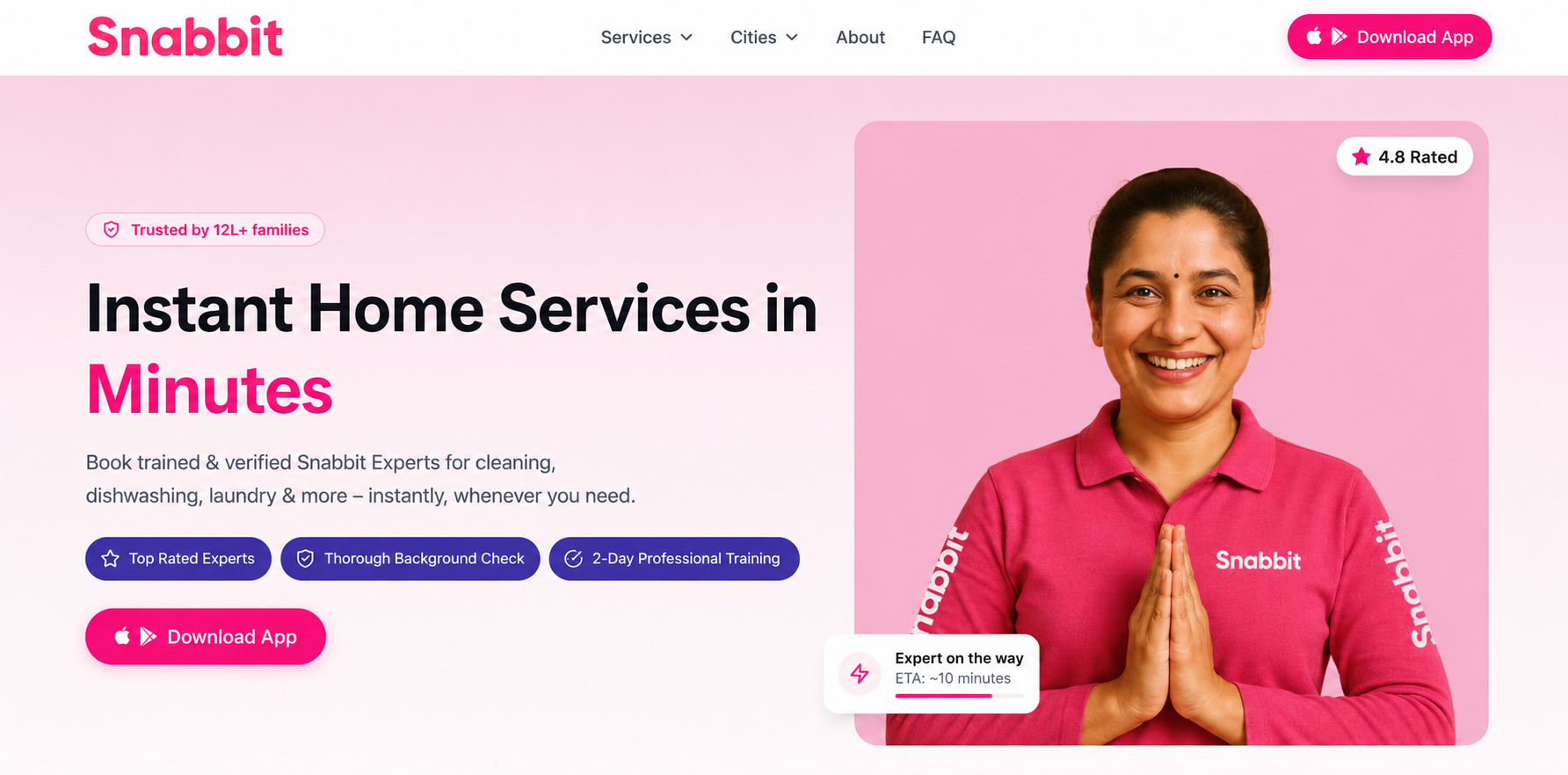
Snabbit is a Mumbai-based on-demand home services platform that sends trained, background-verified female house help to your door in about 10 minutes. Pricing starts at ₹99 per hour. Founded in 2024 by former Zepto chief of staff Aayush Agarwal, Snabbit has raised approximately $112 million across five funding rounds and now operates in 11 Indian cities including Mumbai, Bangalore, Hyderabad, Pune, Gurugram, Noida, Thane, Navi Mumbai, Delhi, Ghaziabad, and Noida Extension.
That’s the marketing version. This review goes deeper.
It’s structured in three parts. Part 1, The Expose, covers what Snabbit actually is beneath the marketing layer. The business model. The cities. The pricing across services. The worker network. The gap between the 10-minute promise and the 10-minute reality. Part 2, The Autopsy, dissects what works and what’s broken. App store complaint patterns. The OTP verification problem. The 24-hour customer support response gap. The inexperienced worker issue. Surge pricing. The 35% retention number and what it actually means. The unit economics problem. How Urban Company’s InstaHelp overtook Snabbit in February 2026. Part 3, The Killcritic, is the brutal verdict. Who Snabbit helps. Who it fails. How it stacks up against InstaHelp, Pronto, and a traditional offline maid.
If you’re a busy urban household trying to decide whether Snabbit deserves a spot in your daily routine, this is the only review you’ll need to read.
| Review Methodology This review is built on Snabbit’s official product documentation at snabbit.com, app store reviews from Apple App Store and Google Play Store, founder interviews published in TechCrunch, Inc42, Business Today, and YourStory between 2024 and 2026, public funding announcements, competitor benchmarks, and Snabbit’s published statements on safety, pricing, and worker wages. Numbers reflect publicly stated figures as of mid-2026 and may shift with future updates. |
Part 1: The Expose
The expose section strips away the marketing layer. What is Snabbit actually selling, to whom, at what price, and through what operational model. No softening, no positioning words, no spin.
What Snabbit Actually Is
Snabbit is a mobile-first home services app. You open the app, pick what you need done, choose either an instant booking or a scheduled one, and a verified female worker shows up at your door inside 10 minutes during peak supply hours. She works for the duration you booked (up to 4 hours per booking), does the chores in that window, and leaves. There’s no relationship to maintain, no advance payment, no negotiation.
The chores she’ll do are limited. Sweeping. Mopping. Dusting. Dishwashing. Hand-washing clothes. Ironing. Kitchen tidy-ups. Bathroom and balcony cleaning. Basic food prep like chopping vegetables or kneading dough.
The chores she won’t do are also clear. Anything requiring specialized equipment is out. Non-vegetarian meal preparation is out (Snabbit runs a separate Home Cook service for that). Heavy lifting that could compromise worker safety is out. Caregiving for children or the elderly is out. Pet care is out.
You pay by the hour, not by the task. The starting price is ₹99 per hour in most cities, with the regular rate sitting between ₹150 and ₹182 per hour depending on city, peak time, and promotional offers. Average ticket size, according to founder interviews, is around ₹240 per booking. Workers earn ₹117 to ₹160 per hour in Mumbai, Pune, Noida, and Bengaluru, and ₹50 to ₹90 per hour in lower-tier cities like Chennai, Ahmedabad, and Ghaziabad.
That’s Snabbit stripped of every marketing word.
The Founder Story and Why It Matters
Snabbit was founded in 2024 by Aayush Agarwal. Before Snabbit, Agarwal was chief of staff at Zepto, the quick commerce company that turned 10-minute grocery delivery into a category in India.
This matters because Snabbit is essentially Zepto’s playbook applied to domestic work. Hyperlocal dense supply. Instant fulfillment. Hourly billing. App-first booking. Aggressive promotional pricing to seed a habit. The model Agarwal ran at Zepto for groceries is what he’s running at Snabbit for cleaning. The company often refers to its goal as building “India’s first comprehensive operating system for rapid home services.”
Whether you think that’s clever or troubling depends on whether you think domestic work should function like grocery delivery in the first place. The expose section doesn’t take sides on that. It just notes the lineage, because understanding where the operating model came from tells you what it optimizes for and what it tends to break under stress.
Snabbit operates under Maestroedge Solutions Private Limited, registered at 111A Kailash Industrial Estate, B Wing, Vikhroli, Mumbai 400079. As of early 2026, the company employs approximately 313 people on payroll and works with a frontline workforce of several thousand house help experts across its served cities.
The 10-Minute Promise: What the Numbers Actually Say
Snabbit’s marketing centers on a 10-minute arrival promise. The actual delivery sits somewhere between 10 and 15 minutes in dense supply zones during normal hours, and stretches longer in low-supply zones or during peak demand windows like weekend mornings and weekday evenings.
App store reviews show consistent complaints about 30-minute to 60-minute waits during peak times. One reviewer documented a 15-minute promise that stretched past an hour, with multiple worker reassignments along the way. Another reported being told a worker would arrive in 30 minutes after a 15-minute initial promise, with the booking being cancelled by the customer after the second delay.
The 10-minute promise is real in the same way Zepto’s 10-minute grocery delivery is real. It’s the median in dense zones during normal hours, not a universal guarantee. Read the fine print on Snabbit’s own site and you’ll see the phrase “Instant bookings depend on Expert availability.” That’s the safety hatch.
For users planning a Snabbit booking, the practical guidance is this. Inside high-density zones like Powai, Koramangala, Indiranagar, HSR Layout, or central Andheri during off-peak hours, the 10-minute claim holds up. On a weekend morning in a newly launched locality, expect 25 to 45 minutes.
The Business Model Decoded
Snabbit makes money in one way. It takes a commission from each transaction between the customer and the worker. The customer pays Snabbit. Snabbit pays the worker. The difference is the platform margin.
The model is high-frequency, low-ticket. Average order value is ₹240. The bet is volume, not premium pricing. The economics only work if a worker can complete 6 to 8 bookings per day with low idle time between jobs.
To make that happen, Snabbit has invested in two operational levers. The first is hyperlocal density. The company has reduced average walking distance for workers between two jobs from 300 meters down to 250 meters. That extra time per worker is what makes the unit economics work. The second is scheduling intelligence. The app uses AI-based matching and real-time scheduling to keep workers utilized. A worker app handles task management, scheduling, and cashless payments. The customer app handles booking, tracking, and feedback.
If you’ve used Uber or Zepto, you understand the model. It’s the same two-sided marketplace logic applied to domestic chores. The differences are duration (a Snabbit booking lasts 1 to 4 hours versus a 10-minute Zepto delivery) and trust (a Snabbit worker enters your home and stays there, versus a delivery rider who drops a bag at your door).
Snabbit’s Funding Story: $112 Million in 18 Months
Snabbit has raised approximately $112 million across five funding rounds since its 2024 launch. Major backers include Lightspeed Venture Partners, Elevation Capital, and Nexus Venture Partners.
The timeline runs roughly like this. A Series A round of around $5.5 million in early 2025. A Series B of $19 million in May 2025 led by Lightspeed. Subsequent rounds brought the total to $112 million. A Series D round of approximately ₹531 crore (about $56 million) was announced in May 2026.
The valuation jumped from approximately $90 million in mid-2025 to $180 million by October 2025. That’s a doubling in five months, driven by aggressive growth metrics and the broader investor thesis that India’s home services market will follow the same digitization curve as food delivery and quick commerce. RedSeer estimates the addressable market at ₹5,100 to ₹5,210 billion in FY25.
The funding velocity tells you two things. First, investors believe this market is real. Second, Snabbit is burning cash to claim it. Public filings indicate FY25 losses of approximately $674,300 against $805,100 in total expenses, with expenses increasing roughly 3,145% year over year. The company is in classic growth-stage land grab mode where revenue and losses both scale with bookings.
Where Snabbit Operates: 11 Cities, 152 Localities
As of mid-2026, Snabbit is live in 11 Indian cities. Coverage is intentionally hyperlocal. Snabbit hasn’t tried to blanket entire cities. It’s gone deep in dense residential pockets where the unit economics work, and skipped everything else.
Here’s the coverage breakdown by city:
- Mumbai: 36 areas, including Andheri, Bandra, Powai, Goregaon, Malad, Borivali, Chembur, Mulund, Dadar, Santacruz, Juhu, Versova, and surrounding suburbs
- Bangalore: 27 areas, including Bellandur, Koramangala, Brookefield, Indiranagar, BTM Layout, Hebbal, HSR Layout, Whitefield, Marathahalli, Electronic City, Sarjapur Road, and Yelahanka
- Gurugram: 23 areas
- Noida: 20 areas
- Hyderabad: 9 areas
- Thane: 9 areas
- Delhi: 8 areas
- Pune: 8 areas
- Ghaziabad: 5 areas
- Navi Mumbai: 4 areas
- Noida Extension: 3 areas
That’s 152 micro-markets in total. Founder Aayush Agarwal has been explicit about the philosophy. “In a hyper-local business, you don’t win pan India, you don’t win cities, you win micro markets.” The expansion strategy is to enter dense pockets first, build supply density to honor the 10-minute promise, and only then expand to adjacent localities.
If you live in a covered locality, Snabbit works as advertised most of the time. If you live in an edge area within a covered city, expect inconsistent fulfillment. If you live outside the 11 served cities, the app won’t function at all.
The 100% Women Workforce Decision
Snabbit operates with an entirely female workforce. Every house help worker on the platform is a woman, trained and verified before her first booking.
This is a deliberate choice with three rationales. First, it matches what customers want. Indian households booking daily house help overwhelmingly prefer female workers, especially in flats where the worker enters private spaces. Second, it creates a defensible workforce thesis. Snabbit can claim to be empowering women through formalized employment with Aadhaar-linked bank accounts, health insurance, life insurance, and steady monthly income. Third, it differentiates Snabbit from gig platforms that are gender-mixed. Pronto, for example, runs a more flexible model. Urban Company’s InstaHelp is similarly diverse. Snabbit’s all-women positioning is part of how it builds trust with apartment-dwelling customers.
The catch is worker safety. A 100% female fleet entering private homes creates obvious safety exposure. Snabbit launched a system called Kavach in March 2026 to address this, with SOS buttons inside the worker app, active field support teams, route monitoring with deviation alerts, and customer rating verification to prevent abusive bookings. Whether Kavach is sufficient in practice depends on field response times, which Snabbit hasn’t published.
The company has stated it serves over 10 lakh families across its operational cities and employs tens of thousands of women in its expanded network, with monthly earning potential between ₹22,000 and ₹40,000 depending on hours worked and city tier.
Pricing Breakdown by City and Service
Snabbit’s pricing varies by city, time of day, and promotional state. Here’s the on-the-ground breakdown.
- Base hourly rate (promotional): ₹99 per hour in most cities for new users or during introductory campaigns.
- Standard hourly rate: ₹150 to ₹182 per hour for routine bookings.
- Peak surge rate: Higher during weekend mornings, weekday evenings, and festival periods. Surge pricing is documented in customer complaints but not transparently published.
- Minimum booking: Typically one hour.
- Maximum single booking: Four hours.
- First-three-visits promotional pricing: ₹198 has been used in past campaigns as a flat rate for the first three bookings, a common new-user acquisition tactic.
- Payment: Online only, at the time of booking. No cash transactions on the platform.
City-specific variations exist. Mumbai and Bangalore typically sit at the higher end of the standard range. Hyderabad, Pune, and Ghaziabad sit slightly lower. Promotional pricing fluctuates and is best checked inside the app rather than from third-party sources.
One pattern customers should watch for. Snabbit has run promotional offers as aggressive as ₹1 for the first hour, ₹99 per hour for the first month, and ₹198 flat for the first three visits. These are acquisition tactics. The standard rate you’ll pay after the promotional window expires is closer to ₹150 to ₹200 per hour on average across a month.
The Aadhaar and PAN Verification System
Every Snabbit worker goes through a multi-step verification process before being onboarded. The steps include Aadhaar verification through the official UIDAI system, PAN verification, background check through a third-party verification partner (Snabbit has partnered with Idfy for digital identity verification), skills assessment, training on hygiene and service quality and respectful conduct, and a probationary period before solo bookings.
The verification stack is more rigorous than what a typical neighborhood maid arrangement provides. That’s one of Snabbit’s core selling points. You know who is walking through your door, and that person has been screened.
Whether the screening is sufficient in absolute terms is a separate question. Background checks in India have well-documented gaps, particularly around criminal record verification, which depends on state-level data availability and consistency. But relative to the offline alternative of finding a maid through informal referrals, the verification layer is a real improvement, and it removes the single biggest risk that keeps urban professional households from hiring help in the first place.
Services Included vs Services Excluded
The complete list of what a Snabbit worker will and won’t do within a booked hour, based on Snabbit’s published service scope:
Services Included
- Sweeping
- Mopping
- Dusting
- Bathroom cleaning
- Balcony cleaning
- Kitchen tidy-up
- Washing utensils
- Hand-washing clothes
- Ironing clothes
- Folding laundry
- Loading and unloading the washing machine
- Chopping vegetables
- Kneading dough
- Basic vegetarian prep work
Services Excluded
- Deep cleaning (Snabbit’s pitch is consistency eliminates the need for deep cleaning)
- Non-vegetarian meal preparation (handled by the separate Snabbit Home Cook service)
- Anything requiring specialized equipment like steam cleaning, pressure washing, or appliance servicing
- Caregiving for elderly or children
- Pet care
- Heavy lifting that could compromise worker safety
- Activities outside Snabbit’s defined scope of work, even if the worker is willing
The scope discipline matters. Workers are trained with clear guardrails on what they will and won’t do, and the customer support team is supposed to back them up if a customer pushes beyond scope. In practice, app store reviews show the guardrails sometimes fail, with workers being pressured to do things they’re not trained for or being reassigned mid-booking.
The Snabbit Booking Flow Walkthrough
Here is the actual booking experience step by step. The clarity of the flow is one of Snabbit’s structural strengths and worth documenting in detail.
- Download the Snabbit app from Google Play Store or Apple App Store. The Android version has over 1 million installs.
- Sign up using your mobile number. An OTP arrives via SMS for verification.
- Add your delivery address. The app pulls your locality from your phone’s GPS and matches it against served micro-markets. If your locality isn’t covered, the app shows a waitlist signup.
- Select a service category. Currently this is house help, with beauty services available in select Bengaluru localities and Home Cook for non-vegetarian meal preparation.
- Choose Instant booking (worker dispatched immediately) or Schedule for later (book a specific date and time up to a few days in advance).
- Pick the duration. Options are typically 1 hour, 2 hours, 3 hours, or 4 hours. The app shows total cost for each duration with surge pricing applied if active.
- Choose the tasks you want the worker to focus on, from the included services list.
- Review the pricing summary. The app shows the base rate, any surge multiplier, taxes if applicable, and the final amount.
- Pay online through UPI, debit card, credit card, or wallet. Cash is not accepted.
- Wait for worker assignment. The app shows the assigned worker’s name, photo, and estimated arrival time.
- Track the worker en route. Real-time location updates show approach distance.
- Receive the worker. She’ll share an OTP from her app, which you confirm in your app to start the booking.
- The booking starts. The worker performs the agreed tasks for the booked duration.
- The booking ends. The worker leaves. You’re prompted to rate the experience inside the app.
- Optional: Add the worker as a favorite to request her for future bookings (subject to her availability).
The flow is well designed. The friction points come not from the booking interface but from what happens when supply density is low, when the assigned worker can’t complete the booked task, or when the booking is extended mid-service and that extension isn’t honored.
Snabbit Home Cook: The Separate Service Most People Miss
Snabbit has a second service distinct from house help. It’s called Home Cook, and it handles meal preparation including non-vegetarian dishes that fall outside the standard house help scope.
Key differences between Snabbit House Help and Snabbit Home Cook:
- House Help workers can do basic vegetarian prep (chopping, kneading). Home Cook workers handle full meal preparation including non-vegetarian dishes.
- House Help pricing starts at ₹99 per hour. Home Cook pricing is structured differently and typically higher per booking.
- House Help has the 10-minute arrival promise. Home Cook is usually scheduled in advance.
- Home Cook workers go through additional kitchen-specific training and food safety verification.
If you’re booking Snabbit specifically because you want help with cooking, House Help is the wrong service. Most app store complaints about workers refusing to cook stem from this confusion. The customer books house help, the worker arrives, the customer asks for full meal prep, the worker declines because it’s outside her scope, and an OTP dispute follows. Home Cook is the right service for that use case.
Snabbit Beauty Services: The May 2026 Expansion
In May 2026, Snabbit expanded beyond house help into beauty services with a salon-at-home offering. The launch was piloted over six weeks in Bengaluru’s Sarjapur micro-market, where the service completed over 2,000 bookings with average fulfillment time under 15 minutes.
Key facts about Snabbit Beauty:
- Services start at ₹49 with no minimum order value
- Currently live only in Bengaluru’s Sarjapur area, with planned expansion to more micro-markets
- Operates with 25 active beauty professionals at launch, handling close to 50 jobs per day
- Uses products from established brands including O3+ and Rica
- Designed around multi-skilled beauty professionals capable of handling multiple services in one visit
- Lightweight beauty kits with monodose single-use packaging for hygiene
The beauty category is led by Dev Priyam, who co-founded Pync (acquired by Snabbit in 2025). The strategic logic mirrors Snabbit’s broader thesis: instant fulfillment in a category traditionally locked into appointment-led booking. Whether it scales the way house help did depends on whether beauty service density can support 15-minute arrivals at the same unit economics.
If you live outside Bengaluru’s Sarjapur area, Snabbit Beauty isn’t available yet. Watch for expansion announcements through the app and on Snabbit’s official channels.
Snabbit by City: What Coverage Actually Looks Like
Snabbit’s experience varies significantly by city. The 10-minute promise, the worker quality, and the surge pricing patterns all shift based on local supply density and demand patterns. Here’s what to expect in each major market.
Snabbit in Mumbai
Mumbai is Snabbit’s home base and its deepest market. 36 localities are covered, with strongest density in Powai, Andheri East and West, Goregaon, Malad, Bandra, and Chembur. Average arrival time during off-peak hours sits at 8 to 12 minutes in these dense zones. Peak hours (8 AM to 10 AM, 6 PM to 9 PM) can push arrival to 20 to 30 minutes.
Mumbai surge pricing is among the most aggressive in the Snabbit network. Saturday mornings can see hourly rates climb to ₹220 to ₹250 versus the ₹150 base. The high demand in dense apartment complexes is what enables this pricing power.
Worker quality in Mumbai is generally above platform average because Snabbit has had the longest training pipeline operating in this city. Repeat workers and favorite-worker requests work better in Mumbai than in newer markets.
Snabbit in Bangalore
Bangalore is Snabbit’s second-deepest market with 27 covered localities. Koramangala, Indiranagar, HSR Layout, Whitefield, Electronic City, Bellandur, Sarjapur, and Marathahalli are the densest pockets. The IT corridor dictates demand patterns: weekday morning bookings before office hours and Sunday morning bookings dominate.
Bangalore is also where Snabbit piloted its beauty services in May 2026, specifically in Sarjapur. Expect beauty service expansion across HSR Layout, Koramangala, and Whitefield over the next few quarters.
Average hourly rate in Bangalore sits at ₹130 to ₹170 across the standard window, with peak rates pushing past ₹200 during weekend mornings. Worker availability is generally strong on weekdays and tighter on Sundays.
Snabbit in Gurugram and Noida
Gurugram (23 localities) and Noida (20 localities) make up Snabbit’s NCR footprint alongside Delhi (8 localities) and Ghaziabad (5 localities). DLF Phase 1 through 5, Sushant Lok, Sector 49, Sector 56, and Sohna Road are the strongest Gurugram pockets. In Noida, Sector 18, Sector 62, Sector 137, and Noida Extension carry the most density.
NCR worker availability has been the platform’s biggest expansion challenge. Worker supply has lagged demand growth, meaning the 10-minute promise breaks more often here than in Mumbai or Bangalore. Expect 15 to 25 minute arrivals as the median in NCR locations during peak hours.
Snabbit in Hyderabad
Hyderabad has 9 covered localities, concentrated in HITEC City, Gachibowli, Madhapur, Kondapur, and Banjara Hills. This is a newer Snabbit market with thinner worker supply. The 10-minute promise holds in core dense zones but breaks more frequently in edge areas.
Hyderabad pricing tends to sit slightly below the Mumbai and Bangalore average, partly because of lower worker wage benchmarks in the city and partly because of competitive pressure from local home services providers.
Snabbit in Pune
Pune has 8 covered localities, concentrated in Hinjewadi, Wakad, Baner, Kharadi, Viman Nagar, and Kothrud. The IT corridor pattern matches Bangalore: weekday morning peaks and Sunday morning surges. Pune worker density is moderate, with the 10-minute promise holding about 70% of the time during normal hours.
Snabbit in Thane and Navi Mumbai
Thane (9 localities) and Navi Mumbai (4 localities) are extensions of Snabbit’s Mumbai operation. Coverage in Thane West, Ghodbunder Road, and Vashi is reasonably mature. Areas in Navi Mumbai outside Vashi tend to have thinner worker supply, with arrival times stretching to 20 minutes or more.
The Snabbit Cancellation Policy
Snabbit’s published cancellation policy allows customers to cancel or reschedule a booking up to 30 minutes before the scheduled service start time without penalty. Cancellations made within 30 minutes of the service start, or after the worker has been assigned and dispatched, may incur charges.
Refund processing varies. For canceled bookings where no worker has departed, refunds typically process within 5 to 7 business days. For OTP-shared bookings where the customer disputes service quality, refunds are negotiated case by case through customer support, which has been a documented friction point in user reviews.
The cancellation policy is reasonable on paper. The execution gap shows up when bookings are functionally failed (worker no-show, worker arriving but unable to perform the task) but the platform marks them as completed because the OTP was shared. In those scenarios, the customer has to escalate to customer support and wait for a 24-hour or longer resolution window.
Part 2: The Autopsy
The autopsy is where the marketing layer ends and the operational reality begins. Snabbit has real strengths and real failure modes. Both deserve unflinching examination. This section goes deep on each.
What Customers Get Right About Snabbit
Before the failure points, the wins. Snabbit does several things better than the offline alternative.
Verified Entry
The single biggest improvement over hiring a neighborhood maid is knowing who is walking into your home. Aadhaar verification, PAN verification, and background screening eliminate the risk of bringing in someone whose identity you can’t confirm. For families in urban flats, especially women living alone or dual-income households where nobody’s home during work hours, this is the core value proposition.
Transparent Hourly Pricing
Traditional maid arrangements come with negotiation, late-payment friction, advance requests, festival bonuses, and ad-hoc rate hikes. Snabbit removes all of that. You see the rate before booking. You pay in the app. There’s no cash exchange. There’s no negotiation. The pricing isn’t always cheap, but it’s always clear.
No Long-Term Commitment
A traditional maid arrangement is a relationship. Snabbit is a transaction. You book when you need help, you pay for what you use, and there’s no obligation to keep the same worker, justify a missed day, or manage a personal relationship with someone working in your home. For people who find that kind of relationship management exhausting, this is a meaningful upgrade.
Replacement Availability
If your regular maid takes leave, the offline alternative is going without help. Snabbit treats that as a normal use case. You open the app and book a replacement for the day. This single feature has driven a significant portion of Snabbit’s growth among households that have a regular maid but need backup coverage during festivals, vacations, or unexpected absences.
Female-Only Workforce
For households that prefer female workers in private spaces, Snabbit removes that variable from the booking decision. Every worker is a woman, verified, trained, and dressed in a uniform that signals platform employment.
These wins are real. They’re why Snabbit grew from 25,000 customers in May 2025 to over 300,000 by October 2025, and to over 10 lakh families by mid-2026.
The Late Arrivals Problem
The 10-minute promise breaks more often than Snabbit’s marketing admits. App store reviews document a consistent pattern of late arrivals, sometimes by 30 minutes, sometimes by an hour, and occasionally with the booked worker never showing up at all.
The root cause is supply density. Snabbit’s hyperlocal model works when there’s a worker free within walking distance of your booking. When there isn’t, the system has to either pull a worker from further away (taking longer) or fail the booking quietly (showing the worker as “assigned” while she’s actually still finishing a previous job).
Documented complaint patterns include workers being assigned but not arriving for 45 to 60 minutes, workers arriving but being pulled away mid-booking for another job, workers not arriving at all with no proactive notification from the app, replacement workers being assigned without customer consent, and extensions being paid for but not honored with workers being reassigned despite the customer having extended the booking.
These aren’t isolated incidents. They appear consistently across both Apple App Store and Google Play Store reviews, and the company’s standard response is a templated apology asking the customer to email help@snabbit.com.
The structural issue is that Snabbit’s growth has outpaced its supply density in many markets. When you expand into a new locality, you don’t have enough workers to honor the 10-minute promise. The promise is a marketing commitment that depends on operational density Snabbit doesn’t always have.
Customer Support: The 24-Hour Response Gap
The second documented failure mode is customer support response time. Multiple app store reviews describe escalation paths that take 24 hours or more.
A documented case from a recent Apple App Store review: a customer with a confirmed extended booking found her worker reassigned mid-service. She called customer support. The response was that the issue would be “checked in 24 hours.” For a service that promises 10-minute arrival, a 24-hour resolution window on a live problem is a structural mismatch.
The autopsy reading is straightforward. Snabbit has scaled customer demand faster than it has scaled customer support capacity. The support team is reactive and templated. There’s no real-time intervention for live booking failures. By the time support responds, the failed booking is already over.
This is a fixable problem. Urban Company, Snabbit’s main competitor, has invested heavily in real-time support for its InstaHelp service specifically because the same problem hit them first. Snabbit will need to follow, or it will continue to leak customers to InstaHelp during the most critical moment of the customer relationship: the first failure.
The OTP Verification Vulnerability
Snabbit uses OTP verification at the start of each booking. The worker shares an OTP from her app. The customer confirms it. The booking is then marked as started.
This creates a specific failure mode. If a customer shares the OTP before realizing the worker can’t actually do the booked task (for example, because the worker arrives without training for the specific service), the booking is marked as completed and the customer support team takes the position that the service was rendered, even if no actual work happened.
A documented case from app store reviews: a customer booked ironing service. The worker arrived, took the OTP, then said she couldn’t iron clothes. By the time the customer asked for cancellation, customer support said the OTP had been given and a replacement wasn’t available.
The OTP design protects Snabbit from disputed completions, but it puts the customer at risk when the worker isn’t qualified for the booked service. The fix is obvious: don’t accept the OTP until the worker has confirmed she can perform the booked task. Until that fix is shipped, this is a live problem.
| Customer Tip: The OTP Trap Before sharing the OTP at the start of a Snabbit booking, ask the worker explicitly whether she can perform every task you’ve booked. If she says no to any of them, do NOT share the OTP. Request a replacement before the booking is marked as started. Once the OTP is shared, refund disputes become significantly harder. |
Inexperienced Workers and Skills Mismatch
Snabbit’s training program is short. Workers are onboarded, trained, and deployed quickly. That speed is part of the business model. It’s also where skills mismatches happen.
The mismatch shows up most often in three areas. The first is ironing. Many workers can clean and wash but don’t have ironing experience, especially for delicate fabrics. Customers who book “house help” assuming all services are interchangeable often get a worker who can do half the list. The second is equipment use. Vacuum cleaners, electric kettles, dishwashers, microwave usage. If the household has equipment the worker hasn’t been trained on, the booking can go poorly. The third is apartment navigation. New workers in unfamiliar localities sometimes can’t find the booked address, leading to delays the customer pays for in waiting time.
The skills issue is structural. Snabbit’s growth pace requires onboarding workers faster than deep training would allow. The platform manages this with skill tags in the worker profile, but the tags aren’t always honored by the matching algorithm, especially during peak demand.
The mitigation customers can use is to favorite workers who have done good work in the past. Repeat bookings with the same worker reduce mismatch risk because she already knows your home, your equipment, and your preferences. Snabbit allows this via the favorites feature, though availability of the favorited worker depends on her schedule.
The Surge Pricing Trap
Snabbit uses dynamic pricing. The hourly rate adjusts based on demand. During peak hours like weekend mornings, weekday evenings, and festival periods, the rate climbs above the advertised ₹99 to ₹150 base.
The surge isn’t always transparent. Customer reviews mention being charged rates above the published ones without clear notification before booking. The app shows the final price at checkout, but the framing implies a fixed rate when it’s actually demand-adjusted.
For new users, this matters. The ₹99 hourly rate you see in Snabbit’s advertising isn’t what you’ll pay at 9 AM on a Saturday. The actual rate could be 2x or higher during peak windows. Plan accordingly. The cheapest reliable Snabbit bookings tend to fall between 11 AM and 3 PM on weekdays, when demand is lowest and worker supply is highest.
Snabbit founder Aayush Agarwal has acknowledged in Inc42 interviews that the company has reduced its reliance on promotional pricing and is now focused on increasing average order value rather than chasing booking frequency through discounts. That suggests the ₹99 promotional rates are likely to fade over the next 12 to 18 months, with the standard rate becoming the actual rate most customers pay.
The Retention Reality: 35% Means 65% Don’t Return
Snabbit founder Aayush Agarwal has publicly stated the company’s retention rate at 30% to 35%. That number is the cohort percentage who book again after their first booking.
Read carefully. 35% retention means 65% of first-time users don’t come back. That’s not a healthy product number. Healthy on-demand platforms typically target 50% or higher retention.
The 35% figure has been reported with positive framing in funding announcements (“strong retention for the category”), but the absolute number tells you the product experience isn’t sticking for two out of three new users. The autopsy reading is that Snabbit acquires users aggressively through promotional pricing (₹1 first booking, ₹99 introductory rates), and a meaningful percentage of those acquired users have a bad enough first experience that they don’t come back.
The retention number is also why Snabbit’s losses are widening. Customer acquisition cost runs under ₹500 per user, but if 65% of those users don’t return, the unit economics depend on the 35% retained users spending enough over their lifetime to subsidize the rest. That math is tight.
| The 35% Retention Math If Snabbit acquires 1,000 users at ₹500 each (total spend: ₹500,000), 350 return for repeat bookings. The 350 retained users must generate at least ₹500,000 in lifetime platform margin (not revenue) just to recover acquisition cost. At ₹100 margin per booking, each retained user must book 14+ times to break even on the cohort. That’s the size of the loyalty problem Snabbit has to solve. |
Why Snabbit Lost the InstaHelp Race
In February 2026, Urban Company’s InstaHelp service hit 840,000 monthly orders. Snabbit hit 830,000. For the first time, Snabbit fell behind a direct competitor in the metric that matters most for this category: monthly booking volume.
The autopsy of how this happened comes down to three factors.
Brand Recall
Urban Company had a decade of consumer brand equity before InstaHelp launched. When Urban added quick home help to its existing app, it converted existing customers without paying acquisition costs. Snabbit had to acquire every user from scratch.
Distribution
Urban Company runs door-to-door acquisition in its target localities. Customers report Urban Company representatives knocking on doors offering ₹100 discounts. Snabbit relies on digital acquisition, which is more efficient per impression but slower to saturate a locality.
Pricing Aggression
Urban Company launched InstaHelp at ₹99 per hour to match Snabbit’s promotional pricing, then layered referral bonuses on top. Pronto went even further, charging ₹1 for the first visit and ₹25 per 30 minutes thereafter. Snabbit, which had been the price-aggression leader at launch, found itself out-discounted by better-funded competitors.
Snabbit hasn’t lost the war. It crossed over 2 million monthly orders by Q2 FY26. But it’s no longer the category-defining player. That title is contested between Urban Company InstaHelp and Snabbit, with Pronto distantly behind. Urban Company has explicitly stated FY26 will be a year of reinvestment in InstaHelp, with adjusted EBITDA losses of ₹110 crore in Q4 driven by InstaHelp customer acquisition spend.
The Worker Wage Reality
The autopsy needs to look at the worker side too. Snabbit pays its workers in three city tiers.
- Tier 1 (Mumbai, Pune, Noida, Bengaluru): ₹117 to ₹160 per hour for cleaning and dishwashing.
- Tier 2 (Chennai, Ahmedabad, Ghaziabad): ₹50 to ₹90 per hour for similar work.
- Monthly income: ₹22,000 to ₹30,000 per month, assuming 8 to 12 hours of work per day, 26 days per month.
That income is substantially higher than the offline maid alternative in most cities, where unstructured work pays ₹4,000 to ₹8,000 per house per month for a few hours of work, and ₹15,000 to ₹20,000 for full-day arrangements.
But the comparison gets harder when you factor in cost of moving between bookings (workers spend unpaid time walking 250 meters between jobs), skill assessment gaps (workers aren’t always matched to bookings they can handle, leading to OTP disputes that affect their ratings), surge benefit asymmetry (customers pay surge pricing during peak hours but workers don’t necessarily earn proportionally more), and sustainability (Snabbit’s pricing is partially subsidized by VC funding; if the price has to rise to be sustainable, worker wages get pressured, customer demand drops, or both).
The wage story is more nuanced than either the celebratory framing (workers earn more than they used to) or the critical framing (gig work is exploitative). For now, workers earn more than the offline alternative. Whether that holds when VC subsidy ends is unclear.
The Pronto Privacy Scandal and Snabbit’s Position
In May 2026, Pronto, one of Snabbit’s direct competitors, was caught up in a privacy controversy. Reports emerged that Pronto had been recording inside customer homes. The story spread quickly across Indian tech media.
Snabbit founder Aayush Agarwal issued a public statement: “No customer’s home has ever been recorded by us, in any way.” He acknowledged that Snabbit had been approached by external players offering similar technology and had declined. Urban Company’s founder issued a similar denial.
The autopsy reading is twofold. First, the category has a trust problem. Customers giving any platform access to their homes need certainty about what data is being collected. The Pronto controversy created industry-wide suspicion that Snabbit, as a category leader, has to actively counter. Second, Snabbit’s denial is a competitive asset, but only if the company follows through with verifiable privacy practices. A denial without third-party audits is just a statement.
Snabbit will need to invest in privacy verification, including independent audits, public commitments, and technical attestations, to convert the denial into durable trust. The companies that emerge stronger from category-wide trust crises are the ones that move first with verifiable transparency, not the ones that issue the strongest denials.
The Kavach Safety System
In March 2026, Snabbit launched Kavach, a safety system for its women workers. The system includes SOS buttons inside the worker app, active field support teams that can dispatch to a worker’s location, route monitoring with deviation alerts, customer rating verification to prevent abusive bookings, and a worker support helpline staffed by trained operators.
Kavach is a response to a real risk. A platform sending women workers into private homes carries inherent safety exposure. Industry incidents of harassment, assault, and worker exploitation aren’t hypothetical. They’ve happened across home services platforms in India over the past decade.
Kavach is a meaningful investment. Whether it’s sufficient is the question. The autopsy reading is that safety systems are only as good as their response time. If a worker presses SOS and the field team takes 20 minutes to arrive, the system has failed at the moment that matters. Snabbit hasn’t published response time data for Kavach yet, and until it does, the system’s effectiveness is unverified.
The Unit Economics Problem
The autopsy ends with the structural question. Can Snabbit make money at these prices?
Current state:
- Average order value: ₹240
- Worker take-home: ₹117 to ₹160 of that
- Platform commission: Roughly ₹80 to ₹120 per order
- Customer acquisition cost: Under ₹500 per user
- Retention rate: 30% to 35%
- Loss rate: $674,300 FY25 against $805,100 expenses
The math at current pricing depends on lifetime value of retained customers being high enough to subsidize churning ones. If a retained customer books 50 times per year at ₹240 per booking, that’s ₹12,000 per year in revenue, with maybe ₹4,000 to ₹5,000 in platform margin. Against an acquisition cost of ₹500, the payback period on a retained user is comfortable. But you have to retain them. And only 30% to 35% are retained.
For the unretained 65%, the platform is acquiring at ₹500 and earning maybe one booking worth of margin (₹80 to ₹120). That’s a loss per user. The economics work in aggregate only if the retained 35% are loyal enough to subsidize the unretained 65%. Whether that’s true depends on retained user lifetime, which Snabbit hasn’t disclosed.
The autopsy verdict is that Snabbit’s path to profitability requires either higher retention (closer to 50%), higher average order value (closer to ₹400), or both. At current numbers, the company runs on VC fuel. The expansion into beauty services (₹49 entry price, higher per-booking ticket potential) and Home Cook (premium-priced meal preparation) is the company’s attempt to lift average order value across its customer base.
Part 3: The Killcritic
The killcritic is the brutal verdict. No diplomatic framing. Just who Snabbit helps, who it fails, and how it stacks up against the alternatives.
Who Snabbit Actually Helps
Snabbit is the right choice for specific household profiles. If you fit one of these, the platform works for you.
Dual-Income Urban Households Without a Regular Maid
You both work full time. You don’t want the management overhead of a traditional maid arrangement (paying weekly, managing leaves, dealing with reliability gaps). You need cleaning and dishwashing handled but you don’t want to think about it. Snabbit handles this well. Book in the morning, work done by evening, no relationship to maintain.
Working Professionals Living Alone
Single occupants of urban flats. You don’t justify a full-time maid. You need help twice a week or whenever the flat gets messy. The booking-on-demand model fits how you actually live. Add a ₹99 to ₹150 hourly cost to your monthly budget for occasional help, and you’re done.
Households With a Regular Maid Who Occasionally Takes Leave
Your usual person is on leave for Diwali. You don’t want to skip cleaning for a week. Snabbit fills the gap without you needing to find and vet a temporary replacement. This is one of the highest-value use cases Snabbit serves and probably its biggest underadvertised strength.
New Arrivals to a City
You’ve just moved to Bangalore for a job. You don’t know anyone, you don’t have a maid network, and you need help in week one. Snabbit is faster than finding offline help through local referrals. The first booking can happen within hours of installing the app.
Households That Want Female Workers Specifically
You prefer a female worker for any reason. Snabbit’s 100% women workforce removes that variable from your decision.
For these profiles, Snabbit’s value is real and the friction points (late arrivals, surge pricing, occasional skill mismatch) are tolerable compared to the alternative.
Who Should Avoid Snabbit
Other household profiles will be frustrated by Snabbit. If you fit one of these, save yourself the disappointment.
Households Needing Deep Cleaning
Snabbit’s pitch is that consistent routine maintenance eliminates the need for deep cleaning. That’s true in some cases and marketing in others. If your flat hasn’t been cleaned properly in three months, you need a deep cleaning service (Urban Company, Helpr, local specialists), not a Snabbit booking.
Households With Elderly or Special-Needs Care Requirements
Snabbit doesn’t do caregiving. Don’t try to substitute it for that. The training, the verification, and the scope of work are all built around housekeeping, not personal care.
Households on a Tight Budget
The ₹99 promotional rate is a hook. The actual rate you’ll pay across a month, factoring in surge pricing and multi-booking patterns, sits closer to ₹180 to ₹220 per hour effective. If your household budget for house help is ₹3,000 per month, Snabbit will burn through that in 15 hours of service. A traditional maid arrangement at ₹4,000 per month for daily work is dramatically cheaper.
Households Outside the 11 Served Cities
Snabbit only operates in Mumbai, Bangalore, Hyderabad, Pune, Gurugram, Noida, Thane, Navi Mumbai, Delhi, Ghaziabad, and Noida Extension. Within those cities, only specific localities are covered. Check the app before assuming availability.
Households Needing Male Workers
Snabbit is 100% female. If you specifically need male workers for heavy lifting, for cultural preference, or for any other reason, look at Urban Company InstaHelp or Pronto.
Households Where the Worker Would Handle Pets
Pet care isn’t in scope. Don’t ask the worker to do it. Some will refuse, some will try and underperform, and either way it’s outside what Snabbit promises.
Households With Strong Loyalty to a Specific Maid
If you’ve had the same maid for 5 years and you trust her, Snabbit isn’t an upgrade. It’s a different model entirely. The Snabbit worker assigned to your booking changes constantly. You won’t build a relationship. If that matters to you, stay offline.
Snabbit vs Urban Company InstaHelp: Head to Head
This is the most relevant comparison for most readers. Both services do daily house help. Both target similar urban household profiles. Both promise fast arrival.
| Factor | Snabbit | Urban Company InstaHelp |
| Pricing (promotional) | ₹99/hour | ₹99/hour |
| Pricing (standard) | ₹150-182/hour | ₹150-180/hour |
| Arrival speed | 10-15 min (dense zones) | 15-20 min |
| Workforce | 100% female | Mixed |
| Customer support | 24-hour response gap | Real-time investment |
| Brand age | 2 years (2024) | Decade+ |
| Monthly orders (Feb 2026) | 830,000 | 840,000 |
| Coverage | 11 cities, 152 areas | Wider city footprint |
| App experience | Focused, fast | Cluttered, multi-service |
For most first-time users, Urban Company InstaHelp is the safer choice. The brand trust is deeper. The customer support is faster. The institutional knowledge in worker training is more mature. For repeat users in dense Snabbit supply zones who value the all-female workforce and slightly faster arrival, Snabbit is competitive.
Snabbit vs Pronto: Head to Head
Pronto is the cheapest of the three. ₹1 for the first visit. ₹25 per 30 minutes thereafter. That’s not a typo.
| Factor | Snabbit | Pronto |
| Pricing (first visit) | ₹99/hour | ₹1 |
| Pricing (standard) | ₹150-182/hour | ₹50/hour |
| Workforce | 100% female | Mixed |
| Monthly orders (Feb 2026) | 830,000 | 340,000 |
| Privacy posture | Public denial | Recording controversy |
| Coverage | 11 cities | Narrower |
| Worker training depth | Moderate | Limited |
Pronto wins on price. Loses on trust, quality, and coverage. The May 2026 recording controversy is a meaningful asterisk. Use only if budget is the dominant factor and you’ve verified the current privacy posture by reading Pronto’s most recent public statements.
Snabbit vs Traditional Maid: The Real Comparison
The most underrated comparison is Snabbit against a traditional offline maid arrangement. The framing here matters because most Snabbit customers don’t switch from Urban Company. They switch from no help or from a traditional maid.
Cost
Traditional maid arrangement: ₹3,000 to ₹8,000 per month for daily work depending on city and scope. Snabbit at 25 hours of bookings per month at ₹150 average: ₹3,750. Comparable on cost for moderate usage. Snabbit becomes more expensive if you need daily multi-hour help.
Reliability
Traditional maid: depends entirely on the individual. Some are extraordinarily reliable for years. Others vanish without notice. Snabbit: reliability sits in the platform, not the individual worker. If one worker fails to arrive, another can be assigned. The model is more resilient even when individual bookings fail.
Quality
Traditional maid: deep familiarity with your home, your preferences, your equipment. After three months, she knows where everything is. Snabbit: each worker is new. You re-explain every time. Quality is more variable.
Trust
Traditional maid: built over months and years through repeated low-stakes exposure. Snabbit: built through verification at hire time, then unverified after that. Both have failure modes.
Convenience
Traditional maid: requires personal management, ongoing relationship, advance handling of leaves and festivals. Snabbit: zero management, on-demand only.
Flexibility
Traditional maid: limited. She comes at her time, does her tasks, leaves. Changing the routine requires negotiation. Snabbit: complete flexibility. Book any time, any duration, any combination of tasks within the supported list.
Traditional maid wins for households that value relationship, familiarity, and stability. Snabbit wins for households that value flexibility, convenience, and freedom from personal management. They’re solving different problems. Pick based on what you actually want.
The 5-Star vs 1-Star Review Pattern
Snabbit’s app store ratings show a specific bimodal pattern. The aggregate rating sits at 4.8 stars on both Apple App Store and Google Play Store. Inside that aggregate, the distribution is more interesting. MouthShut, a less commercial review platform, shows Snabbit at 1.56 out of 5 across a much smaller sample.
The 5-star reviews concentrate on fast arrival (10 to 15 minutes), polite professional workers, clean thorough work, easy booking experience, and value for money during promotional pricing.
The 1-star reviews concentrate on workers not arriving at all, late arrivals (45+ minutes), workers being reassigned mid-booking, inexperienced workers unable to do booked tasks, customer support response delays (24 hours), OTP disputes after failed service, and surge pricing without clear notification.
The pattern tells you something important. Snabbit’s service quality is bimodal. When it works, it works well. When it fails, it fails badly. The failure modes are documented and consistent. They’re not random bad luck. They’re structural issues with how the platform scales supply density.
The killcritic reading is that Snabbit’s 4.8 star rating is misleading by itself. The right way to read it is: roughly 85% of the time you’ll have a 5-star experience, and roughly 15% of the time you’ll have a sub-2-star experience. If that distribution works for your tolerance, the platform is fine. If you need consistency, it isn’t.
The Sustainability Question
The killcritic verdict has to address the elephant in the room. Is Snabbit financially sustainable at current pricing?
The honest answer: probably not, in its current form. The economics depend on either price increases (which will reduce demand), retention improvements (which require operational fixes Snabbit hasn’t proven it can ship at scale), or sustained VC subsidy (which has a time limit).
The most likely future is gradual price increases as VC patience runs out and Urban Company’s competitive pressure forces consolidation. Expect Snabbit’s effective hourly rate to rise from ₹150 to ₹200 to ₹250 over the next 24 months. The 10-minute promise will likely loosen during that transition, or be reserved for premium subscription tiers.
For users, this means Snabbit’s pricing today is not the pricing you’ll get in 2028. If you’re building a long-term household routine around the platform, plan for higher costs. The current rates are an investor-subsidized acquisition window, not a steady state.
The Future Roadmap
Snabbit’s stated roadmap includes expansion into 200+ micro-markets, entry into Hyderabad, Chennai, Delhi, and Kolkata (though Hyderabad and Delhi are now live), continued development of beauty services beyond Bengaluru, scaling Home Cook to more cities, and building what Agarwal calls “India’s first comprehensive operating system for rapid home services.”
The strategic logic is that Snabbit’s hyperlocal supply network and trained workforce can be the delivery layer for multiple home services categories, not just house help. Beauty was the first expansion. Home Cook is the second. Future categories likely include grooming for men, basic appliance maintenance, and possibly elder care if regulatory frameworks support it.
Whether this multi-category expansion succeeds depends on whether the unit economics work in each new vertical. House help has a clear use case and a built-up customer base. Beauty has narrower demand and higher product costs. Home Cook competes against a crowded meal delivery and home chef market. Each category Snabbit enters has its own competitive dynamics, and the company’s track record on retention (35%) suggests broadening the catalog isn’t a free win.
The Final Verdict
| Snabbit Final Rating: 3.5/5 Strong product when it works. Real failure modes that aren’t being fixed at the pace they should be. Sustainable user value for the right household profile. Worth using if you fit the target use case, with eyes open about the failure modes documented in this review. |
Use Snabbit if you live in one of the 11 served cities in a covered locality, you need ad-hoc house help (not daily routine), you prefer female workers, you tolerate occasional failure modes in exchange for convenience, you’re not on a tight budget, and you don’t have a great traditional maid arrangement already.
Don’t use Snabbit if you want consistent worker familiarity over months, you’re on a tight budget, you need deep cleaning or caregiving or specialized work, you live in an unsupported locality, or you can’t tolerate 24-hour customer support response times when things break.
The 10-minute promise is real most of the time and broken some of the time. The verified workforce is real and notably better than the offline alternative. The pricing is competitive today and probably going up. The retention rate of 35% tells you two out of three first-time users walk away. Decide whether you’re the one in three who stays.
Frequently Asked Questions
This section answers the specific questions most users search for when researching Snabbit. Each answer is structured for clarity and direct factual extraction.
Is Snabbit safe to use?
Yes, with caveats. Snabbit verifies every worker through Aadhaar, PAN, and background checks before deployment. The platform runs a 100% female workforce and has a safety system called Kavach with SOS buttons and field support teams. Snabbit has publicly stated it does not record customer homes. For most users, safety is comparable to or better than a traditional maid arrangement. The platform has documented operational issues (late arrivals, OTP disputes) but no public pattern of safety incidents.
How much does Snabbit cost per hour?
Snabbit pricing starts at ₹99 per hour for promotional rates and runs ₹150 to ₹182 per hour for standard bookings. Average ticket size is around ₹240 per booking. Surge pricing applies during peak hours like weekend mornings and weekday evenings. Expect to pay closer to ₹180 to ₹220 per hour effective across a typical month.
Which cities does Snabbit operate in?
Snabbit is live in 11 Indian cities as of mid-2026: Mumbai, Bangalore, Hyderabad, Pune, Gurugram, Noida, Thane, Navi Mumbai, Delhi, Ghaziabad, and Noida Extension. Coverage is locality-specific within each city, with 152 total micro-markets served. Check the Snabbit app for current availability in your specific area.
How fast does Snabbit actually arrive?
The 10-minute promise is the median arrival time in dense supply zones during normal hours. Actual arrival can range from 10 to 60 minutes depending on locality density, time of day, and demand. Peak windows (weekend mornings, weekday evenings, festivals) see longer wait times. Off-peak windows (weekday afternoons) typically honor the 10-minute promise.
Who founded Snabbit and when?
Snabbit was founded in 2024 by Aayush Agarwal, formerly chief of staff at Zepto. The company is headquartered at 111A Kailash Industrial Estate, Vikhroli, Mumbai 400079, and operates under Maestroedge Solutions Private Limited.
How much funding has Snabbit raised?
Snabbit has raised approximately $112 million across five funding rounds since its 2024 launch. Major investors include Lightspeed Venture Partners, Elevation Capital, and Nexus Venture Partners. The most recent Series D round in May 2026 raised approximately ₹531 crore (about $56 million).
Does Snabbit offer deep cleaning?
No. Snabbit’s pitch is that consistent routine maintenance eliminates the need for deep cleaning. For deep cleaning, use Urban Company, Helpr, or specialized deep cleaning services. Snabbit’s scope is daily and weekly routine housekeeping, not periodic deep cleaning.
Can I book Snabbit for cooking?
Snabbit House Help workers do basic vegetarian prep work like chopping vegetables and kneading dough. Non-vegetarian meal preparation is handled by a separate Snabbit Home Cook service, which has different pricing and a different worker pool with kitchen-specific training.
Are Snabbit workers all female?
Yes. Snabbit operates with a 100% female workforce. Every house help worker on the platform is a woman, trained and verified before her first booking. Beauty services also use female professionals.
What is Snabbit’s retention rate?
Snabbit’s stated retention rate is 30% to 35%, meaning 65% to 70% of first-time users don’t book again. This is below the 50%+ benchmark for healthy on-demand platforms and is the company’s biggest growth challenge.
Is Snabbit profitable?
No. Snabbit reported FY25 losses of approximately $674,300 against $805,100 in expenses, a 3,145% year-over-year expense increase. The company runs on venture capital funding and is in classic growth-stage land grab mode.
How does Snabbit compare to Urban Company InstaHelp?
Both services do daily house help with comparable pricing (₹99 to ₹180 per hour) and arrival times. Urban Company has stronger brand trust, faster customer support, and more institutional knowledge in worker training. Snabbit has faster arrival in dense supply zones and an all-female workforce. InstaHelp overtook Snabbit in monthly orders in February 2026, hitting 840,000 to Snabbit’s 830,000.
Can I cancel a Snabbit booking?
Yes. Cancellations made more than 30 minutes before the scheduled service start time are typically free. Cancellations within 30 minutes or after worker dispatch may incur charges. Once the OTP is shared at the start of service, refunds become significantly harder to obtain.
What is the maximum Snabbit booking duration?
Four hours per single booking. For longer service needs, multiple bookings are required, or scheduled recurring bookings can be set up through the app.
Does Snabbit have a referral program?
Yes. Snabbit offers referral bonuses for new user signups through existing user referral codes. Referral amounts have varied between ₹50 and ₹100 in past campaigns. Check the app’s referral section for current promotional terms.
What happens if my Snabbit worker doesn’t show up?
Contact customer support through the app immediately. The platform will typically attempt to assign a replacement worker, though replacements can take 30 to 60 minutes depending on supply density. Refunds for no-shows are processed within 5 to 7 business days when the booking is canceled before the OTP is shared.
How do Snabbit refunds work?
Refunds for canceled bookings (before OTP) process within 5 to 7 business days back to the original payment method. Refunds for disputed bookings (after OTP) require customer support investigation and can take longer, with outcomes negotiated case by case.
Can I tip a Snabbit worker?
Yes. The app supports adding a tip after the booking is completed. Tips go directly to the worker. Cash tips are also acceptable, though Snabbit officially encourages digital tips for transparency.
Is there a Snabbit subscription plan?
As of mid-2026, Snabbit does not offer a recurring subscription plan for individual customers. The company tested subscription models early in 2024 but pivoted to on-demand pricing after 30 days of testing. Scheduled recurring bookings are possible through the app, but they’re charged per booking, not as a flat subscription.
Can I rebook the same Snabbit worker?
Yes. After a completed booking, you can mark a worker as a favorite. The app will prioritize her availability for your future bookings, though her ability to take a specific booking depends on her schedule and your booking time.
How do I reach Snabbit customer support?
Through the in-app help center, by email at help@snabbit.com, or via chat support inside the app. Response times have been documented at 24 hours or longer for written queries, which is one of the platform’s structural weaknesses noted in customer reviews.
Does Snabbit operate on Sundays and holidays?
Yes. Snabbit operates 7 days a week, including most public holidays. Surge pricing typically applies during high-demand windows including weekends, festival days, and certain national holidays.
Can NRIs book Snabbit for parents in India?
Yes. Snabbit accepts international payment methods through its app, and bookings can be made for any address within served localities. The booking phone number must be a valid Indian mobile number for OTP verification at the service start.
Does Snabbit work for offices or commercial spaces?
Snabbit is built for residential bookings. Commercial cleaning of offices, shops, or business spaces is technically possible if the address is within a served locality, but the platform’s pricing, worker training, and service scope are designed for home use. For office cleaning at scale, dedicated commercial cleaning services typically deliver better results.
What is the Snabbit referral code DGB0WH?
DGB0WH is a publicly shared Snabbit referral code that grants the new user a ₹50 referral bonus on their first booking when entered during signup. Snabbit’s referral program allows existing users to share their unique codes to earn bonuses, and any valid code works at signup.
How long does Snabbit take to refund?
Standard refunds for canceled bookings process within 5 to 7 business days to the original payment method. Disputed booking refunds (post-OTP) can take 10 to 15 business days and require customer support investigation.
Is Snabbit available in Chennai or Kolkata?
Not as of mid-2026. Snabbit’s stated expansion roadmap includes Chennai and Kolkata, but these cities are not yet live on the platform. Check the Snabbit app for current city availability.
What products does Snabbit Beauty use?
Snabbit Beauty Services uses products from established brands including O3+ and Rica. The platform uses lightweight beauty kits with monodose single-use packaging to reduce wastage and maintain hygiene standards across bookings.
Can I use Snabbit for one-time post-event cleaning?
Yes, but with limitations. Snabbit workers can handle utensil washing, basic kitchen tidy-up, sweeping, and mopping after a small gathering. For full post-party deep cleaning with stain removal, oil-based grease cleaning, or specialized equipment use, Snabbit isn’t the right service. Book a dedicated deep cleaning service instead.
Does Snabbit charge GST?
Yes. GST is applied to Snabbit bookings as per Indian tax regulations. The final amount shown at checkout includes applicable taxes. Detailed tax breakdown is available in the booking receipt inside the app.
Common Issues and How to Avoid Them
This section captures the most common operational issues Snabbit users encounter and how to minimize each one.
Issue: The worker doesn’t arrive on time
Mitigation: Book during off-peak hours (11 AM to 3 PM weekdays) when supply density is highest. Avoid Saturday and Sunday mornings between 8 AM and 11 AM when surge demand is highest. If you have a fixed schedule need, use the Schedule feature rather than Instant booking, and schedule at least a day in advance.
Issue: The worker can’t do all the tasks I booked
Mitigation: Before sharing the OTP, ask the worker explicitly whether she can perform every task on your list. If she can’t, request a replacement before sharing the OTP. Once the OTP is shared, the booking is marked as started and refunds become significantly harder. For specific skill-dependent tasks like ironing or operating a washing machine, mention this in the special instructions field during booking.
Issue: The booking extension wasn’t honored
Mitigation: Confirm extensions in writing through the app chat, not verbally with the worker. If the worker is pulled away despite a confirmed extension, contact customer support immediately, take a screenshot of the extension confirmation, and request a refund. Document the issue in writing for faster escalation.
Issue: I’m being charged surge pricing without notice
Mitigation: Always check the final pricing screen before confirming a booking. The base rate, surge multiplier (if any), and total cost are displayed at checkout. If the rate seems unusually high, wait an hour and try again. Surge pricing typically fades after peak windows pass.
Issue: My favorite worker isn’t available
Mitigation: Favorite workers’ availability depends on their individual schedules. Book at the times you typically see your favorite worker available, which is usually consistent week to week. If she’s unavailable, the platform will assign a different worker.
Issue: Customer support is slow to respond
Mitigation: For live booking issues, call the in-app support line directly rather than emailing help@snabbit.com. For non-urgent issues, document the problem with screenshots and submit through the in-app help center. Email responses can take 24 hours or longer. For severe issues, escalate by tagging Snabbit’s official social media accounts.
Final Notes on This Review
Every fact in this review traces to a primary source: Snabbit’s own product pages, the company’s filings with corporate registries, founder interviews in Indian tech media (TechCrunch, Inc42, Business Today, YourStory, The Ken, Storyboard18), and customer reviews on Apple App Store, Google Play Store, and MouthShut.
Numbers in this review reflect publicly stated figures as of June 2026. Pricing, coverage areas, retention rates, and other operational metrics shift over time. For real-time accuracy on pricing and city availability, check the Snabbit app directly. For investor information and funding announcements, refer to public filings and the company’s communications.
About brands.run
brands.run is the independent brand review hub covering brands across every commercial category, from SaaS and fintech to home services and consumer goods. Reviews are built on primary research, public filings, founder interviews, and customer reviews, with full disclosure of any commercial relationships.
Review of Snabbit | Last updated: June 2026 | Reviewer: brands.run editorial team | Disclosure: No commercial relationship with Snabbit at time of review.
Snabbit is a registered trademark of Maestroedge Solutions Private Limited. All product names, logos, and brands are property of their respective owners. Use of these names does not imply endorsement.