
An honest, deeply researched review of PharmEasy, covering how the online pharmacy and healthcare platform works, whether it is reliable, the delivery and refund complaints, the money troubles and turnaround, and the verdict for buyers in 2026
Thank you for reading this post, don't forget to subscribe!Published by brands.run | The independent brand review hub
Reviewed Brand: PharmEasy (API Holdings) | Sector: HealthTech and E-commerce | Base: Mumbai, India | Website: pharmeasy.in
PharmEasy is one of India’s best known online pharmacies, the app and website millions of people use to order prescription medicines, health products, and lab tests and have them delivered to their door. Founded in 2015 and the flagship of the group API Holdings, it rode the rise of digital health to become a household name and, at its peak, one of the country’s most valuable startups. This review is part of brands.run’s independent brand reviews, covering the platforms people trust with important, and sometimes urgent, health needs.
For convenience and access, PharmEasy offers something real. Being able to order medicines and book lab tests from home, and have them delivered even in smaller towns, truly helps many people, especially the elderly, those managing long-term conditions, and patients far from big-city pharmacies. That value is real and earns credit. But PharmEasy also carries serious concerns that anyone relying on it should understand: frequent complaints about delayed or undelivered medicines when timing can matter for health, reports of wrong or expired products, difficulties getting refunds, and a turbulent financial history that saw its valuation crash by around ninety percent. An honest review has to weigh the genuine convenience against these real, and sometimes health-critical, concerns, and help you use the platform safely.
This review is built in three parts. Part 1, The Expose, covers what PharmEasy actually is: its history, how it works, its products, how it makes money, its scale, and the dramatic rise and fall of its valuation. Part 2, The Autopsy, weighs what PharmEasy gets right against what to scrutinize: the convenience and access, against the delivery reliability, the product-quality complaints, the refund problems, and the financial fragility. Part 3, The Killcritic, is the verdict: who PharmEasy suits, who should be cautious, how it compares to a local pharmacy and to rivals like 1mg, Netmeds, and Apollo, and how to use it safely in 2026.
If you are wondering whether PharmEasy is safe, whether its medicines are genuine, whether it is reliable for delivery, how to get a refund, or whether the company is even going to survive, this is the honest version, written to give you the facts, treat the concerns fairly, and help you protect yourself, especially when medicines are involved and the stakes are your health.
| Read This Before Ordering Urgent Medicines from PharmEasy The most common and serious complaint about PharmEasy is delayed or undelivered medicines. Many customers report that an order marked for same-day or next-day delivery is pushed back repeatedly over days, and sometimes cancelled entirely, which is a real risk when medicines are time-critical. Because of this, do not rely on PharmEasy for urgent, emergency, or life-critical medicines, and keep a local pharmacy as a backup for anything you need quickly. For regular or long-term medicines, order well in advance rather than at the last moment. When your order arrives, check immediately that you received the correct medicine, that it is not expired, and that the seal is intact, and keep the invoice and photos in case you need a return or refund. This review is informational and not medical advice of any kind; for anything urgent, please contact a doctor or nearby pharmacy directly. |
Part 1: The Expose
The expose lays out what PharmEasy actually is: where it came from, how it works, what it offers, how it makes money, how big it is, and the striking story of its valuation collapse and attempted recovery.
What PharmEasy Actually Is
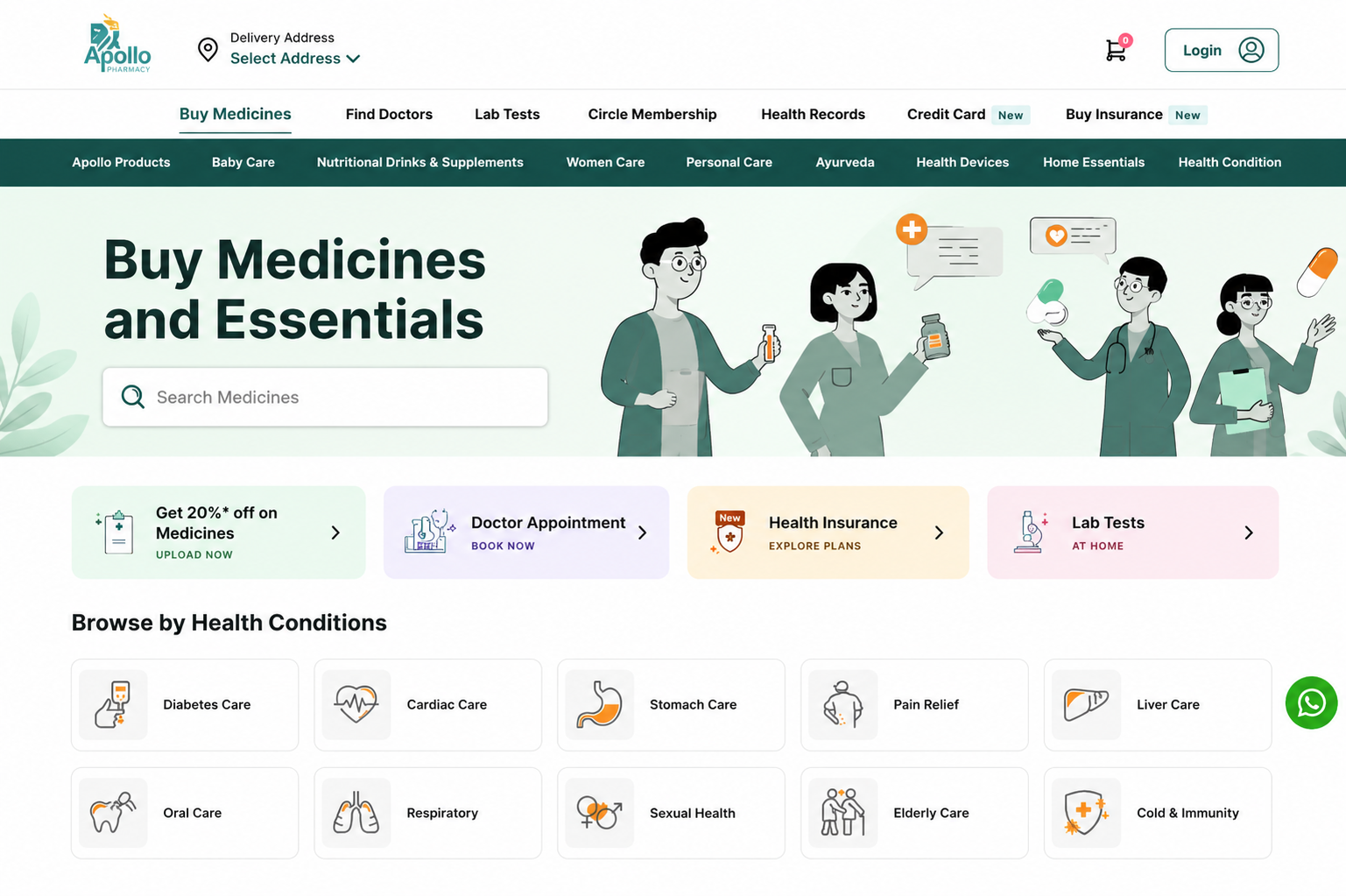
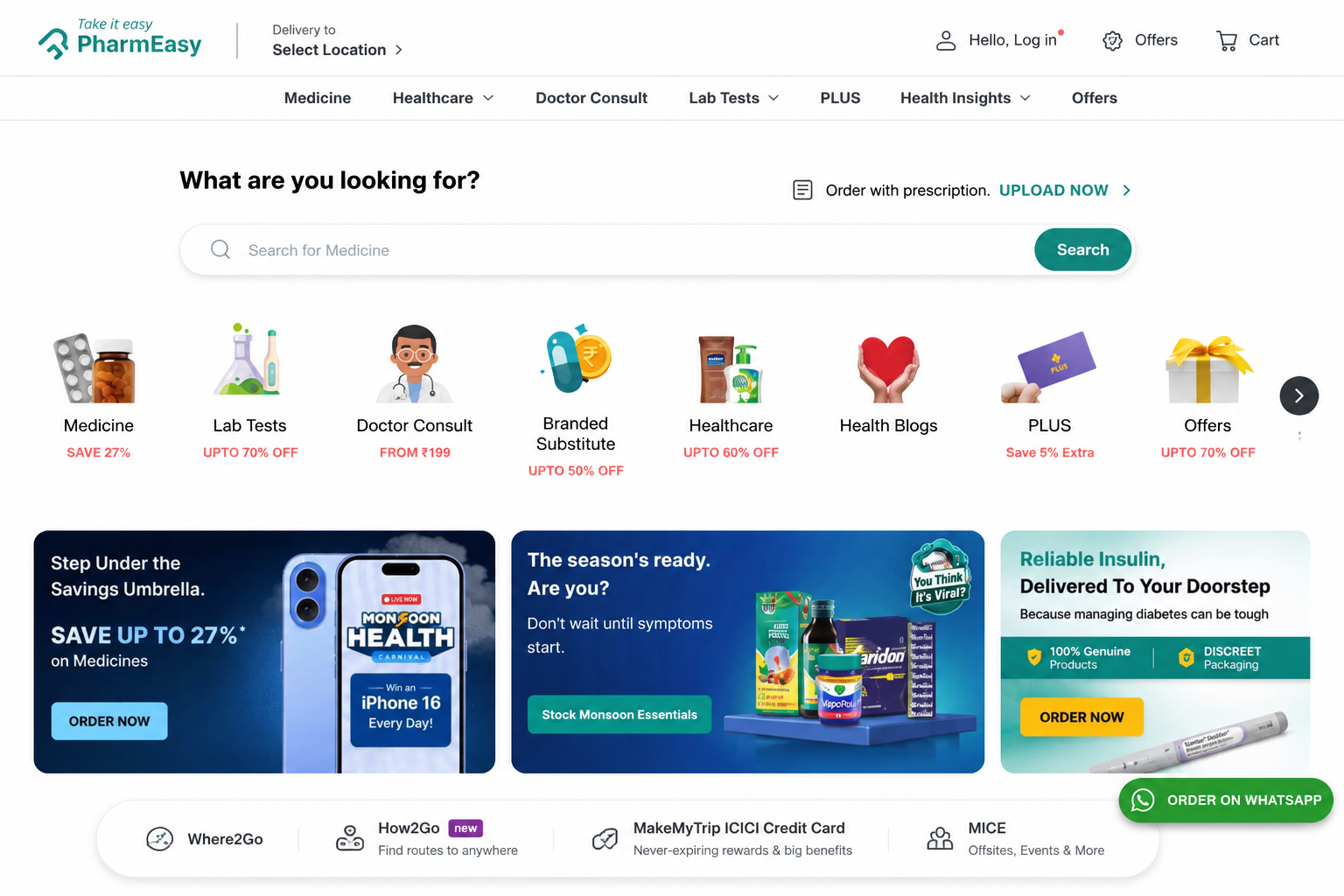
PharmEasy is an online pharmacy and healthcare platform, an app and website where people in India can order prescription medicines, over-the-counter health products, and medical supplies, and book diagnostic lab tests, all delivered to their home. In plain terms, instead of walking to a chemist, you upload your doctor’s prescription, order the medicines you need, and PharmEasy arranges for them to be delivered, and you can also book blood tests and other lab work with a technician coming to your home to collect the sample. It is not primarily a shop that stocks everything itself. It works mostly as an aggregator, connecting you to partner pharmacies and diagnostic labs that actually fulfill the order, while PharmEasy runs the platform, the app, the delivery coordination, and the customer relationship. It grew into one of India’s largest and best known digital health brands, backed by its parent group API Holdings, and for a time its advertising, including high-profile sports sponsorships, made it one of the most visible names in the sector.
What makes PharmEasy notable is that it brought the convenience of e-commerce to medicines and health services, which is really useful in a country where getting the right medicine, especially in smaller towns, can be difficult. By letting people order medicines and tests from home, often at a discount, it improved access for many. At the same time, because it is an aggregator that depends on partner pharmacies and delivery networks, and because it grew very fast on heavy funding before its finances came under severe strain, PharmEasy faces real questions about how reliably it delivers, how well it controls quality, how it treats customers when something goes wrong, and whether it is on stable financial footing. PharmEasy is, in short, both a truly useful platform that made medicines and health services more accessible for millions, and an aggregator with real reliability, quality, and stability concerns, and this review weighs both honestly.
For a customer, the practical thing to understand is that PharmEasy is a convenient way to order medicines and lab tests from home, which has real value, while it is not a substitute for a reliable local pharmacy when you need something urgently, and its service can be inconsistent. When people talk about PharmEasy, they usually mean this online pharmacy and its app that competes with going to a local chemist and with rival platforms. Understanding PharmEasy means appreciating both the real convenience it offers and the real need to use it carefully, verify your orders, and keep a backup for urgent needs, which is the balance this review strikes.
History and Founding
PharmEasy was founded in 2015 by Dharmil Sheth, Dhaval Shah, and others, starting out linked to a pharmaceutical distribution business named Ascent Health, with the idea of making medicines easier to buy by connecting patients with local pharmacies through an app rather than stocking and shipping everything itself. The founding problem was real: buying medicines in India could be inconvenient, prices varied, and access to specific medicines was uneven, especially outside big cities. PharmEasy set out to fix this by letting people order medicines online for home delivery, and it later added diagnostic lab tests, teleconsultation, and health products. It grew quickly, raised large amounts of money from major investors, and expanded across the country, becoming one of India’s leading digital health platforms and, through its parent API Holdings, a company that acquired others, including the diagnostics chain Thyrocare in a deal worth several thousand crore rupees and a pharmacy distribution and software business. This acquisition spree, funded by cheap capital during the boom, later became part of the debt burden that would strain the company when funding dried up.
From that start, PharmEasy grew into a dominant online pharmacy and a symbol of India’s health-tech boom, reaching a peak valuation of around five and a half billion dollars in 2021 and preparing for a stock market listing. But the story then turned sharply. The planned public listing was withdrawn as market sentiment soured on loss-making tech companies, the company had taken on expensive debt, and as funding conditions tightened, its valuation collapsed by around ninety percent in a later fundraising, one of the most dramatic reversals among India’s big startups. The company then shifted its focus from rapid growth to survival and profitability, cut costs and discounts, brought in new leadership, and worked to reduce its debt, with its founders stepping back from day-to-day roles.
This history matters for two reasons. First, the founding mission of making medicines and health services more accessible explains PharmEasy’s real value and why so many people came to use it. Second, the extraordinary rise and fall, from a multi-billion-dollar valuation to a roughly ninety percent crash and a scramble to cut costs and debt, explains both the reliability and quality strains customers report and the real questions about the company’s long-term stability, even as its recent turnaround shows progress. Both the genuine value and the fragility trace back to this history of a fast-funded rise, a hard fall, and an ongoing recovery.
How PharmEasy Works
Understanding how PharmEasy works helps explain both its usefulness and where its reliability and quality concerns come from.
When you use PharmEasy, you search for the medicines or health products you need, or upload a photo of your doctor’s prescription for prescription medicines, and place an order through the app or website, choosing home delivery. Behind the scenes, PharmEasy routes your order to a partner pharmacy that has the medicines, which prepares the order, and a delivery network brings it to your door, with delivery times that can range from same-day in some larger cities to a few days in smaller towns. Because a specific medicine has to be matched to a pharmacy that actually stocks it, and India’s market carries tens of thousands of distinct medicine variants, availability at the assigned pharmacy is a real factor in how fast, or whether, an order is fulfilled. For lab tests, you book a diagnostic package, a technician comes to your home at a scheduled time to collect a sample, and the report is delivered digitally once the lab processes it, usually within a day or two for common tests. PharmEasy also offers doctor teleconsultation, where you can speak to a physician through the app for minor issues or follow-ups, and a paid membership that gives benefits like discounts and free delivery for people who order often. Because it is mostly an aggregator, the actual medicines are supplied by partner pharmacies and the tests by partner or group labs, while PharmEasy manages the app, the ordering, the coordination, and the customer support. This split matters, because when something goes wrong with a product, PharmEasy’s own policy positions it as an intermediary and points responsibility for the product back to the fulfilling pharmacy.
For a customer, this design explains both the convenience and the risks. On one hand, being able to order medicines and book tests from home, with delivery and digital reports, is truly convenient and improves access. On the other hand, because fulfillment depends on partner pharmacies and delivery networks, the reliability of delivery, the accuracy of what you receive, and the handling of problems can vary, which is exactly where many complaints arise, and because PharmEasy positions itself as an intermediary, it often points customers to the partner pharmacy when there is a product issue. The honest framing is that PharmEasy’s ordering and delivery model is truly convenient when it works smoothly, while its dependence on partners and networks makes reliability and quality inconsistent and problem resolution harder, which the autopsy examines. Understanding that PharmEasy is a coordinating platform rather than a pharmacy that stocks and controls everything itself helps you use it wisely and keep a backup for urgent needs.
Leadership and the Turnaround
PharmEasy’s leadership has changed significantly as the company moved from rapid growth to a fight for survival and profitability, and understanding this helps explain the company today.
PharmEasy was built by its founders, including Dharmil Sheth and Dhaval Shah, with Siddharth Shah leading the parent group API Holdings, and for years the focus was aggressive growth, funded by large investments and expensive debt. After the valuation crash and the strain that followed, the company shifted course, and in a major change the founders stepped back from day-to-day executive roles, with a new chief executive, Rahul Guha, who also leads the group’s diagnostics arm Thyrocare, taking charge of the parent and driving a turnaround focused on profit over growth. Under this new leadership, the company cut costs, reduced discounts, exited loss-making lines, refinanced expensive debt at lower rates, and worked toward group-level profitability, with the stated aim of eventually pursuing a stock market listing once the company is profitable and largely free of debt. This is a deliberate change from the earlier growth-at-any-cost approach to a leaner, discipline-focused one, and management has described it as keeping good revenue while shedding bad, unprofitable revenue even at the cost of slower top-line growth.
For a customer or observer, the relevance is twofold. On one hand, the turnaround under new leadership, cutting losses, reducing debt, and focusing on profitability, is a real positive sign for the company’s stability, suggesting it is working seriously to put itself on firmer footing after a near-death financial experience. On the other hand, the very fact that such a turnaround was needed, after a roughly ninety percent valuation crash and heavy debt, underscores how fragile the company became, and cost-cutting can also affect service levels, which may relate to some of the reliability complaints. The honest framing is that PharmEasy’s new leadership is making real progress in stabilizing a company that had come under severe strain, which is reassuring, while the need for that rescue and the pressure of cost discipline are part of the backdrop to the reliability and quality concerns this review examines. Both the progress and the fragility are part of the picture.
What PharmEasy Offers
PharmEasy offers a range of health-related products and services, and knowing them helps you understand the platform.
- Prescription medicines: ordering prescription medicines for home delivery by uploading a doctor’s prescription, its core service.
- Over-the-counter and health products: non-prescription medicines, supplements, wellness, and personal-care products, and medical supplies.
- Diagnostic lab tests: booking blood and other lab tests with home sample collection and digital reports, linked to the group’s diagnostics arm.
- Doctor teleconsultation: online consultations with doctors through the app for some health needs.
- PharmEasy Plus membership: a paid membership offering benefits like discounts, cashback, and free delivery for regular users.
- Business and distribution services: through its parent group, supplying pharmacies and offering software and distribution services, a large part of the group’s business beyond the consumer app.
This range shows that PharmEasy is a broad digital health platform, covering medicines, health products, diagnostics, and consultation for consumers, plus a substantial business supplying the wider pharmacy trade. The breadth, especially combining medicine delivery with lab tests and consultation, is truly useful for managing health needs in one place. For a customer, the practical point is that PharmEasy can serve many routine health needs conveniently, from refilling regular medicines to booking a blood test, which is a real strength, while the reliability of each service can vary, which the autopsy examines. The breadth and convenience are real, used with appropriate care.
How PharmEasy Makes Money
Understanding how PharmEasy makes money helps explain both its value and the pressures it faces.
PharmEasy makes money mainly from the margin or commission on the medicines and health products sold through its platform, earning the difference between what it pays partner pharmacies and distributors and what the customer pays, or a commission on each order, with the large majority of its revenue coming from this product business. The margins on physical medicine distribution are inherently thin, which is one reason the company has leaned on higher-margin diagnostics and on scale to try to make the economics work. It also earns from delivery charges, from its paid membership, from advertising placements on its platform where brands pay to be seen, from diagnostic tests through its group labs, and, at the group level, from a large business supplying pharmacies and providing distribution and software services, which is a substantial revenue source separate from the consumer app. For years it spent heavily on discounts and marketing to win customers, which drove rapid growth but also deep losses, since it was effectively buying revenue that did not pay for itself, and its recent strategy has been to cut discounts and marketing sharply, exit unprofitable lines of business, focus on more profitable revenue, and move toward making money rather than chasing growth at any cost. The product margin and the diagnostics and distribution businesses are central to how it aims to become profitable.
For a customer, this model explains both the earlier appeal and the current pressures. The historic discounts made PharmEasy truly cheaper for many buyers, which was a real benefit, but those discounts were part of an unsustainable, loss-making model that had to be cut back, so the savings today may be smaller. The reliance on thin product margins and on partner pharmacies also means cost pressures are real, which can affect service, and the shift to profitability, while healthy for the company, has meant reducing the discounts customers once enjoyed. The honest framing is that PharmEasy makes money mainly from product margins plus diagnostics, distribution, and membership, and its move from discount-fueled growth to profitability is financially healthier but means smaller savings for buyers, while cost pressures form part of the backdrop to the service concerns. Understanding that the company is under real pressure to make its economics work helps explain both the reduced discounts and the strain on service.
Who Uses PharmEasy and How Big It Is
PharmEasy’s scale is large, and the numbers explain why it matters, even if they move fast and should be checked against current sources.
PharmEasy is used by a very large number of people across India, delivering medicines in over a thousand cities and more than twenty thousand pin codes, and it is one of the largest online pharmacies in the country, often cited as holding roughly a quarter of the online pharmacy market and stocking on the order of sixty-five thousand distinct medicine and product variants to match the wide range of prescriptions patients bring. Its parent group API Holdings reported operating revenue in the range of several thousand crore rupees, though it has been loss-making, with losses that were very large at their peak and have since narrowed significantly as the company cut costs. The group also runs a significant diagnostics business through Thyrocare and a large pharmacy-supply and software business. By scale, PharmEasy is a major, established player in Indian digital health, competing with other large platforms backed by big corporate groups, even as it works through its financial recovery.
This scale signals that PharmEasy is a large, established platform used by many people, which reflects real demand for its convenience, and that it is a serious player rather than a tiny startup. It also frames the autopsy’s concerns, because operating at this scale, in a health-critical category, makes reliability and quality especially important, and because the company’s financial strain and the intense competition from deep-pocketed rivals raise real questions about its stability and its ability to invest in service. For a customer, the practical point is that PharmEasy is a large, widely used platform that is truly useful for many, while its scale in a health category makes its reliability and quality concerns matter more, and its financial and competitive pressures are worth keeping in mind. The scale and demand are real, and so are the pressures that come with them.
The Rise and Fall of the Valuation
A defining part of PharmEasy’s story, and important context for its stability, is the dramatic rise and fall of its valuation, which deserves clear, factual treatment.
PharmEasy’s parent reached a peak valuation of around five and a half billion dollars in 2021, at the height of a funding boom for Indian startups, and it prepared for a large stock market listing, filing draft papers to raise several thousand crore rupees. At that moment it was celebrated as one of the country’s most valuable new-age companies and a likely blockbuster public offering. But the listing was withdrawn as investor sentiment turned against loss-making technology companies, and the company had taken on expensive debt, reportedly at high interest rates, to fund acquisitions and growth. As funding conditions tightened and the company struggled, it faced strain on that debt, including reported covenant pressures on a large loan from a global bank, and in a later fundraising its valuation was cut by around ninety percent, to roughly seven hundred million dollars, one of the steepest declines among India’s major startups and a widely cited example of how sharply boom-era valuations could reverse. The company then executed a heavily dilutive rights issue, raised domestic debt to clear the expensive earlier loan, cut costs and discounts sharply, and installed new leadership focused on profitability, steering the group to narrower losses and, at the group level, a small profit.
The honest framing treats this as important but balanced. On one hand, the crash is a serious concern: a roughly ninety percent collapse in valuation, heavy debt, a withdrawn public listing, and years of large losses point to a company that came under severe financial strain and had to fight for survival, which raises real questions about long-term stability, especially against rivals with far deeper pockets. On the other hand, fairness notes that the company has made real progress in its turnaround, cutting losses substantially, clearing its most expensive debt, refinancing at lower rates, and reaching group-level profitability, so it is a company that stumbled badly but is recovering rather than one that has failed. The fair takeaway is that PharmEasy went through one of India’s most dramatic startup valuation crashes and remains under financial and competitive pressure, but it is actively recovering and stabilizing, so its stability is improving from a low point rather than assured. For a customer, this mostly matters as context: it is a reminder that the company has been under strain, which is worth keeping in mind, even though the platform continues to operate and serve customers.
Part 2: The Autopsy
The autopsy weighs PharmEasy’s genuine strengths against its real concerns. It offers real convenience and access and is large and recovering, and it faces genuine, sometimes health-critical, concerns about delivery reliability, product quality, refunds, and stability. Both the value and the concerns are real, and because of that, both get honest treatment, with complaints presented as documented patterns rather than universal outcomes, and the company’s genuine strengths credited fairly.
What PharmEasy Gets Right
The strengths are real and explain why so many people use PharmEasy despite its problems.
Genuine Convenience
Being able to order medicines and health products from home and have them delivered, without going to a chemist and standing in a queue, is a real convenience that saves time and effort, especially valuable for the elderly, the unwell, people with mobility issues, and busy working people who cannot easily reach a pharmacy during opening hours. This ease of ordering, and the fact that it can be done any time of day, is a real strength when the delivery side works as promised.
Improved Access, Especially in Smaller Towns
PharmEasy delivers to a very wide area, including many smaller towns and pin codes where getting specific branded medicines can be hard and where specialists who prescribe them are scarce, which truly improves access to prescribed medicines for people far from well-stocked pharmacies in the big cities. This reach into thousands of pin codes is a real benefit for many patients who would otherwise struggle to find their prescribed medicine locally.
Medicines, Tests, and Consultation in One Place
Combining medicine delivery with diagnostic lab tests, home sample collection, and doctor teleconsultation lets people manage several health needs through one app, which is truly convenient and saves juggling multiple services, especially for someone coordinating care for a family member. This integration of medicines, tests, and consultation is a real strength for routine, ongoing health management across a whole family.
Savings and Discounts
PharmEasy has historically offered noticeable discounts on medicines, which saved money for many buyers, particularly those on long-term medication with recurring costs, and a membership that adds benefits like free delivery and extra cashback. While discounts have been reduced as the company shifts its focus toward profitability rather than growth at any cost, the potential for at least some savings on regular medicines remains a real draw for cost-conscious buyers.
A Large, Established Platform
PharmEasy is one of India’s largest and best known online pharmacies, used by many people, which reflects real demand and gives it scale and experience. Being an established, widely used platform with years of operating experience is a real point in its favor for many routine, non-urgent needs.
A Real Turnaround Underway
After severe financial strain that nearly sank it, PharmEasy is now cutting its losses, reducing and refinancing its debt, and moving toward profitability under new leadership, which is a real and encouraging sign that it is working seriously to put itself on firmer, more sustainable footing. This progress is a real positive for the company’s stability.
These strengths, above all the convenience and improved access, are why so many people use PharmEasy and why it became a leading digital health platform. The concerns that follow are serious and important, especially around delivery reliability and product quality in a health-critical category, but they do not erase the real value PharmEasy offers when its service works, which is why it remains useful for many routine, non-urgent needs when used with care.
The Delivery Reliability Problem
The most common and serious concern about PharmEasy, and the one with the highest stakes, is delivery reliability, and it deserves careful, prominent treatment.
Across independent consumer review platforms, from dedicated complaint sites to general review services, the single most frequent complaint about PharmEasy is delayed or undelivered medicines, and it recurs so consistently that it is the defining service issue for the brand. Many customers report ordering medicines with a promised same-day or next-day delivery, only for the delivery date to be pushed back repeatedly over several days, sometimes with the order eventually cancelled, and sometimes with little clear communication about why. Customers describe the app continuing to show new delivery dates that come and go, difficulty cancelling once an order is delayed since the option may disappear, and, in some cases, non-prescription add-on products or promoted items arriving quickly while the essential prescription medicines they actually needed did not, which understandably feels backwards to someone waiting on a critical medicine. Because medicines are often time-critical, and some customers describe ordering for elderly parents or heart patients who needed the medicines urgently, so for such patients these delays are not a minor inconvenience but a real risk to health when they happen, since a missed dose of a critical medicine can carry real consequences. While delivery works smoothly for many orders, the volume and consistency of delay complaints across multiple platforms make this a genuine and serious reliability problem.
The honest framing keeps this proportionate but takes it seriously. On one hand, the concern is real and high-stakes: frequent, well-documented complaints of delayed or undelivered time-critical medicines, sometimes cancelled after days of waiting, are a genuine and serious problem in a category where timing can affect health, and the reliance on partner pharmacies and delivery networks makes such failures more likely. On the other hand, fairness notes that these are complaints on platforms that naturally attract unhappy voices, that many orders are delivered on time and some customers report good experiences, especially after following up, and that delivery challenges affect the whole sector to some degree. The fair takeaway is that delivery delays and non-delivery are a frequent, serious, and well-documented problem with PharmEasy that buyers must plan around, even though many orders go through fine. For a customer, the practical point is clear and important: do not rely on PharmEasy for urgent or emergency medicines, order regular medicines well in advance, keep a local pharmacy as a backup, and follow up promptly if an order is delayed.
Product Quality: Wrong, Expired, and Substituted Items
Alongside delivery, a serious concern is the quality and accuracy of what customers receive, which in a pharmacy is especially important and deserves careful treatment.
On consumer review platforms, some PharmEasy customers report receiving the wrong medicine entirely, medicines close to or past their expiry date, products with broken or already-opened tamper seals, half-empty bottles, or a substitute product different from what they ordered without clear consent, with the app sometimes showing the originally ordered item as available at the time of purchase. Some describe ordering a specific prescribed medicine and receiving a different one with a similar-sounding name, which in a pharmacy is a serious safety issue, since taking the wrong medicine, or the wrong strength, can be harmful and a patient who does not check carefully might take it in good faith. Others describe partial deliveries, where only some of the ordered items arrived. Because PharmEasy works as an aggregator, these issues typically originate with the partner pharmacy fulfilling the order rather than with PharmEasy directly, but from the customer’s point of view they simply received a faulty or wrong product from PharmEasy, and being told the fault lies with an unnamed partner pharmacy is cold comfort when you are holding the wrong medicine. Against this, many orders arrive correctly, and PharmEasy states that it maintains quality controls on partner retailers, but the reports of wrong, expired, or tampered products are serious given the health stakes.
The honest framing keeps this proportionate but takes the stakes seriously. On one hand, the concerns are real and high-stakes: reports of wrong medicines, expired products, broken seals, and unrequested substitutes are genuine safety issues in a pharmacy, where receiving the wrong or compromised medicine can harm health, and the aggregator model can make quality harder to control consistently. On the other hand, fairness notes that these are individual complaints alongside many correct deliveries, that any large pharmacy platform handling huge volumes will generate some errors, and that PharmEasy says it applies quality controls and will help resolve product issues through its partners. The fair takeaway is that a meaningful number of customers report serious product-quality and accuracy problems with PharmEasy, which buyers must guard against by checking every order carefully, even though many deliveries are correct. For a customer, the practical point is essential: when your order arrives, immediately check that it is the correct medicine, that it is not expired, and that the seal is intact, and refuse or return anything wrong or compromised, keeping photos and the invoice as proof.
| Important: Check Every Medicine on Delivery, and Beware of Refund Scam Callers Because some customers report receiving wrong, expired, or tampered medicines, always check your order the moment it arrives: confirm it is the exact medicine prescribed, verify the expiry date, and make sure the packaging and tamper seal are intact and unopened. Refuse delivery or start a return immediately if anything is wrong, and keep the invoice and clear photos as proof for a refund. Separately, be alert to scam callers who impersonate PharmEasy: fraudsters may call or message pretending to be from PharmEasy, offer a refund or a problem resolution, and ask you to share an OTP, your bank or card details, or to install an app or share your phone screen. PharmEasy will never need your OTP, full card number, or screen access to process a refund, and losses from sharing details with such scammers are typically not covered. Only use the official PharmEasy app or website and its listed customer-care channels, and never share sensitive details with unsolicited callers. This is informational and not medical or financial advice. |
Refunds and Customer Service
A further concern, closely tied to the delivery and quality issues, is the difficulty some customers report in getting refunds and reaching effective support, which deserves fair treatment.
Many complaints about PharmEasy involve refunds and customer service. Customers describe refunds for delayed, cancelled, wrong, or returned orders being slow, sometimes shown as generated in the app but not actually received for many days, and in some cases refused, for example on the grounds that a returned medicine was used or its seal broken, which customers dispute, saying the delivery agent broke the seal during a verification step or that the item was never opened at all. Disputes of this kind, where the platform and the customer disagree about the condition of a returned medicine, are a recurring source of frustration. Others describe difficulty reaching a human at customer support, with heavy reliance on automated chatbots that fail to understand the issue, repeated tickets raised and closed without a real resolution, error messages when trying to chat, and calls that ring out or disconnect, leaving customers feeling stuck in a loop. Some also report being told to wait a fixed number of days before a complaint can even be registered. Against this, some customers do get issues resolved after persistent follow-up, sometimes receiving the delayed order the very next day after escalating, and PharmEasy publishes a formal grievance process with an escalation path and a named grievance officer, but the sheer volume and consistency of refund and support complaints across platforms is significant and hard to dismiss.
The honest framing keeps this balanced. On one hand, the concerns are real: slow, unreceived, or refused refunds, and difficulty reaching effective human support, are genuine problems that leave customers out of pocket and frustrated, especially painful when combined with a delayed or wrong medicine order. On the other hand, fairness notes that these are complaints that skew negative, that many refunds and issues are resolved, especially with persistent follow-up, and that PharmEasy does provide a documented grievance and escalation process. The fair takeaway is that refund difficulties and weak customer service are a common, real complaint with PharmEasy, which buyers should prepare for by keeping records and knowing the escalation path, even though many issues do get resolved. For a customer, the practical point is to keep screenshots, invoices, and a record of all communication, escalate through the grievance officer if the first level of support fails, and, if still unresolved, use external consumer-protection routes like the national consumer helpline or the relevant drug or consumer authorities.
Financial Stability and Competition
A concern that is less about any single order and more about the company’s future is its financial stability and the intense competition it faces, which deserves fair, factual treatment.
PharmEasy’s parent went through a roughly ninety percent valuation crash, carried heavy debt at high interest rates, withdrew a planned public listing, and posted large losses for years, which points to real financial strain. It now competes against online pharmacies backed by some of India’s largest and best-funded corporate groups, including major conglomerates, rivals that can afford to subsidize losses and invest heavily for a very long time, which puts PharmEasy, still working back from a near-death financial experience, at a structural disadvantage on capital. Against this, the company has made real progress: it cut its losses substantially, cleared its most expensive debt and refinanced at lower rates, reduced discounts and exited loss-making lines, and reached group-level profitability under new leadership, with a longer-term aim of a public listing once it is profitable and largely debt-free. So the picture is of a company that came under severe strain and is now recovering, but that still faces financial and competitive pressure.
The honest framing weighs this fairly. On one hand, the concern is real: a history of a dramatic valuation crash, heavy debt, and large losses, combined with competition from far better-funded rivals, raises genuine questions about the company’s long-term stability and its ability to keep investing in service and growth. On the other hand, fairness notes that the turnaround is real and substantial, with losses cut, debt reduced and refinanced, and group-level profitability reached, so the company is clearly recovering rather than failing, and it remains a major player. The fair takeaway is that PharmEasy has been financially fragile and faces tough, well-funded competition, but it is actively recovering and stabilizing, so its long-term position is improving from a difficult point rather than secure. For a customer, this mostly matters as context and as a reason to not become overly dependent on any single platform, since the sector is competitive and evolving and providers can change terms, pricing, or service levels, rather than as an immediate risk to using the service today.
What You Cannot Fully Verify
In the interest of honesty, here is what is hard to assess definitively about PharmEasy, and which depends on your location, your order, and factors that are not fully transparent.
- How reliable delivery will be for your specific location and order, since experiences range widely from smooth and fast to badly delayed or cancelled.
- Whether you will receive exactly the right, unexpired, properly sealed medicine, since quality depends on the partner pharmacy fulfilling your order.
- How quickly and fairly a refund or complaint will be handled if something goes wrong, since resolution experiences vary and often require persistence.
- How your health and personal data is stored and used in detail, beyond that a health platform necessarily handles sensitive information.
- The precise, current figures for the company’s revenue, losses, valuation, and debt, which move fast and should be checked against the latest sources.
This is not a list designed to dismiss a truly useful platform so much as a reminder that using an aggregator for something as important as medicines involves real uncertainty that you should account for. A review can tell you that PharmEasy is a truly convenient way to order medicines and lab tests from home, with real value especially for access and routine needs, and that it carries serious, sometimes health-critical concerns around delivery reliability, product quality, refunds, and stability. It cannot guarantee how your specific order will go. The honest guidance is to use PharmEasy for its real strengths, convenience and access for non-urgent, routine needs, while keeping a backup for anything urgent, checking every order carefully, keeping records, and not relying on it alone, so you get the benefit while protecting your health and your money.
Part 3: The Killcritic
The killcritic is the verdict. Who PharmEasy suits, who should be cautious, and how it compares to the alternatives.
Who PharmEasy Is For
PharmEasy suits some needs well, especially routine and non-urgent ones, with the fit depending on how you use it and how carefully you verify.
Routine and Regular Medicine Orders
If you take regular, long-term medicines for a chronic condition and can order them well in advance, PharmEasy’s home delivery is truly convenient and can save repeated pharmacy trips, as long as you plan ahead and reorder with a buffer of several days rather than waiting until you run out, and check what you receive each time.
People in Smaller Towns Needing Access
If you live where getting specific medicines is hard, PharmEasy’s wide delivery reach truly improves access to prescribed medicines, which is a real benefit, provided you allow time for delivery and keep a local backup for urgent needs.
Booking Lab Tests at Home
If you want the convenience of booking blood and other lab tests with home sample collection and digital reports, PharmEasy’s diagnostics service, linked to an established and separately listed lab group, is a practical option, with many customers reporting satisfactory and hygienic sample collection and reasonably timely reports.
Savings and One-App Health Management
If you want potential discounts and the convenience of managing medicines, tests, and consultation in one app, PharmEasy offers that in a single place, provided you treat any savings as a welcome bonus rather than something guaranteed, and verify each order and its price after logging in, since prices can differ from what is shown before sign-in.
For these needs, especially routine, planned, non-urgent ones, PharmEasy offers real value, as long as users order in advance, check every delivery, keep records, and hold a local backup for anything urgent.
Who Should Be Cautious
Others should approach PharmEasy with real care or use alternatives, depending on their needs.
Anyone Needing Urgent or Emergency Medicines
If you need medicines urgently, for an emergency, or for a critical condition where a delay is dangerous, be very cautious about relying on PharmEasy given the frequent delivery-delay complaints, and use a local pharmacy that can deliver or dispense immediately instead.
Those Who Cannot Easily Verify Orders
If you or the person the medicines are for cannot easily check that the correct, unexpired, sealed medicine arrived, for example an elderly relative ordering alone, be cautious, since product-accuracy errors are reported and checking on delivery is important.
People Who Want Easy Human Support
If you want quick, reliable human customer support when something goes wrong, be prepared for chatbot-heavy service and possible difficulty reaching a person, and keep records and the escalation path in mind, or choose a provider whose support you trust.
Anyone Wanting Certainty of Supply
If you need certainty that an order will arrive on a specific day, be cautious given the reports of repeated delays and cancellations, and do not depend on a single delayed order for a medicine you cannot go without.
PharmEasy vs the Alternatives
The most practical comparison is PharmEasy against a local pharmacy and against rival online pharmacies, and the honest answer is that it is convenient for planned needs while a local pharmacy wins for urgency and rivals are worth comparing.
| Option | Best For | Trade-offs |
|---|---|---|
| PharmEasy | Planned home delivery, access, tests | Delivery delays, quality and refund issues |
| Local pharmacy | Urgent and immediate needs | Less convenient, may lack some stock |
| Tata 1mg | A well-funded online alternative | Similar online-pharmacy trade-offs |
| Netmeds (Reliance) | A large-group online alternative | Compare service and coverage yourself |
| Apollo 24|7 | Pharmacy chain plus online reach | Compare pricing and delivery in your area |
For most people, the honest approach is to use PharmEasy or a similar platform for planned, non-urgent orders and home lab tests, while relying on a nearby local pharmacy for anything urgent, since a local chemist can dispense or deliver immediately and lets you check the medicine in person. Among online options, PharmEasy competes with rivals like 1mg, backed by Tata, Netmeds, backed by Reliance, and Apollo, which combines a large pharmacy chain with online delivery, and it is worth comparing these on delivery reliability, pricing, and coverage in your specific area, since experiences vary by location and none is immune to delivery and service issues. The honest take is that PharmEasy is a reasonable choice for planned home delivery and tests but not a substitute for a reliable local pharmacy for urgent needs, and comparing it against the well-funded rivals for your area is wise. Use it as one convenient option among several, with a local backup, rather than as your only source for medicines.
Is PharmEasy Safe, Genuine, and Reliable?
Three questions people ask most are whether PharmEasy is safe, whether its medicines are genuine, and whether it is reliable, and the honest answers differ.
Is It Safe and Are the Medicines Genuine?
PharmEasy is a legitimate, established company, not a scam, and it sources medicines through licensed partner pharmacies that must comply with drug regulations, so in general the medicines dispensed are genuine and properly sourced. It is safe to use in the sense that it is a real, licensed operation dealing in genuine medicines. The real concerns are not that the company is fake but that specific orders can be delayed, wrong, expired, or tampered with in transit or fulfillment, which is exactly why checking every delivery carefully matters so much.
Is It Reliable?
This is the weak point. Reliability, especially delivery of time-critical medicines, is the most common serious complaint, so PharmEasy cannot be considered dependable for urgent needs. It works well for many routine, planned orders, but the frequency of delay, quality, and refund complaints means you should not rely on it alone, and should keep a backup and verify every order.
The Honest Call
PharmEasy is a safe, legitimate, and truly convenient platform for ordering medicines and lab tests, with real value for routine, planned needs and for access, but it is not reliable enough to depend on for urgent or critical medicines, and it comes with real concerns around delivery, product quality, refunds, and financial stability. Use it for non-urgent, planned orders, check every delivery carefully, keep records, and keep a local pharmacy as a backup. Used that way, PharmEasy is a useful tool; relied on for urgent needs or trusted without checking, its reliability and quality problems can truly hurt, so use it carefully rather than blindly.
The Final Verdict
| PharmEasy Final Rating: 3 / 5 A truly convenient and useful online pharmacy, PharmEasy makes ordering medicines and booking lab tests from home easy and improves access for many people, especially in smaller towns and for those managing routine, long-term health needs, and it is a large, established platform now recovering from severe financial strain. It is held back from a higher score by significant, well-documented, and sometimes health-critical concerns: frequent complaints of delayed or undelivered time-critical medicines, reports of wrong, expired, or tampered products, difficulties getting refunds, a chatbot-heavy support experience, an aggregator model that leans on partner pharmacies for quality, and a turbulent financial history including a roughly ninety percent valuation crash. Legitimate, safe, and convenient for routine, planned needs, but not reliable enough to depend on for urgent medicines, so it is best used with care, with every order checked, records kept, and a local pharmacy held as a backup. |
Use PharmEasy if you want convenient home delivery of routine, non-urgent medicines and health products, you want to book lab tests with home collection, or you need access to medicines in an area where they are hard to get, and you are prepared to order in advance, check every delivery, and keep a local backup. For planned, routine needs, it offers real convenience and access.
Be cautious or use a local pharmacy if you need urgent or emergency medicines, you cannot easily verify what arrives, you want reliable human support, or you need certainty that an order will arrive on a specific day. In those cases, a nearby pharmacy that can dispense or deliver immediately is safer, and comparing rival platforms for your area is wise.
PharmEasy earns genuine credit for making medicines and health services more accessible and convenient for millions, for its wide delivery reach, for combining medicines, tests, and consultation in one place, and for a real turnaround that is stabilizing a company which had come under severe strain. The 3 out of 5 reflects that real value, tempered honestly by significant concerns: frequent and serious delivery-reliability complaints in a category where timing affects health, reports of wrong, expired, or tampered products, refund and support difficulties, and a fragile though improving financial position. As a convenient tool for routine, planned needs, PharmEasy is useful and legitimate. The keys are to never rely on it for urgent or critical medicines, to keep a local pharmacy as a backup, to order regular medicines well in advance, to check every delivery for the right, unexpired, sealed medicine, to keep records and know the escalation path for refunds, and to stay alert to scam callers impersonating the brand. Used carefully as one option among several, PharmEasy truly helps; relied on blindly for urgent health needs, its reliability and quality problems can cause real harm, so the smart approach is to use its convenience for planned needs while protecting your health and money at every step.
Frequently Asked Questions
This section answers the specific questions people search for about PharmEasy. Each answer is structured for direct factual extraction.
What is PharmEasy?
PharmEasy is one of India’s largest online pharmacies, an app and website where people can order prescription medicines, over-the-counter health products, and medical supplies, and book diagnostic lab tests with home sample collection, all delivered to their door. Founded in 2015 and the flagship of the group API Holdings, it works mainly as an aggregator, connecting customers to partner pharmacies and diagnostic labs that fulfill orders, while PharmEasy runs the app, delivery coordination, and customer support. It also offers doctor teleconsultation and a paid membership. PharmEasy grew into a leading digital health platform, delivering across more than a thousand cities, and it makes medicines and health services more convenient and accessible, though its delivery reliability and service can be inconsistent.
Is PharmEasy safe and legit?
Yes, PharmEasy is a legitimate, established company and is safe to use in the sense that it is a real, licensed operation, not a scam, and it sources medicines through licensed partner pharmacies. The real concerns are not about whether the company is genuine but about service and reliability: frequent complaints of delayed or undelivered medicines, some reports of wrong, expired, or tampered products, and refund difficulties. So PharmEasy is safe and legitimate to use for routine, planned orders, but you should check every delivery carefully, keep records, keep a local pharmacy as a backup for urgent needs, and stay alert to scam callers who impersonate PharmEasy and ask for OTPs or bank details.
Are PharmEasy medicines genuine or fake?
In general, PharmEasy’s medicines are genuine, since they are sourced through licensed partner pharmacies, and PharmEasy states that it applies quality controls on its partner retailers. However, some customers have reported receiving the wrong medicine, products close to or past expiry, or items with broken tamper seals, which are quality and accuracy problems rather than deliberate fakes, but are serious in a pharmacy. To protect yourself, always check on delivery that you received the exact medicine prescribed, verify the expiry date, and make sure the packaging and seal are intact and unopened, and refuse or return anything wrong or compromised, keeping photos and the invoice as proof. If you have a genuine quality concern, you can also raise it with the relevant drug-control authority.
Is PharmEasy reliable for delivery?
Delivery reliability is PharmEasy’s biggest weak point. The most common serious complaint is delayed or undelivered medicines, with orders promised for same-day or next-day delivery being pushed back repeatedly over days and sometimes cancelled. While many orders do arrive on time, the frequency of delay complaints across independent platforms means PharmEasy cannot be considered dependable for urgent needs. Use it for routine, planned orders where you can afford some flexibility on timing, order regular medicines well in advance, and keep a local pharmacy as a backup for anything you need urgently. If an order is delayed, follow up promptly, and do not depend on a single delayed order for a medicine you cannot go without.
Why is my PharmEasy order delayed?
PharmEasy orders can be delayed for several reasons tied to its aggregator model: the partner pharmacy may be slow to prepare the order, the medicine may be out of stock at the assigned pharmacy, or the delivery network may face backlogs, and communication about the reason is often limited. Customers frequently report the app showing repeatedly updated delivery dates. If your order is delayed, contact customer support through the app promptly, use the escalation option to reach a supervisor if needed, and consider cancelling and buying from a local pharmacy if the medicine is urgent. To reduce the risk in future, order regular medicines well in advance and keep a local backup, since delivery timing on the platform is not consistently reliable.
How do I get a refund from PharmEasy?
To get a refund from PharmEasy for a delayed, cancelled, wrong, or returned order, raise the request through the app or website as soon as possible, clearly stating the problem and attaching photos and the invoice as proof. Keep screenshots and a record of all communication. If the refund is slow, shown as generated but not received, or refused, escalate through PharmEasy’s grievance process to its grievance officer, whose contact is in its customer-support policy, after the first level of support fails. If it remains unresolved, you can take it further through external consumer-protection routes, such as the national consumer helpline or the consumer commission, and for medicine-quality issues the relevant drug-control authority. Persistence and good records significantly improve the chances of getting a refund resolved.
Is PharmEasy going to shut down or is it in financial trouble?
PharmEasy went through severe financial strain, including a roughly ninety percent crash in its parent’s valuation from a peak of around five and a half billion dollars, heavy debt at high interest rates, a withdrawn stock market listing, and years of large losses, which raised real questions about its future. However, it is not shutting down and has made a real turnaround: it cut its losses substantially, cleared its most expensive debt and refinanced at lower rates, reduced discounts and exited loss-making lines, and reached group-level profitability under new leadership, with a longer-term aim of a public listing once it is profitable and largely debt-free. So the company remains under financial and competitive pressure but is actively recovering and continuing to operate, rather than failing. For customers, this mostly matters as context rather than an immediate risk to using the service.
Who owns PharmEasy?
PharmEasy is owned by the group API Holdings, and it was founded in 2015 by Dharmil Sheth, Dhaval Shah, and others, with Siddharth Shah leading the parent group. After the company’s financial strain, its founders stepped back from day-to-day executive roles, and a new chief executive, Rahul Guha, who also leads the group’s diagnostics arm Thyrocare, took charge of the parent and is driving its turnaround. API Holdings is backed by many investors, and a later fundraising to stabilize the company was led by the investor Ranjan Pai. The group includes not just the PharmEasy consumer app but also a diagnostics business and a large pharmacy-supply and software business, making PharmEasy the consumer-facing flagship of a broader healthcare group.
Is PharmEasy good for lab tests?
PharmEasy can be a convenient option for lab tests, letting you book blood and other diagnostic tests with a technician coming to your home to collect the sample and reports delivered digitally, and it is linked to an established diagnostics group, with many customers reporting satisfactory and hygienic sample collection. As with medicines, though, experiences vary, and some customers report issues like delayed or missing reports or tests being cancelled without clear reasons, so it is not free of the service inconsistencies seen elsewhere on the platform. If you use it for lab tests, confirm the specific tests included in a package before booking, keep records, and follow up if a report is delayed. For routine home testing it is a practical option, used with the same care as for medicine orders.
Common Mistakes and Tips When Using PharmEasy
This section captures the most common mistakes people make with PharmEasy and how to avoid each. Following these helps you get the convenience while protecting your health and money.
Mistake: Ordering urgent medicines expecting fast delivery
Mitigation: Delivery is frequently delayed, so never rely on PharmEasy for urgent or emergency medicines. For anything you need quickly, use a local pharmacy that can dispense over the counter or deliver within hours, and treat PharmEasy as an option only for planned, non-urgent orders where some flexibility on timing is truly acceptable and a delay of a few days would not put anyone at risk.
Mistake: Not keeping a local pharmacy backup
Mitigation: Because an order can be delayed or cancelled after days, always keep a nearby pharmacy as a backup for essential medicines, so a failed or late PharmEasy order never leaves you without a medicine you cannot go without.
Mistake: Not checking the medicine on delivery
Mitigation: Some customers receive wrong, expired, or tampered products. On delivery, immediately check that it is the correct medicine, verify the expiry date, and confirm the seal is intact, and refuse or return anything wrong or compromised, keeping photos and the invoice as proof.
Mistake: Not keeping records for refunds
Mitigation: Refunds can be slow or disputed. Keep screenshots of the order, the promised delivery, and all communication, plus the invoice and photos of any faulty product, so you have clear, dated proof to support a refund claim and a formal escalation later if needed.
Mistake: Sharing details with scam callers
Mitigation: Fraudsters impersonate PharmEasy and ask for OTPs, bank details, or screen sharing to process a refund. PharmEasy never needs these to refund you. Only use the official app and listed channels, and never share sensitive details or install apps at the request of an unsolicited caller.
Mistake: Not escalating when support fails
Mitigation: First-level support is often chatbot-heavy and may not resolve issues. If it fails, use the escalation path to a supervisor and then to PharmEasy’s grievance officer, and if still unresolved, use external routes like the national consumer helpline or the relevant drug or consumer authority.
Final Notes on This Review
This review was built using a query fan-out approach designed to answer the questions people actually search for about PharmEasy, organized into topic clusters that map to how Google’s AI Overview surfaces answers. Every claim is grounded in a source: PharmEasy’s public information and policies, independent reporting on its business and finances, and consumer reviews and complaints across multiple platforms, with complaints presented as documented patterns from platforms that skew negative rather than as universal outcomes, and the company’s genuine strengths and turnaround credited fairly.
Figures for the company’s revenue, losses, valuation, and debt reflect publicly available information as of mid-2026 and change fast, and the business is in active transition, so verify the current situation against the latest reliable sources before relying on it. This review is informational and is not medical or financial advice; for medical decisions consult a qualified doctor or pharmacist, and for anything urgent or an emergency contact a nearby pharmacy or emergency services right away. Above all, use PharmEasy for its real strengths, convenience and access for routine, planned needs, while never relying on it for urgent medicines, keeping a local backup, checking every delivery, keeping records, and staying alert to scams, so you get the benefit while protecting your health and your money at every step.
More brand reviews on brands.run
brands.run publishes honest, independent reviews of brands across every category, from health and e-commerce to food, finance, and more. Explore the latest reviews on the brands.run homepage.
Review of PharmEasy | Last updated: June 2026 | Reviewer: brands.run editorial team | Independent review. Figures and the company’s financial situation can change quickly, so verify current details before relying on them. Not medical or financial advice.
PharmEasy is a trademark of its parent company API Holdings and its operating entities. Other names mentioned are trademarks of their respective owners. All product names, logos, and brands are the property of their respective owners. Use of these names here does not imply any affiliation or endorsement. This review is for general informational purposes only and reflects publicly available information, reputable reporting, company policies, and consumer feedback as of mid-2026. It is not medical or financial advice. Consumer complaints are drawn from public review platforms that tend to attract dissatisfied users and are presented as reported patterns rather than verified or universal outcomes, and the company’s stated positions and genuine strengths are noted alongside them.