
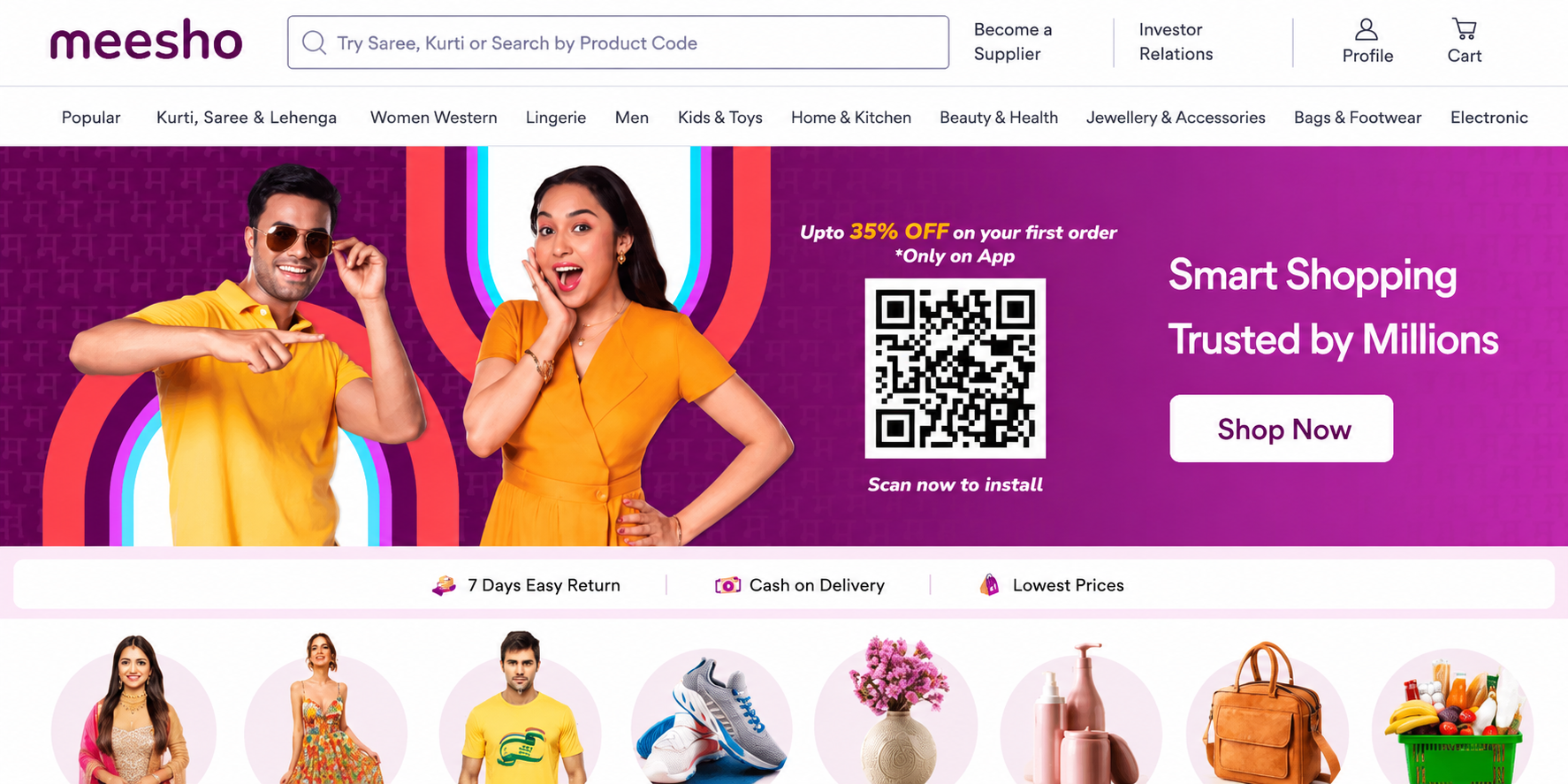
An honest, deeply researched review of Meesho covering how it works, why products are so cheap, pricing, the reselling model, customer complaints, the seller reality, and the verdict on whether it deserves your money
Thank you for reading this post, don't forget to subscribe!Published by brands.run | The independent brand review hub
Reviewed Brand: Meesho | Sector: E-commerce and Social Commerce | Founded: 2015 | Headquarters: Bengaluru, India | Website: meesho.com
Meesho is India’s largest e-commerce platform by order volume and the country’s biggest social commerce player. It connects manufacturers and small sellers directly to budget-conscious shoppers, mostly in Tier 2, Tier 3, and smaller towns, at prices that undercut almost everyone. Founded in 2015 by Vidit Aatrey and Sanjeev Barnwal, Meesho went public in December 2025 and listed at a 46 percent premium. It now serves over 23 crore annual transacting users and placed 1.83 billion orders in FY25. This review sits inside our E-commerce, Retail and Shopping coverage.
That’s the headline. This review goes underneath it.
It’s built in three parts. Part 1, The Expose, covers what Meesho actually is beneath the marketing: the business model, why the products are so cheap, the zero-commission seller engine, the reselling network, the Valmo logistics arm, Meesho Mall, the IPO, the financials, and how buying and selling actually work. Part 2, The Autopsy, dissects what works and what’s broken: the product quality problem, the return and refund breakdown, the customer support gap, the OTP delivery flaw, the Pay Later disputes, the seller margin reality, the phishing ecosystem, and the gap between Meesho’s enormous scale and its harsh consumer review scores. Part 3, The Killcritic, is the verdict: who Meesho helps, who it fails, who should sell on it, and how it compares to Flipkart, Amazon, Shopsy, and your local market.
If you’re deciding whether to shop on Meesho, sell on Meesho, or just understand how a platform with millions of one-star reviews became one of India’s most valuable internet companies, this is the honest version.
| Review MethodologyThis review draws on Meesho’s own platform and IPO prospectus, public financial filings and stock data, founder interviews, and a large body of customer reviews across Trustpilot, PissedConsumer, Reviews.io, ComplaintsBoard, and Voxya, alongside seller-side analysis from multiple e-commerce industry sources. Figures reflect publicly available information as of June 2026 and may change with future updates. |
Part 1: The Expose
The expose strips away the marketing layer. What is Meesho actually, who is it for, how does it make money, and why are the products priced the way they are. No spin.
What Meesho Actually Is
Meesho is a value-focused online marketplace. You open the app, browse cheap products across fashion, home, kitchen, beauty, and accessories, place an order, and a third-party courier delivers it to your door, usually in 5 to 7 days. Prices are the lowest in mainstream Indian e-commerce, often a fraction of what the same category costs on Amazon or Flipkart.
Underneath the shopping app sits a second business: reselling. Meesho lets anyone, with no inventory and no money down, pick products from its catalog, add a margin, share them on WhatsApp, Facebook, or Instagram, and pocket the difference when someone buys. Over 9 million people, most of them women working from home, have used this model to earn income.
And underneath that sits the real engine: a marketplace that charges sellers zero commission. Meesho makes its money elsewhere, from advertising, logistics margins, brand placement fees, and financial services. The platform’s bet is volume, not commission. Sell enough cheap things to enough people, and the economics work.
So Meesho is three things at once: a value shopping app for buyers, a zero-investment reselling tool for small entrepreneurs, and a zero-commission marketplace for sellers. That combination is what makes it different from Amazon or Flipkart, and it’s why it grew the way it did.
The Founders and the FashNear Origin
Meesho was founded in December 2015 in Bengaluru by Vidit Aatrey and Sanjeev Barnwal, two IIT Delhi graduates. It started life as FashNear, a hyperlocal fashion delivery idea connecting local boutiques to nearby buyers. That model didn’t work. The founders pivoted to what became Meesho, a contraction of “meri shop,” meaning “my shop,” built around helping small sellers and resellers reach customers through social media.
Aatrey is the CEO. Barnwal is the CTO. The company is headquartered at Vaishnavi Tech Park on Sarjapur Main Road in Bellandur, Bengaluru. The pivot from FashNear to Meesho is worth noting because the willingness to abandon a failing model and rebuild around resellers is the decision that created the entire company. Meesho’s DNA is constant pivoting, and you see it again later in how it added direct shopping, then Valmo logistics, then Meesho Mall, then financial services, each a bet layered on the last.
The Business Model Decoded
Meesho runs a B2B2C model, which means business to business to consumer. It connects suppliers (the first B) to resellers (the second B) who sell to end customers (the C). It blends three models into one: a marketplace like Amazon, a social commerce layer that sells through WhatsApp and Instagram, and a dropshipping structure where resellers never touch inventory.
Here’s the flow on the reselling side. A supplier lists a product. A reseller finds it, adds a markup, and shares it on social media. A customer orders through the reseller. The supplier ships the product directly to the customer. The reseller keeps the margin and never handled stock, money up front, or logistics.
On the direct side, which is now the larger part of the business, a customer simply shops the app like any marketplace, and the supplier ships through Meesho’s logistics network. As of recent figures, around 75 percent of Meesho’s sales come directly from its own platform rather than through resellers, a major shift from its origins as a pure social commerce play.
The model’s defining trait is being asset-light. For most of its history, Meesho owned no warehouses and no delivery fleet. It rode on third-party logistics. That kept it lean and let it pivot fast, but it also meant Meesho had limited control over delivery quality, a weakness the autopsy returns to in detail.
Why Meesho Products Are So Cheap
This is the question every first-time user asks. Why is the same kurti that costs 800 rupees elsewhere available for 250 on Meesho? Several structural reasons combine.
- Zero commission: Sellers pay no referral fee, so they can price lower and still keep their margin. On Amazon or Flipkart, 20 to 35 percent of the price goes to the platform. On Meesho, that cut is removed.
- Direct sourcing: Many products come straight from manufacturers and wholesalers in hubs like Surat, Tiruppur, and Delhi, cutting out middlemen.
- Unbranded inventory: Most Meesho products are unbranded or regional, so there’s no brand premium baked into the price.
- Low operating costs: The asset-light model and Tier 2 focus keep overheads down.
- Volume economics: Meesho’s whole model is built on thin margins and huge volume, so prices stay low by design.
The honest flip side, covered fully in the autopsy, is that ultra-low prices come from ultra-low costs, and some of that shows up as inconsistent quality, generic goods, and a high return rate. The price is real. So is the trade-off.
The Zero-Commission Model: How Meesho Makes Money
If Meesho charges sellers no commission, how does it earn? Through five main streams.
- Advertising: Sellers pay for promoted listings and better visibility. This is the largest and fastest-growing revenue line.
- Logistics margins: Meesho earns a margin on shipping, increasingly through its own Valmo network.
- Brand placement fees: National brands pay premium fees for placement inside Meesho Mall.
- Float and financial services: Delayed payment settlements and a growing lending and Pay Later business generate income.
- A marginal supplier fee: Some categories carry small charges for add-on services even within the zero-commission frame.
The word “zero commission” is accurate but it isn’t “zero cost” for sellers. Once a seller factors in advertising to get visibility, plus forward and reverse shipping on a high return rate, the effective cost of selling on Meesho lands around 15 to 20 percent of the selling price. That’s still lower than Amazon or Flipkart for cheap products, but it’s not free. The seller section breaks this down.
The Reseller Engine
Meesho’s original growth came from resellers, and the story is a significant one. Over 9 million people, the overwhelming majority women in small towns, have used Meesho to start a home business with no capital.
The mechanics are simple. A reseller browses Meesho’s catalog, picks products, and shares them through WhatsApp groups, Facebook, or Instagram, often to a network of neighbors, relatives, and local contacts. When someone wants to buy, the reseller places the order on Meesho at the base price, adds their margin, and collects the difference. Meesho handles sourcing and delivery. The reseller’s only job is curation and customer relationships.
One widely cited example: a reseller in Lucknow built a WhatsApp group of 800 customers, sharing her Meesho catalog, and reached monthly sales in the lakhs with most orders coming from referrals. Multiply that across millions of resellers and you understand how Meesho built distribution that Amazon and Flipkart, with their metro-first, app-first models, couldn’t replicate. The reselling engine is also the source of Meesho’s strongest social claim: that it created income for millions of women who had no prior access to formal earning.
The shift worth noting is that direct shopping has now overtaken reselling as Meesho’s main channel. The reseller engine built the brand and the early base. The direct marketplace is what scales it now.
Categories and the Price Sweet Spot
Meesho is not a everything-store the way Amazon is. It’s concentrated in specific categories where cheap, unbranded, high-velocity products thrive.
- Women’s clothing and ethnic wear (the single largest category, especially sarees, kurtis, suits)
- Men’s fashion and accessories
- Home and kitchen (organizers, cookware, tools, daily-use items)
- Home decor
- Beauty and personal care (generic and value-priced)
- Electronics accessories (cases, cables, chargers, not big-ticket electronics)
- Kids’ products and toys
- Jewelry and fashion accessories
The price sweet spot is roughly 149 to 499 rupees. Industry analysis shows products in the 200 to 800 range perform exceptionally well on Meesho, a band that’s too cheap to thrive on Amazon and gets lost in competition on Flipkart. Meesho owns the under-500-rupee value segment in a way no competitor has matched. If you want a 199-rupee pair of leggings or a 299-rupee kitchen organizer, Meesho’s economics are unmatched. If you want a 25,000-rupee phone or a premium branded appliance, Meesho is the wrong platform.
Meesho Mall: The Brand Play
Meesho Mall is a dedicated section of the app where established national brands sell directly to consumers. Brands like Mamaearth, Himalaya, Dabur, Bata, and Titan use it to reach Meesho’s huge base of first-time online buyers in non-metro cities.
The strategic logic is twofold. For brands, Meesho Mall is access to a customer Amazon and Flipkart reach less effectively: the Tier 2 and Tier 3 shopper making their first branded online purchase. For Meesho, it’s a way to add trust and higher-value transactions to a catalog dominated by unbranded goods, and to earn premium placement fees rather than relying only on cheap-product volume.
Meesho Mall is also part of a broader move toward profitability. Branded goods carry higher order values and stronger margins than 200-rupee unbranded items. As public-market pressure for profit grows after the IPO, expect Meesho to push Mall, advertising, and premium services harder, since these lift average order value without breaking the zero-commission promise that defines the brand.
Valmo: The Logistics Bet
For most of its life, Meesho outsourced all delivery to third-party couriers. Valmo is its answer to the limits of that approach: a Meesho-built logistics network designed to cut delivery costs and improve control, especially for daily essentials and value products.
Valmo matters because logistics is where Meesho’s unit economics live or die. On cheap products, every rupee of delivery cost is significant. By building Valmo, Meesho aims to reduce its dependence on external couriers and capture logistics margin itself. At its peak, Valmo handled around 65 percent of Meesho’s delivery volume, though that share has since come down to roughly 50 percent as the company balances its own network against third-party partners.
The honest read is that Valmo is a work in progress. Building a delivery network is expensive and operationally hard, and Meesho’s historic weakness in delivery quality (rude agents, failed pickups, mismarked deliveries) won’t be fixed by ownership alone. Control is necessary but not sufficient. The autopsy covers the delivery experience in detail.
The Tier 2 and Tier 3 Strategy That Won
Meesho’s single biggest strategic decision was to build for the market Amazon and Flipkart ignored. Over 75 percent of Meesho’s users come from Tier 2 cities and beyond. While the incumbents chased premium urban buyers who valued convenience, Meesho chased price-sensitive buyers in smaller towns who valued cost above speed.
That focus shaped everything. Cash on delivery, which urban-first platforms de-emphasized, was central to Meesho because it made first-time online buyers comfortable. The 5-to-7-day delivery window, slow by metro standards, was acceptable to buyers who cared more about saving money than saving time. CEO Vidit Aatrey has stated plainly that Meesho’s buyers are willing to wait for significantly lower prices, and that discipline kept the company out of expensive races it didn’t need to run.
The result: Meesho holds roughly 60 percent of India’s social commerce market and handles an estimated 29 to 31 percent of all e-commerce orders in the country by order count, making it the largest platform by number of orders despite a lower total transaction value than Flipkart or Amazon. It found a market nobody was serving properly and built a fortress in it.
The No-Quick-Commerce Discipline
While Blinkit, Zepto, and Swiggy Instamart poured money into 10-minute delivery, Meesho deliberately stayed out. This was a discipline, not an oversight. Quick commerce works on convenience and higher margins. Meesho’s buyers are over-indexed on low average order values where 10-minute delivery economics simply don’t work.
By refusing to chase delivery speed in low-value categories, Meesho kept its unit economics healthier than they would have been in a delivery arms race. It’s a useful illustration of focus: Meesho understood that its customer wanted price, not speed, and refused to spend money solving a problem its customer didn’t have. Not every fast-growing company shows that restraint.
The IPO Story
Meesho listed on the NSE and BSE on December 10, 2025. The IPO was a defining moment for Indian consumer internet.
- Issue price: 111 rupees per share, at the top of the 105 to 111 band.
- Listing price: 162.5 rupees, a 46 percent premium on debut, one of the stronger large-cap consumer internet listings in recent years.
- Issue size: Around 5,421 crore rupees, combining a fresh issue of about 4,250 crore and an offer for sale of about 1,171 crore.
- Subscription: Heavily oversubscribed across institutional, non-institutional, and retail categories, signaling strong investor conviction.
- Use of proceeds: Cloud infrastructure, Meesho AI Labs, the Valmo logistics network, financial services, and acquisitions.
Post-listing, the stock has been volatile. It hit a lower circuit after Q3 losses in February 2026, then recovered to trade well above its IPO price by April 2026 on improving results. As of mid-2026, Meesho’s market capitalization sits around 75,000 crore rupees, with promoter holding near 16.6 percent. The IPO turned Meesho from a venture-backed startup into a public company answerable to quarterly earnings, which changes the pressure on it to show a credible path to profit.
The Financials: Growth, Losses, and the Path to Profit
Meesho’s numbers tell a classic high-growth, still-unprofitable story, with a recent turn toward narrowing losses.
- Revenue: Grew from 5,898 crore rupees in FY23 to 9,901 crore in FY25, a compound annual growth rate near 30 percent. Trailing twelve-month revenue is around 12,626 crore.
- Orders: 1.83 billion orders placed in FY25.
- Users: Annual transacting users scaled from 13.64 crore in FY23 to 23.42 crore by late 2025.
- Losses: Still loss-making at the consolidated level, with a trailing loss near 1,358 crore rupees. But Q4 FY26 saw losses trimmed by around 88 percent year over year on revenue of 3,531 crore, a meaningful step toward profitability.
- Funding history: Raised about 1.36 billion dollars across 12 rounds from investors including SoftBank, Peak XV (formerly Sequoia India), Meta, Elevation Capital, and Fidelity, before going public.
The honest financial read: revenue growth is strong and real, the user base is enormous and still expanding, and losses are narrowing fast. But the marketplace segment generates nearly all the revenue while new initiatives (logistics and financial services) are still loss-making, and a 1,500 crore rupee tax demand received in March 2026 is an overhang. Meesho is closer to profitability than it has ever been, but it isn’t there yet, and the public market will judge it on that gap.
How to Shop on Meesho: The Buyer Flow
The buying experience is straightforward, which is part of Meesho’s appeal to first-time online shoppers.
- Download the Meesho app or visit meesho.com. Sign up with your mobile number and verify with an OTP.
- Browse or search. The app surfaces low-priced products with images, ratings, and prices. Filters cover category, price, and popularity.
- Open a product. Check the photos, the price, the seller rating, the delivery estimate, and crucially the customer reviews and review photos, which are your best quality signal on Meesho.
- Add to cart and choose delivery address. The app pulls serviceability for your pincode.
- Pick a payment method. Options include UPI, cards, wallets, Meesho Pay Later, and cash on delivery where available.
- Place the order. You receive an order ID and tracking.
- Track delivery through a third-party courier (Valmo, Delhivery, Shadowfax, Ecom Express, and others). Delivery typically takes 5 to 7 days.
- Receive the order. For some deliveries you share an OTP to confirm receipt.
- Rate and review, or initiate a return within the return window if the product is wrong, damaged, or not as described.
The flow is clean. The friction, as the autopsy details, comes after the order: delivery reliability, return pickups, and refund timelines are where Meesho’s experience most often breaks down.
How to Sell or Resell on Meesho
Meesho has the lowest barrier to entry of any major Indian marketplace, which is a real strength for new sellers.
For Sellers
- Register on the Meesho Supplier panel with GST details (or under the composition scheme rules where applicable) and a bank account.
- List products with images, descriptions, pricing, and inventory. Onboarding is simpler than Amazon or Flipkart.
- Set your price. There’s no referral commission, so you keep the gross margin minus shipping and any advertising.
- Receive orders, pack them, and hand them to the assigned courier for pickup.
- Get paid on a 7-to-15-day settlement cycle, faster than many competitors.
- Optionally buy ads to improve visibility, which is increasingly necessary to get sales volume.
For Resellers
- Install the Meesho app and browse the catalog.
- Share products you like on WhatsApp, Facebook, or Instagram with your own markup.
- When a customer orders, place it on Meesho at the base price and enter the customer’s address.
- Meesho and the supplier handle delivery. You collect your margin.
The simplicity is the selling point. The catch, covered in the autopsy, is that zero commission doesn’t mean zero cost, and high return rates plus advertising spend can erode the margins that drew sellers in.
Cash on Delivery vs Prepaid on Meesho
Cash on delivery is central to Meesho’s accessibility. For first-time online buyers who don’t trust paying in advance, COD removes the fear. It’s a major reason Meesho reached customers Amazon and Flipkart struggled to convert.
But COD creates real cost. Industry data puts Meesho’s COD order success rate around 77 percent, versus roughly 97 percent for prepaid orders. The gap comes from refused deliveries, customers not having cash, and address problems, all of which trigger expensive return-to-origin logistics that Meesho absorbs. This is one reason Meesho nudges users toward prepaid with incentives, and why some products show prepaid-only options. For buyers, the practical note is that COD availability varies by product and pincode, and prepaid often comes with better prices or faster handling.
How to Get the Lowest Price on Meesho
Even on a platform built around low prices, there are ways to pay less and buy smarter. A few practical levers consistently help.
- Compare sellers on the same product: The identical or near-identical item is often listed by multiple sellers at different prices. Sort by price and check the cheaper listings, then weigh them against seller ratings and review photos.
- Use coupons and bank offers: Meesho runs frequent coupon codes and card or UPI offers, especially during festive sales. Apply available coupons at checkout and check for instant discounts on specific payment methods.
- Buy during festive sale events: Meesho’s multi-day sales bring the deepest discounts of the year. For non-urgent purchases, waiting for a sale event can cut prices noticeably.
- Prefer prepaid where it’s cheaper: Some products are priced lower for prepaid orders than cash on delivery, since prepaid costs Meesho less. If you’re comfortable paying in advance, check whether prepaid gets you a better price.
- Watch the effective price, not just the sticker: A slightly pricier item with strong review photos and a good seller rating is often a better deal than the absolute cheapest listing that arrives wrong and can’t be returned easily.
The discipline that separates a good Meesho experience from a bad one isn’t chasing the rock-bottom number. It’s combining a low price with a seller who has real reviews and photos that match the listing. Do both, and Meesho delivers the value it promises. Chase only the lowest price, and you inherit the quality lottery in full.
The Meesho OTP Delivery System
Meesho uses OTP confirmation on some deliveries. The courier marks the order delivered once an OTP is shared. This is meant to prevent false delivery claims, but it has a documented flaw worth flagging for every buyer.
When multiple products are delivered together, customers report that a single OTP can mark all items as delivered, even if some are missing. Once the system shows an item delivered, getting a refund for a truly missing product becomes much harder, because the platform’s records say it arrived. This is one of the most cited complaint patterns in Meesho reviews, and the autopsy and buyer-tips sections both address how to protect yourself.
Meesho’s AI Push: Vaani and AI Labs
Meesho has moved aggressively into artificial intelligence. In March 2026 it launched Vaani, a generative-AI voice shopping assistant aimed at helping its 500 million target users, many of whom are more comfortable speaking than typing, navigate the app in their own language.
The company has also stated that around 70 percent of its code is now AI-generated and roughly 75 percent of orders are AI-driven through recommendations and discovery, and it has partnered with Google Cloud for infrastructure. Meesho AI Labs is the umbrella for this work. The strategic aim is twofold: cut costs through automation, and improve product discovery for buyers who don’t search the way metro users do. Whether AI actually fixes the trust and quality problems, which are operational and human as much as technological, is the open question. AI can improve discovery. It cannot, by itself, make a 200-rupee product arrive on time and match its photo.
Meesho vs Myntra and Ajio: The Fashion Question
Since fashion is Meesho’s largest category, the comparison against dedicated fashion platforms matters. Myntra (owned by Flipkart) and Ajio (owned by Reliance) target a different shopper than Meesho does.
Myntra and Ajio sell branded and premium fashion to a more aspirational, often metro buyer who wants recognized labels, curated styling, and reliable quality. Their prices are far higher, but so is the consistency, the return experience, and the brand assurance. Meesho sells unbranded and regional fashion to a price-led buyer who wants the lowest possible cost and will accept quality variance to get it.
The practical split is clean. If you want a branded kurta set or a recognized label and you’ll pay for reliability, Myntra or Ajio. If you want five unbranded outfits for the price of one branded piece and you’ll filter by buyer review photos, Meesho. They aren’t really competing for the same purchase. Meesho owns the value floor of Indian fashion, while Myntra and Ajio own the branded middle and top. A shopper might use Meesho for everyday basics and Myntra for an outfit that matters, which is exactly how many Indians now split their fashion spending.
For the branded side of the market, our Myntra review and Ajio review cover those platforms in full.
Is Meesho Safe for Payments and Data?
Beyond product quality, buyers reasonably ask whether Meesho is safe for their money and personal information. The answer has two parts.
On payments, Meesho is a legitimate listed company using standard payment gateways, UPI, and established methods, so the core payment rails are as safe as any major platform. The risks are specific rather than systemic: Pay Later disputes where charges are contested, slow refunds on payment errors, and the broader phishing ecosystem where fraudsters impersonate Meesho to extract money from sellers and resellers through fake links. None of these means Meesho itself is unsafe to pay, but they mean you should use trusted payment methods, keep records, and never act on payment demands from anyone claiming to be Meesho outside the official app.
On data, Meesho collects the usual e-commerce information: contact details, addresses, order history, and browsing behavior, which feeds its AI-driven recommendations. As a public company under Indian regulation, it operates within the country’s data and consumer protection frameworks. The practical advice is standard: use a strong password, be cautious with permissions, and treat unsolicited calls or messages claiming to be from Meesho with suspicion, since impersonation scams are the real data-and-money risk in this ecosystem, not the core platform.
The Festive Sales and Live Commerce Push
Meesho has borrowed tactics from the very giants it disrupts. It runs multi-day festive sale events, mirroring Amazon’s Great Indian Festival and Flipkart’s Big Billion Days, and these have driven enormous spikes in its user base and direct sales. The festive events are a major customer-acquisition lever, pulling first-time buyers onto the platform with deep discounts.
It has also moved into live commerce, the live-streamed shopping format popularized by Chinese platforms, where sellers and hosts demonstrate products in real time and viewers buy directly. For Meesho’s audience, many of whom are more comfortable with video than text, live commerce fits naturally and supports product discovery in a way search bars don’t. These moves show Meesho maturing from a pure social-reselling app into a fuller commerce platform, using the incumbents’ own playbook while keeping its price advantage. The open question is whether layering these features on raises costs in ways that pressure the low prices and lean model that made Meesho what it is.
Part 2: The Autopsy
The autopsy is where the marketing ends and the experience begins. Meesho has real strengths and serious, well-documented problems. Both get stated plainly.
What Meesho Gets Right
The strengths first, because they’re real and they explain the scale.
Unmatched Prices
For cheap, everyday products, nothing in Indian e-commerce beats Meesho on price. The zero-commission model and direct sourcing produce prices that are simply lower. For a price-led shopper, this is the entire value proposition and it delivers.
Access for First-Time Buyers
Cash on delivery, a simple interface, vernacular support, and ultra-low prices brought hundreds of millions of Indians into online shopping for the first time. That’s a real achievement, not marketing.
A Genuine Income Engine
The reselling model created earning opportunities for over 9 million people, mostly women in small towns, with no capital required. Whatever its flaws, Meesho built something that put money in the hands of people the formal economy had ignored.
Zero Commission for Sellers
For sellers of cheap, high-volume products, keeping the full gross margin (minus shipping and ads) is a structural advantage Amazon and Flipkart can’t fully match, even after both introduced reduced fees on low-priced goods to compete.
Massive Selection in Value Categories
In fashion, accessories, home, and kitchen under 500 rupees, the sheer breadth of choice is enormous. For browsing-led shoppers who enjoy hunting for deals, the catalog is deep.
These strengths are why Meesho reached 23 crore users and over a billion orders. They’re real. Now the problems, which are equally real.
The Product Quality Problem
The most consistent complaint across every review platform is product quality. Customers repeatedly report items arriving in poor condition, made of cheap materials, not matching the photos, sized wrong, or simply different from what was ordered.
This isn’t random. It’s structural. Meesho’s prices come from unbranded, low-cost, direct-sourced goods, and quality control across millions of small sellers is extremely hard. The platform’s own anti-fraud program, Project Suraksha, exists partly because fake and misrepresented products were a real problem, with millions of listings delisted. The result is a catalog where quality is a lottery: some products are good value, others are markedly worse than their photos suggest.
The honest framing for buyers is that Meesho is a value platform, not a quality platform. The price reflects the quality risk. Review photos from other buyers are your single best defense, and the autopsy’s buyer-tips section leans on them heavily. For low-stakes purchases where a miss costs 250 rupees, the risk is tolerable. For anything you actually need to be right, it’s a gamble.
The Return and Refund Breakdown
If product quality is the most common complaint, returns and refunds are the most painful. The pattern across thousands of reviews is consistent: return pickups that are scheduled but never happen, refunds delayed for weeks, and refunds denied on the grounds that the returned product “doesn’t match” the original.
Specific recurring issues include pickup agents who don’t arrive day after day, refund timelines that stretch past three weeks, refunds rejected because the seller claims a mismatch, and customers stuck repeating the same complaint to a support system that keeps asking them to wait 24 hours. One documented case involved a reseller whose refunds were delayed over three weeks, creating real financial strain because she’d already refunded her own clients.
The structural cause ties back to the asset-light logistics model and thin margins. Reverse logistics is expensive, and on a 200-rupee product the cost of a smooth return can exceed the product’s value, which creates pressure on the system to resist returns. The result is a refund experience that, for a real minority of orders, ranges from frustrating to plainly unfair.
| Buyer Tip: Protect Your ReturnBefore accepting a delivery, if you can, check the item at the door. For OTP deliveries of multiple products, confirm every item is present before sharing the OTP, because once the system marks an item delivered, refunds get much harder. Photograph the product and packaging on arrival. Keep your order ID and all chat records. If a refund stalls, escalate in writing to help@meesho.com and, for unresolved disputes, the consumer helpline or a consumer forum. |
The Customer Support Gap
Meesho’s customer support is the third pillar of complaints. Reviews describe unresponsive support, generic automated replies, long delays, and a recurring 24-hour wait that resolves nothing. For a platform of Meesho’s scale, support capacity has not kept pace with order volume.
Independent complaint-resolution data gives a mixed but telling picture. One consumer platform recorded Meesho resolving roughly 369 of 504 complaints, about 73 percent, which means more than a quarter went unresolved through that channel. The harsher review platforms, where unhappy customers concentrate, show far lower satisfaction. The truth sits in between: many issues do get resolved eventually, but the path is slow, repetitive, and frustrating, and a real share of customers never get a satisfactory outcome.
The fix is investment in real-time, human support, especially for live delivery and refund failures. Meesho’s AI assistant Vaani may help with discovery and basic queries, but the complaints that damage trust are exactly the ones that need a competent human to intervene quickly. That capacity is still lacking.
The OTP Vulnerability
As covered in the expose, Meesho’s OTP delivery confirmation has a specific flaw: when several items are delivered together, a single shared OTP can mark all of them delivered, including ones that are missing. Customers then struggle to get refunds for items the system insists arrived.
This is more than an annoyance. It shifts the burden of proof onto the customer in exactly the situation where they’re most vulnerable, a missing item from a multi-product order. Combined with slow support and refund resistance, the OTP design can turn a simple missing-item problem into a weeks-long fight. The fix is obvious: per-item delivery confirmation rather than a single OTP for a whole shipment. Until that ships, buyers should treat multi-item OTP deliveries with care.
The Delivery Experience Problem
Delivery is where Meesho’s asset-light history hurts most. Because it relied on third-party couriers for years and is still only partway through building Valmo, Meesho has limited control over the last mile. Reviews document delivery agents who ask customers to collect parcels hundreds of meters away, agents who behave rudely, parcels marked delivered that never arrived, and pickups for returns that simply don’t happen.
Amazon and Flipkart invested heavily in their own delivery fleets precisely to control this experience, and their higher satisfaction on delivery reflects it. Meesho’s model traded that control for leanness and speed of expansion. Valmo is the attempt to claw control back, but owning a network doesn’t instantly fix agent behavior, pickup reliability, or mismarked deliveries. These are operational problems that take years and money to solve, and Meesho is early in that work.
Pay Later and Payment Disputes
Meesho Pay Later, the platform’s buy-now-pay-later option, generates its own cluster of complaints. Customers report being charged for orders they say they didn’t place, seeing due amounts they don’t recognize, and in some cases having the app restrict access over disputed unpaid balances.
Payment and order-not-showing issues also recur: payments made but no order generated, double billing, and money deducted without a trackable order. These are serious because they involve real money moving with unclear recourse. The advice that surfaces repeatedly in consumer guidance is to keep proof of every payment, monitor Pay Later statements closely, and be ready for slow refund processing on payment errors. A growing lending and financial-services business is core to Meesho’s profitability plan, which makes getting the dispute-resolution side right more important, not less.
The Seller Side Reality
Meesho’s zero-commission pitch draws sellers, but the experience on the seller side is more complicated than the marketing suggests.
The biggest issue is returns. Meesho’s gross return rate runs around 15 to 20 percent overall and 25 to 40 percent on apparel and fashion, sometimes higher. Because the buyer is price-led and quick to return, what looks like zero commission becomes an effective cost of 15 to 20 percent once a seller allocates forward and reverse shipping across all units shipped. For thin-margin sellers, high return-to-origin rates can erase profit entirely.
Other seller realities include the growing need to pay for advertising to get visibility (so “free” listings increasingly require ad spend to sell), and the operational complexity of handling high return volumes. Industry guidance is consistent: Meesho is excellent for sellers of truly cheap, high-volume products who can absorb returns, and a poor fit for sellers with tight margins or higher-value goods, who keep more money on Amazon or Flipkart despite the commission.
The Phishing and Scam Ecosystem
A darker problem surrounds Meesho’s seller and reseller community: phishing scams. Fraudsters pose as Meesho executives, sometimes impersonating senior leadership, and demand payments from sellers or resellers via fake links and emails, promising better placement or threatening account issues.
This isn’t Meesho defrauding its sellers, but it’s a problem Meesho’s scale and large base of less digitally-experienced users attract, and it damages trust either way. The platform has anti-fraud measures, but the advice that recurs in seller communities is blunt: never pay anyone claiming to be from Meesho through external links, and verify every communication through official channels. A platform built on bringing first-time, less digitally-savvy users online has a heightened duty to protect them from exactly this kind of fraud, and execution there is still a work in progress.
Project Suraksha: The Response
To its credit, Meesho has acknowledged its trust problems and built a response. Project Suraksha is its anti-fraud and quality program, under which the company says it has delisted millions of fake or misrepresented products and blocked bad actors.
The intent is right and the scale of delisting suggests the problem was large. But the recurring theme in user reviews is that execution lags intent. Delisting fake listings helps, but it doesn’t fix slow refunds, failed pickups, mismarked deliveries, or unresponsive support, which are the day-to-day failures that actually erode trust. Project Suraksha is a necessary step. It is not, on the evidence of ongoing complaints, a sufficient one yet.
The Review Score Paradox
Here’s the puzzle the autopsy has to confront. On harsh review platforms, Meesho scores terribly. One major consumer-complaint site shows 1.7 out of 5 from over 10,000 reviews, with only 18 percent of reviewers likely to recommend. Other platforms show somewhat higher but still mixed scores. Yet Meesho has 23 crore transacting users, over a billion orders a year, and a successful IPO. How can both be true?
Several things reconcile it. First, review platforms attract unhappy customers, so they over-represent bad experiences. Second, Meesho’s sheer volume means even a small percentage of bad orders produces a huge absolute number of angry reviews. Third, and most important, Meesho’s customers are making a rational trade: they accept a real risk of a bad order in exchange for prices nothing else matches, and for many low-stakes purchases the math works out. A 250-rupee miss is annoying but survivable, and the wins outnumber the losses often enough to keep people coming back.
The honest reading is that both the harsh reviews and the massive usage are true. Meesho’s experience is highly inconsistent, and a real minority of orders go badly. But for its core buyer, on its core products, the value still beats the risk. That tension is the most important single fact about Meesho, and it’s why the verdict has to be conditional rather than simple.
The Unit Economics and Profitability Question
The autopsy ends on the structural question. Can Meesho make money?
The trajectory is improving. Revenue is growing near 30 percent annually, losses were trimmed by around 88 percent year over year in Q4 FY26, and the company is closer to profitability than ever. The path runs through advertising revenue, Meesho Mall and higher-value branded transactions, Valmo logistics margins, and financial services, all of which lift earnings without breaking the zero-commission model.
The risks are equally clear. The marketplace generates nearly all current revenue while new initiatives lose money. The buyer is intensely price-sensitive, which caps how much Meesho can monetize without losing them. Returns remain costly. A 1,500 crore rupee tax demand is unresolved. And public-market pressure for profit could push Meesho toward more aggressive monetization that risks the low prices and trust its growth depends on. The honest verdict is that Meesho has a credible path to profitability but hasn’t reached it, and the next two years of balancing monetization against its value promise will decide whether the IPO optimism was justified.
Part 3: The Killcritic
The killcritic is the verdict. No diplomatic framing. Who Meesho helps, who it fails, who should sell on it, and how it stacks up against the alternatives.
Who Meesho Actually Helps
Meesho is the right choice for specific shopper profiles. If you fit one of these, it earns its place on your phone.
Price-First Shoppers Buying Low-Stakes Products
You want cheap fashion, home, and daily-use items, and you care more about price than brand or perfection. For a 199-rupee top or a 299-rupee organizer, Meesho’s value is unmatched and the occasional miss is affordable. This is Meesho’s core buyer and the platform serves them well.
Tier 2, Tier 3, and Small-Town Buyers
You’re outside the metros, you may be shopping online for the first time, and you value cash on delivery and low prices over fast shipping. Meesho was built for you specifically, and it reaches your pincode when others deliver a thinner experience.
Bargain Hunters Who Enjoy the Hunt
You like browsing, comparing, and finding deals, and you read buyer review photos before ordering. Used carefully, with reviews as your filter, Meesho rewards this behavior with genuine bargains.
Resellers and Home Entrepreneurs
You want to earn from home with no capital, selling to a network of contacts through WhatsApp. Meesho’s reselling model is the lowest-risk on-ramp to that, and millions have used it successfully.
Bulk Buyers of Cheap Essentials
You’re buying multiple low-cost items where individual quality variance matters less, diyas for a festival, basic organizers, generic accessories. Meesho’s price and selection fit this perfectly.
For these profiles, Meesho’s strengths clearly outweigh its flaws, provided you shop smart and keep stakes low.
Who Should Avoid Meesho
Other shoppers will be frustrated. If you fit one of these, shop elsewhere.
Quality-First Buyers
If you care more about getting a reliably good product than about the lowest price, Meesho’s quality lottery will disappoint you. Buy from Amazon, Flipkart, or a brand directly.
Anyone Buying Something That Must Be Right
A gift, an outfit for a specific event, anything time-sensitive or important. Meesho’s quality variance, delivery uncertainty, and slow returns make it a poor choice when the order has to be correct and on time.
Buyers of Higher-Value or Branded Goods
For electronics, appliances, or premium branded products, Meesho is the wrong platform. The value sits in cheap unbranded goods, and higher-value purchases carry more risk and fewer protections than on Amazon or Flipkart.
Shoppers Who Can’t Tolerate Return Hassles
If a difficult return or a delayed refund would seriously upset you, Meesho’s well-documented refund problems make it a risky choice. The savings may not be worth the potential aggravation.
People Who Need Fast Delivery
If you need it in a day or two, Meesho’s 5-to-7-day window won’t work. Use a faster platform.
Who Should Sell on Meesho (and Who Shouldn’t)
The seller verdict is just as conditional as the buyer one.
Sell on Meesho if you produce or source truly cheap, high-volume products, especially fashion and home items under 500 rupees, and you can absorb a 25 to 40 percent return rate on apparel without losing money. For that profile, Meesho’s zero commission and Tier 2 reach can beat Amazon and Flipkart on net rupees, sometimes by a wide margin.
Don’t sell on Meesho if your margins are thin in a way that high returns would destroy, if your products are higher-value or branded (where the commission you’d pay elsewhere buys you a less price-sensitive, lower-return customer), or if you can’t handle the operational load of heavy reverse logistics. For these sellers, the zero-commission headline is a trap, because the real cost lands in returns and ads. Many successful sellers use Meesho for value SKUs and Amazon or Flipkart for premium ones, matching the platform to the product.
Meesho vs Flipkart
Flipkart is India’s e-commerce heavyweight, strong in fashion through Myntra and increasingly competing for value buyers through Shopsy and zero-commission pricing on cheap goods.
| Factor | Meesho | Flipkart |
| Price focus | Lowest, value-first | Mid-market, broad |
| Core buyer | Tier 2/3, price-led | Pan-India, mixed |
| Seller commission | 0% all categories | 0% under 1,000, else varies |
| Delivery speed | 5-7 days | 2-5 days, faster in metros |
| Delivery control | Third-party + Valmo | Own fleet, stronger |
| Quality consistency | Lottery | More reliable |
| Returns experience | Weak | Stronger |
| Best for | Cheapest value goods | Reliable mainstream shopping |
Flipkart wins on reliability, delivery, and returns. Meesho wins on price for cheap goods and Tier 2/3 reach. For most mainstream shoppers who want dependable orders, Flipkart is the safer choice. For pure price on low-stakes items, Meesho. Our full Flipkart review covers the comparison in depth.
Meesho vs Amazon
Amazon India is the premium, convenience-led option with the strongest logistics and customer trust, and a higher-value customer base.
| Factor | Meesho | Amazon India |
| Average order value | Low (around 480) | High (around 1,850) |
| Customer base | Price-sensitive | Brand-conscious, premium |
| Seller fees | 0% commission | 25-35% effective |
| Delivery | 5-7 days, third-party | Fast, Prime, own fleet |
| Trust and quality | Variable | High |
| Returns | Weak | Best in class |
| Best for | Cheap value goods | Reliable, branded, fast |
Amazon wins decisively on trust, delivery, returns, and quality. Meesho wins only on price for cheap products. These platforms serve different needs: Amazon for anything that matters, Meesho for cheap low-stakes buys. Many shoppers use both. See our Amazon India review for the detailed breakdown.
Meesho vs Shopsy
Shopsy is Flipkart’s social commerce app, built specifically to counter Meesho in the value and reselling segment.
Both target budget buyers in smaller cities through reselling. Meesho wins on scale, with a far larger user base, deeper Tier 3 and Tier 4 penetration, an established reseller network, and growing logistics control through Valmo. Shopsy has Flipkart’s infrastructure behind it but hasn’t matched Meesho’s depth in the smallest markets, which is exactly where Meesho is strongest. For resellers and value buyers, Meesho remains the category leader, though Shopsy’s Flipkart backing makes it a credible second.
For more on the value-commerce battle, read our Shopsy review alongside this one.
Meesho vs Buying from Your Local Market
The most honest comparison for many Meesho buyers isn’t another app, it’s the local market. Most Meesho customers aren’t switching from Amazon, they’re choosing between Meesho and the shop down the road.
Price
Meesho often beats local retail on price for unbranded fashion and home goods, because it sources direct from manufacturers. The local shop carries the cost of physical retail.
Trust and Inspection
The local market lets you see, touch, and try before buying, and you know the shopkeeper. Meesho is sight-unseen, and quality is a gamble. For anything where fit, feel, or quality matters, the local market wins on certainty.
Convenience and Selection
Meesho offers vastly more selection and the convenience of ordering from home. The local market offers immediacy and no delivery wait.
Recourse
If a local purchase is faulty, you walk back to the shop. If a Meesho purchase is faulty, you enter the refund system. For many buyers, local recourse is simpler and more reliable, even if the price is higher.
The honest verdict: Meesho beats the local market on price and selection, the local market beats Meesho on trust, inspection, and recourse. For cheap, low-risk items where you don’t need to inspect first, Meesho wins. For anything you’d want to try before buying, the local market still has a real edge.
The Sustainability Question
Can Meesho keep offering these prices? The honest answer is: probably not indefinitely without change. The current low prices are sustained partly by venture-and-public-market patience for losses. As profitability pressure grows post-IPO, Meesho will lean harder on advertising, Meesho Mall, premium services, and financial products to lift earnings.
For buyers, this means today’s prices reflect a land-grab phase, not necessarily a permanent steady state. The platform’s whole identity is low prices, so it can’t raise them directly without losing its base, which is why the monetization is happening at the seller and brand layer instead. Expect the prices you see to hold broadly, but expect more ads, more branded Mall placement, and more nudges toward prepaid and financial products over the next few years.
The Final Verdict
| Meesho Final Rating: 3.5 / 5 Unbeatable on price for cheap, low-stakes products, and a genuine income engine for millions of small sellers. Held back by real and well-documented problems with product quality, returns, refunds, delivery, and support. A strong choice for the right buyer on the right purchase, with eyes wide open about the risk when an order goes wrong. |
Use Meesho if you want the lowest prices on cheap fashion, home, and daily-use items, you shop with buyer review photos as your filter, you keep your order stakes low, you can tolerate a 5-to-7-day wait, and you accept that a minority of orders will go wrong in exchange for prices nothing else matches.
Don’t use Meesho if you need reliable quality, you’re buying something that must be right or arrive fast, you’re purchasing higher-value or branded goods, or a difficult return and a slow refund would seriously upset you. For those needs, Amazon or Flipkart are worth their higher prices.
Meesho is the most important platform in Indian value commerce and a real achievement in reaching underserved buyers and creating income for small sellers. It’s also deeply inconsistent, and the gap between its scale and its review scores is not an accident. It’s the visible cost of selling the cheapest products to the most price-sensitive buyers through the leanest possible operation. Know which side of that trade you’re on before you order.
Frequently Asked Questions
This section answers the specific questions shoppers and sellers search for about Meesho. Each answer is structured for direct factual extraction.
Is Meesho safe and legit?
Yes, Meesho is a legitimate, publicly listed Indian company that went public in December 2025. It’s legally registered and used by over 23 crore people. However, legitimacy doesn’t guarantee a good experience. Product quality is inconsistent, and returns, refunds, and support draw heavy complaints. It’s safe in the sense that it’s a real company, but shop carefully and keep stakes low.
Why are Meesho products so cheap?
Meesho products are cheap because sellers pay zero commission, products are sourced directly from manufacturers without middlemen, most goods are unbranded with no brand premium, and the whole model runs on thin margins and high volume. The trade-off is inconsistent quality, since ultra-low prices come from ultra-low costs.
Is the quality good on Meesho?
Quality is inconsistent. Some products are good value, others are markedly worse than their photos. Meesho is a value platform, not a quality platform. Your best defense is reading customer reviews and especially review photos from other buyers before ordering. For low-stakes purchases the risk is tolerable, for important ones it’s a gamble.
Who owns Meesho and when was it founded?
Meesho was founded in December 2015 in Bengaluru by Vidit Aatrey (CEO) and Sanjeev Barnwal (CTO), both IIT Delhi graduates. It started as FashNear before pivoting. It’s now a publicly listed company, with the founders holding roughly 16.6 percent and the rest owned by public and institutional shareholders including SoftBank, Peak XV, Meta, and others.
How does Meesho make money if there’s no commission?
Meesho earns through seller advertising (promoted listings), logistics margins on shipping, premium placement fees from brands in Meesho Mall, float and financial services including Pay Later and lending, and small charges for some add-on services. Its model is built on volume and these revenue streams rather than seller commission.
Is Meesho profitable?
Not yet, but it’s close and improving. Meesho is still loss-making at the consolidated level, with a trailing loss near 1,358 crore rupees, but it trimmed losses by around 88 percent year over year in Q4 FY26 on revenue of 3,531 crore. Revenue is growing near 30 percent annually. The path to profit runs through advertising, Meesho Mall, logistics, and financial services.
How long does Meesho take to deliver?
Meesho typically delivers in 5 to 7 days, slower than Amazon or Flipkart. Meesho deliberately avoided fast and quick commerce because its buyers prioritize low prices over speed. Delivery is handled by third-party couriers and Meesho’s own Valmo network.
Can I return products on Meesho and get a refund?
In theory yes, within the return window for wrong, damaged, or not-as-described items. In practice, returns and refunds are Meesho’s most complained-about area, with frequent reports of failed pickups, delays of three weeks or more, and refunds denied on mismatch grounds. Keep your order ID, photograph items on arrival, and escalate in writing if a refund stalls.
Is it safe to give the OTP on Meesho delivery?
Be careful. Meesho uses an OTP to confirm delivery, but when multiple items arrive together, a single OTP can mark all of them delivered, even missing ones, which makes refunds for missing items much harder. Before sharing the OTP, confirm every item in the order is actually present.
Is Meesho good for reselling and earning money?
Meesho’s reselling model is the lowest-risk way to start an online business with no capital, and over 9 million people, mostly women, have used it. You share products on WhatsApp or social media with a markup and keep the margin. It works, but earnings depend on your network and effort, and returns can eat into margins.
Is Meesho good for sellers?
It depends on your product. Meesho is excellent for sellers of truly cheap, high-volume goods (fashion and home items under 500 rupees) who can absorb a 25 to 40 percent return rate. Its zero commission and Tier 2 reach can beat Amazon and Flipkart on net earnings for that profile. It’s a poor fit for thin-margin or higher-value sellers, where returns and ad costs erase the commission savings.
What is the effective cost of selling on Meesho?
Although Meesho charges zero commission, the effective cost lands around 15 to 20 percent of the selling price once you factor in forward and reverse shipping across all units (given high return rates) plus the advertising increasingly needed for visibility. It’s still cheaper than Amazon or Flipkart for low-priced goods, but it isn’t free.
How does Meesho compare to Flipkart?
Meesho is cheaper for low-value goods and stronger in Tier 2 and Tier 3 towns. Flipkart is more reliable, faster on delivery, and far better on returns and quality consistency, with its own delivery fleet. For dependable mainstream shopping, Flipkart wins. For the lowest price on cheap items, Meesho wins.
How does Meesho compare to Amazon?
Amazon wins decisively on trust, delivery speed, returns, and quality, and serves a higher-value, brand-conscious customer. Meesho wins only on price for cheap, unbranded products. Use Amazon for anything that matters or needs to arrive fast, and Meesho for cheap low-stakes buys.
What is Meesho Mall?
Meesho Mall is a section of the app where established national brands like Mamaearth, Himalaya, Dabur, Bata, and Titan sell directly to consumers. Brands pay premium placement fees to reach Meesho’s large base of first-time online buyers in non-metro cities. It adds trust and higher-value transactions to a catalog otherwise dominated by unbranded goods.
What is Valmo?
Valmo is Meesho’s own logistics network, built to cut delivery costs and gain control over the last mile after years of relying on third-party couriers. At its peak Valmo handled around 65 percent of Meesho’s delivery volume, since settling to roughly 50 percent as Meesho balances its own network with external partners.
Does Meesho offer cash on delivery?
Yes, cash on delivery is central to Meesho’s accessibility and a major reason it reached first-time online buyers. However, COD availability varies by product and pincode, COD orders succeed only around 77 percent of the time versus 97 percent for prepaid, and some products are prepaid-only or offer better prices when paid in advance.
What are the most common Meesho complaints?
The most common complaints are poor and inconsistent product quality, items not matching their photos, delayed or failed returns and refunds, unresponsive customer support, delivery problems including rude agents and mismarked deliveries, the OTP issue with multi-item orders, and Pay Later or payment disputes.
What is Project Suraksha?
Project Suraksha is Meesho’s anti-fraud and quality program, under which it says it has delisted millions of fake or misrepresented products and blocked bad actors. The intent is sound and the scale of delisting is large, but user reviews suggest execution still lags on day-to-day issues like refunds, pickups, and support.
Why does Meesho have so many bad reviews but so many users?
Both are true. Review platforms attract unhappy customers, and Meesho’s enormous volume turns even a small percentage of bad orders into a large absolute number of complaints. But its core buyers are making a rational trade: accepting the risk of a bad cheap order in exchange for prices nothing else matches. For low-stakes purchases, the wins outnumber the losses often enough to keep people shopping.
Did Meesho have an IPO and how did it perform?
Yes. Meesho listed on the NSE and BSE on December 10, 2025, at an issue price of 111 rupees, and debuted at 162.5 rupees, a 46 percent premium. The IPO was heavily oversubscribed. The stock has been volatile since, hitting a lower circuit after Q3 losses in February 2026 before recovering above its issue price on improving results. Market capitalization sits around 75,000 crore rupees as of mid-2026.
Should I trust Meesho with my money on Pay Later?
Use Pay Later with caution. There are recurring complaints about unrecognized charges, disputed due amounts, and app restrictions over unpaid balances. If you use it, keep proof of every transaction, monitor your statements closely, and be prepared for slow resolution on any payment dispute.
Common Buyer Mistakes and How to Avoid Them
This section captures the most common ways shoppers get burned on Meesho and how to avoid each.
Mistake: Ordering without reading review photos
Mitigation: Always scroll to customer reviews and look at the photos other buyers uploaded. These show the real product, not the seller’s listing image, and are your single best quality filter on Meesho. Skip products with few reviews or photos that don’t match the listing.
Mistake: Sharing the OTP before checking the order
Mitigation: For multi-item deliveries, confirm every item is present before sharing the OTP. Once the system marks items delivered, refunds for missing items become much harder. Open and check at the door where possible.
Mistake: Buying important or time-sensitive items
Mitigation: Don’t use Meesho for gifts, event outfits, or anything that must be right and on time. The quality lottery, delivery uncertainty, and slow returns make it unsuitable. Use a more reliable platform for purchases that matter.
Mistake: Not documenting the order
Mitigation: Keep your order ID, screenshots, and all support chats. Photograph products and packaging on arrival. If a refund stalls, this documentation is what lets you escalate to help@meesho.com, the consumer helpline, or a consumer forum.
Mistake: Assuming the lowest price is the best deal
Mitigation: Factor in the risk. A 250-rupee product that arrives wrong and can’t be returned isn’t cheap, it’s wasted. Weigh the savings against the quality and return risk, and for anything above low stakes, consider whether a slightly higher price elsewhere buys you reliability worth having.
Mistake: Trusting anyone claiming to be a Meesho executive
Mitigation: For sellers and resellers especially, never pay anyone through external links who claims to be from Meesho, even if they impersonate senior leadership. Verify all communication through official Meesho channels. Phishing scams targeting Meesho’s community are well documented.
Final Notes on This Review
This review was built using a query fan-out approach designed to answer the questions buyers and sellers actually search for about Meesho, organized into topic clusters that map to how Google’s AI Overview surfaces answers. Every claim is grounded in a source: Meesho’s own platform and IPO prospectus, public financial and stock data, founder interviews, and a large body of customer reviews across Trustpilot, PissedConsumer, Reviews.io, ComplaintsBoard, and Voxya, alongside seller-side industry analysis.
Figures reflect publicly available information as of June 2026. Pricing, policies, financials, and service quality change over time. For current details, check meesho.com directly. To compare Meesho against the other platforms we cover, browse our E-commerce, Retail and Shopping reviews, including Flipkart, Amazon India, and Myntra.
About brands.run
brands.run is the independent brand review hub covering brands across every commercial category, from e-commerce and fintech to home services and consumer goods, with no affiliation to the companies it reviews. Reviews are built on primary research, public data, and customer feedback. Explore more on our homepage or in the E-commerce, Retail and Shopping category.
Review of Meesho | Last updated: June 2026 | Reviewer: brands.run editorial team | Independent review.
Meesho is a registered trademark of its respective owners. All product names, logos, and brands are property of their respective owners. Use of these names does not imply affiliation or endorsement.