
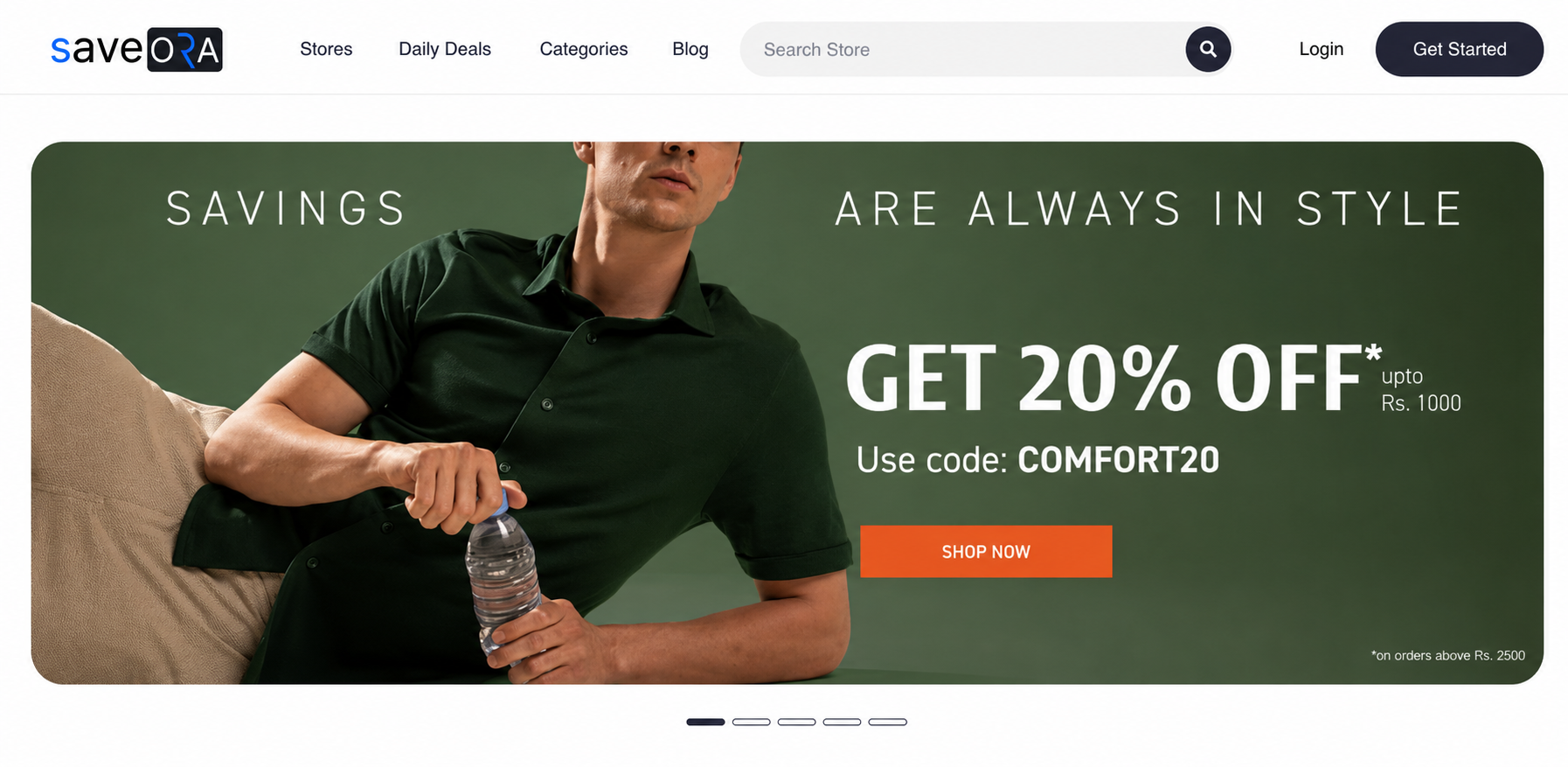
An honest, deeply researched review of Saveora covering how cashback works, the stores and rates, the withdrawal threshold, the payout question every cashback site lives or dies on, and the verdict on whether it deserves your clicks
Thank you for reading this post, don't forget to subscribe!Published by brands.run | The independent brand review hub
Reviewed Brand: Saveora | Sector: Cashback and Coupons | Founded: 2022 | Headquarters: India | Website: saveora.com
Saveora is an Indian cashback and coupons platform founded in 2022. It aggregates cashback offers, coupon codes, and deals from hundreds of online stores, letting shoppers click through Saveora to retailers like Amazon, Flipkart, Myntra, and Nykaa and earn cashback on what they buy, withdrawable to their bank once it reaches 500 rupees. The service is free to use. This review is part of brands.run’s independent brand reviews, and it sits alongside our coverage of value shopping platforms like Meesho.
That’s the promise. This review tests it, and it’s measured, because cashback sites live or die on one thing that a new site cannot yet prove.
It’s built in three parts. Part 1, The Expose, covers what Saveora actually is beneath the marketing: how cashback sites really make money, the affiliate model behind the cashback, the stores and rates, the withdrawal threshold, and how earning and withdrawing actually work. Part 2, The Autopsy, examines what works and what to scrutinize: the single question of whether cashback reliably tracks and pays out, the early-stage and unfunded reality, the near-total absence of independent reviews, the trust problems that affect the entire cashback category even at its biggest players, and what you cannot verify. Part 3, The Killcritic, is the verdict: who Saveora suits, who should look elsewhere, and how it compares to established cashback sites like CashKaro and to simply shopping directly.
If you’re considering using Saveora to earn cashback on your shopping, this is the honest version, written to protect your time and your expectations rather than to earn a referral.
| Review Methodology This review draws on the Saveora website and its own materials, company data from Tracxn and Crunchbase, the mechanics of how affiliate cashback platforms operate, customer experience patterns across the Indian cashback category including established players, and the competitive landscape. Self-reported figures and claims are labeled as company-stated. The near-absence of independent Saveora reviews, and the resulting inability to verify payout reliability, are noted plainly. Figures reflect publicly available information as of June 2026 and may change. |
Part 1: The Expose
The expose strips away the marketing. What is Saveora, how does it actually make money, what does it offer, and what are you really signing up for when you shop through it.
What Saveora Actually Is
Saveora is a cashback and coupons aggregator. You visit Saveora, find the store you want to shop at, click through Saveora’s link to that store, and shop as normal. Because you went through Saveora, the retailer pays Saveora a commission, and Saveora passes part of that back to you as cashback. Saveora also lists coupon codes and deals you can use at checkout for additional savings. The cashback accumulates in your Saveora account, and once it reaches 500 rupees, you can withdraw it to your bank.
In plain terms, Saveora is a middle layer between you and the online stores you already shop at. It does not sell products itself. It earns a commission for sending you to retailers and shares some of that commission with you as an incentive to shop through it. The coupons and deals are an added draw. Its motto, Save Big with Saveora, sums up the pitch: shop the same things, save a bit extra.
So Saveora is an affiliate-based savings platform. Understanding that affiliate model, covered next, is essential, because it explains both how the cashback is funded and why cashback sometimes fails to materialize, which is the central issue this review examines.
How Cashback Sites Actually Make Money
To judge Saveora, you need to understand the affiliate model that powers every cashback site, because it determines how reliable the cashback can be.
Cashback sites are affiliate marketers. They sign up to retailers’ affiliate programs and get unique tracking links. When you click a retailer’s link on the cashback site and then make a purchase, the retailer’s system records that the sale came from the cashback site and pays it a commission, often a few percent of your order. The cashback site keeps part of that commission as its revenue and gives the rest to you as cashback. That’s the entire business: earn commission for referring sales, share some of it to attract shoppers.
This model has a critical dependency: tracking. For you to get cashback, the retailer must correctly record that your purchase came through the cashback site’s link. That tracking relies on cookies and the affiliate link working properly, and it can fail for many reasons, an ad blocker, opening other tabs, using a different coupon, an app intercepting the link, or a cookie issue. When tracking fails, the retailer does not credit the cashback site, the cashback site does not get paid, and so it cannot pay you. This is why cashback so often does not materialize, and it’s a structural feature of the model, not unique to Saveora. The honest implication is that cashback is never guaranteed; it’s conditional on tracking and on the retailer ultimately paying, which is the root of most cashback frustration.
The Company Behind Saveora
Saveora was founded in 2022 and is based in India. According to startup database Tracxn, it’s an unfunded company, meaning it has not raised venture capital. Its listed competitors include established cashback players like CashKaro, Rakuten, and ShopBack.
Two facts shape how to read Saveora. First, it’s young, founded in 2022, which makes it a relatively new entrant in a category where the established players have operated for over a decade. Second, it’s unfunded and appears to be a small operation, without the capital backing of the larger cashback platforms. Neither is automatically a problem, but together they matter for the one thing that counts most on a cashback site: the financial reliability to consistently pay out cashback over time. A cashback site is, in effect, holding a promise to pay you money once conditions are met, and the strength of that promise depends partly on the company’s stability and longevity, which a young, unfunded site has not yet demonstrated.
The Stores, Brands, and Categories
Saveora’s value depends on the range and rates of stores it covers, and it lists a broad selection.
The company states it covers over 1,200 stores and thousands of products across categories including fashion and accessories, footwear, handbags, baby and kids products, beauty and personal care, health, travel, entertainment, electronics, home and kitchen, home decor, and sports. It lists cashback and coupons for major marketplaces including Amazon, Flipkart, Myntra, Ajio, Nykaa, and Firstcry, and for brands such as boAt, The Souled Store, Giva, Dot and Key, Noise, Syska, Croma, Shoppers Stop, Nike, Adidas, The Man Company, Ustraa, Beardo, Biba, Biotique, Cleartrip, Cashify, and food platforms like Swiggy, Zomato, and Dominos.
This is a wide catalog on paper, covering most of the popular online retailers an Indian shopper uses. The honest caveats are two. First, store coverage and exact cashback rates change constantly across all cashback sites as affiliate deals come and go, so the live rate on the day matters more than any headline list. Second, breadth of listed stores is not the same as competitive rates or reliable tracking at those stores, which is what actually determines your savings. The catalog tells you Saveora covers the stores you shop at; whether it delivers better value than alternatives is a separate question the autopsy addresses.
Cashback vs Coupons vs Deals: The Three Savings Types
Saveora offers three different savings mechanisms, and they work differently, so it’s worth separating them clearly.
- Cashback: A percentage of your purchase returned to your Saveora account after you shop through Saveora’s link, withdrawable to your bank once it reaches the threshold. This is conditional on tracking and confirmation, and is the part
that can fail to materialize. - Coupons and promo codes: Codes you enter at the retailer’s checkout for an immediate discount. These work at the point of sale and are not dependent on Saveora’s tracking, so they’re more reliable, though using certain coupons can sometimes void cashback eligibility.
- Deals: Curated offers and discounts, including Saveora’s Deal of the Day, highlighting the best current discounts across stores. These are essentially pointers to good prices rather than a Saveora-specific reward.
The practical distinction matters. Coupons give you a guaranteed, immediate discount at checkout, which is the most reliable form of saving. Cashback is a delayed, conditional reward that may or may not arrive. Deals are just curated discounts. For a shopper, the most dependable value from any cashback site is often the coupon codes and deal curation, while the cashback itself is the uncertain part. Understanding which is which helps you set realistic expectations and capture the reliable savings even if the cashback is hit or miss.
How to Earn Cashback on Saveora
The earning process, step by step, with the points where it commonly breaks.
- Create a free Saveora account, which you need in order to track and accumulate cashback.
- Before shopping, visit Saveora and find your store. Disable any ad blocker, which Saveora explicitly warns can prevent tracking.
- Click through Saveora’s link to the retailer. This sets the tracking that attributes your purchase to Saveora.
- Shop and complete your purchase on the retailer’s site in that same session, ideally without opening other tabs or applying outside coupons that could break tracking.
- Wait for the cashback to appear as pending in your Saveora dashboard, which can take time to register.
- Wait for it to be confirmed, which typically happens only after the retailer’s return or cancellation window closes, since cashback on returned items is reversed.
- Once your confirmed cashback reaches 500 rupees, withdraw it to your bank.
The steps where cashback most often fails are the click-through and the purchase session: if tracking does not set or is broken by an ad blocker, another tab, or an app, the cashback never registers. The confirmation step is where delays live, since you wait out the return window. Following the process precisely, especially disabling ad blockers and completing the purchase cleanly in one session, gives cashback the best chance of tracking, though even then it’s not guaranteed.
| How to Give Cashback the Best Chance of Tracking Disable ad blockers before clicking through. Clear your cart and wishlist first. Click through Saveora immediately before purchasing, and complete the purchase in the same session without opening other cashback links or tabs. Avoid applying coupon codes from outside Saveora that may void eligibility. Keep a record of your order. Even done perfectly, tracking can fail, so treat cashback as a bonus, not a guaranteed discount. |
The Withdrawal Process and the 500 Rupee Threshold
Getting your cashback out is the moment that matters most, and Saveora has a threshold you should understand.
Saveora states that you can withdraw your earned cashback to your bank account once it reaches 500 rupees. Below that threshold, the cashback sits in your account, accumulated but not yet withdrawable. This minimum-payout model is standard across cashback sites, which use thresholds to reduce transaction costs and, in practice, to retain balances.
The threshold carries a specific risk that’s central to evaluating a young cashback site. Because you must accumulate 500 rupees in confirmed cashback before withdrawing, you’re effectively extending credit to the platform: it holds your earned cashback until you reach the threshold. If the site fails to confirm cashback, delays payouts, or, in the worst case for a young unfunded company, ceases operating, accumulated but unwithdrawn cashback can be lost. The practical guidance is to withdraw as soon as you reach the threshold rather than letting a large balance build up, and to weigh how much unconfirmed and unwithdrawn cashback you’re comfortable having tied up in an unproven platform at any time.
Deal of the Day and Curated Offers
Saveora promotes a Deal of the Day feature and curated deal sections, which are worth understanding as a distinct part of the offering.
Deal of the Day highlights selected offers with the highest current discounts, and the curated deal sections group the best available cashback and coupon offers across stores. The value here is discovery and convenience: rather than hunting across multiple retailers, you see surfaced deals in one place. This is essentially editorial curation of existing retailer discounts, pointing you to good prices.
For a shopper, deal curation is a genuine convenience and one of the more reliable parts of a cashback site, because it surfaces real, immediate discounts rather than conditional cashback. The honest note is that deal curation is also the easiest feature for any site to offer, and the same or better curation exists on many deal and coupon sites and within the retailers’ own sale sections. It’s useful, but it’s not unique to Saveora, and it doesn’t depend on the cashback mechanics that carry the real uncertainty.
Refer and Earn and Share and Earn
Saveora offers Refer and Earn and Share and Earn programs, which are common growth features on cashback platforms.
These programs reward you for bringing in new users, typically giving you a bonus or a share of referred users’ activity. They’re a standard way cashback sites grow, turning users into promoters. For an active user, referral programs can add modest earnings on top of cashback.
The honest framing is the same as for any referral-driven platform: referral incentives create a motivation for existing users and bloggers to promote the site enthusiastically, which shapes the positive content you may find about it. Using the referral program is fine, but be aware it also funds some of the promotion you’ll encounter. And as with the cashback itself, any referral earnings are subject to the same accumulation, confirmation, and withdrawal conditions, so they carry the same reliability questions as the core cashback.
Is Saveora Free, and What Is the Catch
Saveora is free to use, and it’s worth being clear about what that means and where the genuine trade-offs lie.
There’s no fee to use Saveora; you don’t pay to access cashback or coupons. The site makes its money from the affiliate commissions described earlier, keeping part and sharing part with you. So unlike some questionable cashback services elsewhere that charge hidden subscription fees, Saveora’s model is the standard, legitimate, free affiliate-cashback approach, where the site is paid by retailers, not by you.
The catch is not a hidden fee; it’s the conditions and reliability. The real costs of using Saveora are the friction of clicking through and following tracking rules, the data you share by creating an account and routing your shopping through the platform, the requirement to disable ad blockers, and above all the uncertainty of whether cashback will actually track, confirm, and pay. Free does not mean risk-free; it means the risk is your time and your unrealized cashback rather than an upfront charge. For a young, unproven platform, that reliability risk is the real consideration, which the autopsy examines directly.
How Saveora Compares to a Cashback Browser Extension
Some cashback services work through browser extensions that activate automatically, and it’s worth understanding the difference as a user.
A browser-extension cashback tool detects when you’re on a partner retailer and prompts you to activate cashback with a click, removing the need to remember to visit a cashback site first. A site-based model like Saveora requires you to deliberately start at Saveora and click through before shopping. The extension approach is more convenient and reduces forgotten-cashback losses, while the site approach requires more discipline but avoids installing an extension that monitors your browsing.
For a shopper, the trade-off is convenience versus browsing privacy and control. If Saveora is primarily site-based, you need to build the habit of starting at Saveora before every relevant purchase, which is the most common reason people miss cashback, simply forgetting to click through first. Whichever model you use, the underlying affiliate-tracking dependency and the payout-reliability question are the same. The delivery method affects convenience, not the fundamental reliability of whether cashback ultimately pays.
The Cashback Lifecycle: Pending, Confirmed, and Paid
Cashback does not arrive instantly, and understanding its lifecycle prevents the confusion and frustration that drive many cashback complaints.
Cashback moves through stages. First, pending: after your tracked purchase, the cashback appears in your account as pending, meaning it’s been registered but not yet validated. Second, confirmed: once the retailer validates the sale and the return or cancellation window has passed, the cashback is confirmed and becomes eligible for withdrawal. This wait exists because if you return the item, the sale is reversed and the cashback with it, so platforms wait out the return window before confirming. Third, paid: once confirmed cashback reaches the withdrawal threshold, you transfer it to your bank. The whole cycle, from purchase to withdrawable cash, commonly takes weeks to a couple of months.
The lifecycle is where two distinct problems live, and you should watch for both on any platform, especially an unproven one. The first is cashback that never moves past pending, or never appears at all, which signals a tracking failure. The second is cashback that sits confirmed but is slow or difficult to withdraw, which signals a payout problem. On an established platform, you can gauge how often each happens from user reports; on Saveora, you cannot, so the practical step is to watch your own pending cashback closely and confirm it progresses to confirmed and then to your bank, treating any stall as a signal to lower your reliance on the platform.
Understanding Cashback Rates and What They Really Mean
Cashback rates are the headline numbers cashback sites advertise, and they’re widely misunderstood, so it’s worth being precise about what they actually deliver.
A cashback rate is the percentage of your purchase the site returns, funded from the commission the retailer pays it. Rates vary widely by store and category, often low single-digit percentages for big marketplaces like Amazon and Flipkart, and sometimes higher for specific brands or categories. Crucially, the advertised rate is the maximum on eligible items, and exclusions are common: certain products, categories, or payment methods may earn reduced cashback or none. The effective rate you actually realize is lower than the headline, reduced by exclusions and, more importantly, by the tracking failures that mean some purchases earn nothing at all.
For a realistic view, mentally discount advertised cashback rates substantially. Between exclusions, the wait for confirmation, and tracking losses, the cashback you actually bank over time is well below the headline percentages. This is true across all cashback sites, and it’s why cashback is best seen as a modest bonus rather than a reliable discount. On Saveora specifically, combine this general gap with the unverified payout reliability, and the prudent expectation is that realized cashback will be both modest and uncertain. Always check the live rate and exclusions for your specific store and item rather than trusting a headline figure.
Cashback on Travel, Food, and Recharges
Saveora lists cashback and deals beyond physical products, including travel, food delivery, and similar services, and these categories have their own characteristics worth understanding.
Travel bookings through platforms like Cleartrip, and food and lifestyle services like Swiggy, Zomato, and Dominos, can carry cashback or offers on a cashback site. These categories can involve larger transaction values, especially travel, which makes the potential cashback more significant, but also raises the stakes if tracking fails on a big booking. Food and recharge offers tend to be smaller and more frequent. The terms, exclusions, and confirmation timelines for these categories can differ from physical-product shopping, and travel in particular often has longer confirmation periods tied to the completion of the trip.
The practical guidance mirrors the rest of this review. For high-value travel bookings, the risk of tracking failure or non-payment on a large cashback amount is exactly where an unproven platform is least suitable; use a proven service or book directly for important travel. For small, frequent food or recharge offers, the stakes are low enough to try, treating any cashback as a minor bonus. As always, the reliable value is in clear, immediate discounts and coupons rather than conditional cashback, particularly on a platform without a track record.
Do You Pay Tax on Cashback in India
Cashback has tax implications that shoppers often overlook, and it’s worth a clear note since it affects the real value of cashback earnings.
In general terms, the tax treatment of cashback in India depends on its nature and amount. Cashback that functions as a discount on a purchase is typically treated differently from cashback or rewards received without a corresponding purchase, and there are thresholds and rules under Indian tax law concerning gifts and benefits. For most shoppers earning modest cashback as a discount on personal purchases, the practical impact is usually limited, but larger cashback or reward earnings can have tax considerations.
This review is not tax advice, and the rules are nuanced and subject to change. The honest, practical point is simply to be aware that cashback is not always entirely free in a tax sense, particularly at higher amounts, and that if you earn significant cashback or rewards across platforms, it’s worth understanding the current tax position or consulting a tax professional. For typical low-value cashback on everyday shopping, this is a minor consideration, but it’s part of an honest picture of what cashback is really worth.
How to Maximize Cashback Safely
For those who do use cashback sites, there are sensible ways to maximize the reliable value while limiting the risks, applicable to Saveora and any platform.
- Prioritize coupons and immediate discounts: These are certain and instant, unlike conditional cashback. Capture them first.
- Compare rates across platforms: Cashback rates for the same store differ across sites and over time. Check a couple of established platforms for the best live rate rather than assuming one site is always best.
- Follow tracking rules every time: Disable ad blockers, clear your cart, click through immediately, and complete the purchase in one clean session.
- Withdraw promptly: Take confirmed cashback out as soon as you hit the threshold, especially on unproven platforms, rather than building a balance.
- Keep records: Save order confirmations so you can raise a missing-cashback claim if tracking fails, which it sometimes will.
- Use proven platforms for meaningful cashback: Reserve large or important cashback for established sites with a payout history, and treat unproven sites as low-stakes extras.
Applied together, these habits let you capture the reliable savings, mostly coupons and deals, while limiting your exposure to the uncertain cashback, which is the sensible way to use any cashback site. On Saveora specifically, they let you test it safely at low stakes without over-relying on an unproven payout record.
Customer Support and Dispute Handling
When cashback goes wrong, and across the category it sometimes does, customer support and the missing-cashback claim process become critical, so it’s worth understanding what to expect.
Cashback sites generally provide a way to raise a claim when cashback fails to track, asking you to submit order details so they can investigate with the retailer. The quality and speed of this process vary widely across platforms, and slow or unhelpful support is one of the most common complaints in the category, even at large players. On an established site, you can gauge support quality from user reports; on Saveora, with almost no reviews, the responsiveness and fairness of its support and claims process are unknown. This matters because the claims process is your only recourse when tracking fails, which it inevitably does on some purchases.
The practical guidance is to keep thorough records of every purchase you expect cashback on, including order confirmations and the date and path of your click-through, so you can raise a claim if needed. Test the support process early with a small claim if cashback fails to track, to learn how responsive it is before relying on the platform. On any cashback site, but especially an unproven one, treat the existence and quality of recourse as part of what you’re evaluating, since cashback that fails to track with no effective way to claim it is simply lost.
The Honest Place for Saveora in Your Shopping
Pulling the expose together before the autopsy, it helps to frame honestly where a platform like Saveora sensibly fits for a shopper today.
Saveora is best understood as one optional, low-stakes tool among several for saving money online, valued mainly for its immediate, reliable features, the coupon codes and curated deals, with its cashback treated as an unproven bonus rather than a dependable saving. It sits alongside, not above, the more reliable savings methods: buying at truly good prices, using immediate discounts, and capturing the automatic cashback your cards and bank already provide. For a shopper building a sensible savings approach, the reliable foundations come first, and a young cashback site like Saveora is an extra to test cautiously at the edges.
This framing is not dismissive; it’s realistic. Plenty of shoppers use cashback sites and capture real value over time, particularly on proven platforms. The honest point for Saveora specifically is that, as an unproven newcomer in a trust-sensitive category, it has not yet earned a central place in anyone’s savings routine, and the prudent approach is to let it prove its payout reliability through your own low-stakes testing before trusting it with more. With that framing set, the autopsy examines exactly how much trust the available evidence supports.
Part 2: The Autopsy
The autopsy weighs the strengths honestly against the central uncertainty. Saveora has a legitimate model and a free, broad offering, and it also has the one weakness that matters most for a cashback site: no track record to prove it reliably pays. Both sides are laid out plainly, because for a cashback site, payout reliability is the entire point.
What Saveora Gets Right
The strengths are real and worth crediting.
A Legitimate, Free Model
Saveora uses the standard, legitimate affiliate-cashback model, funded by retailer commissions rather than user fees. It does not charge hidden subscriptions, which separates it from the truly predatory cashback services that do. Free and legitimately structured is a real baseline positive.
Broad Store and Brand Coverage
On paper, Saveora covers over 1,200 stores and most popular Indian marketplaces and brands, from Amazon and Flipkart to Nykaa, Myntra, and food delivery. For a shopper, the stores you actually use are likely listed.
Multiple Savings Types in One Place
Combining cashback, coupon codes, and curated deals, including a Deal of the Day, gives shoppers several ways to save and a single place to check before buying.
Low Direct Financial Risk
Because Saveora is free and you never deposit money, your direct financial risk is limited. The worst typical case is that cashback fails to track and you simply don’t earn the bonus you hoped for, not that you lose your own money. This substantially lowers the stakes compared with platforms that hold deposits.
Reliable Coupon and Deal Value
The coupon codes and deal curation deliver immediate, dependable discounts that don’t rely on the uncertain cashback tracking, so there’s real, capturable value even setting the cashback aside.
These strengths make Saveora a legitimate, low-risk thing to try. The rest of the autopsy is about the uncertainty that determines whether it’s actually worth relying on, which you should weigh just as honestly.
The Payout Question Every Cashback Site Lives or Dies On
Here is the central issue, and for a cashback site it’s the only one that ultimately matters: does the cashback reliably track, confirm, and pay out. For Saveora, the honest answer is that there’s no way to know yet, and that uncertainty is the core of this review.
A cashback site’s entire value is the cashback actually reaching your bank. A site can list thousands of stores and attractive rates, but if cashback fails to track, gets stuck as pending forever, is denied on the grounds that the retailer did not pay, or is slow to confirm and withdraw, the listed rates are meaningless. Across the whole Indian cashback category, these failures are the dominant complaint, and they happen even at the largest, most established platforms. The difference is that established platforms have years of track record, millions of users, and a visible body of feedback that lets you gauge how often they pay versus fail. Saveora, founded in 2022 and small, has none of that visible track record, so its payout reliability is simply unproven.
This is the heart of the matter. With an established cashback site, you can read years of user experiences to judge whether payouts are reliable enough to be worth the effort. With Saveora, you cannot, because that body of evidence does not exist. You would be trusting an unproven platform to honor conditional cashback over time, with no track record to justify that trust. That’s not an accusation that Saveora fails to pay; it’s the honest statement that no one can yet verify that it reliably does, which for a cashback site is the difference between a confident recommendation and a cautious one.
| The Core Uncertainty Saveora’s entire value depends on cashback reliably tracking, confirming, and paying out. As a young, small platform founded in 2022 with almost no independent user reviews, its payout reliability cannot be verified. This is not evidence that it fails to pay, but it means you cannot confirm that it reliably does, which is the one thing that matters most on a cashback site. Treat any cashback as an unproven bonus, withdraw promptly, and do not route large or important purchases through it expecting guaranteed returns. |
The Missing Review Base
Compounding the payout question is the near-total absence of independent reviews. Despite operating since 2022, Saveora has very little visible, independent user feedback on the major review platforms where shoppers vet services.
There’s no substantial body of Trustpilot reviews, app store feedback, or independent coverage describing real users’ experiences with Saveora’s tracking, confirmation, and payouts. Searches for Saveora reviews surface its competitors and the general cashback category rather than detailed Saveora user experiences. This means the most important evidence you’d normally use to evaluate a cashback site, what real users say about whether they actually got paid, does not exist in any meaningful quantity for Saveora.
This matters enormously for a cashback site specifically. For many products, you can assess quality directly. For a cashback site, the quality is the payout reliability, which you can only learn from other users’ experiences over time. With that evidence missing, you’re left with the company’s own claims, including its self-description as a legitimate source of cashback, which is marketing, not verification. The honest position is that the absence of reviews is not proof of a problem, but it removes the single most useful tool for judging a cashback site, and it’s a strong reason for caution and for keeping your exposure small until the platform proves itself.
The Early-Stage and Unfunded Reality
Saveora’s youth and lack of funding matter more for a cashback site than they would for many other businesses, because of how cashback works.
A cashback site holds an ongoing obligation to pay users money once conditions are met, funded by commissions it collects from retailers, often on a delay. This creates a working-capital and longevity dependency: the site must remain solvent and operating long enough to collect commissions and pay out the cashback it owes, sometimes months after the purchase. A young, unfunded company has less financial cushion to weather delays in retailer payments, disputes, or lean periods, and a higher risk of changing terms, scaling back, or ceasing operations than a well-funded, established platform. If that happens, users’ accumulated, unwithdrawn cashback is at risk.
This is not a prediction that Saveora will fail; many small businesses operate sustainably. It’s an honest assessment that the financial stability underpinning a cashback site’s promise to pay is less established at a young, unfunded company, and that this specifically raises the risk around accumulated cashback. It reinforces the practical guidance to withdraw promptly and keep your tied-up balance small, treating Saveora as a place to capture occasional bonuses rather than to bank meaningful accumulated cashback over time.
The Unverifiable Claims
Saveora makes several marketing claims that warrant honest scrutiny, because they’re presented as facts but cannot be independently verified.
The site describes itself as a legitimate source of earning cashback and, in its materials, as among the best cashback sites in India, and cites figures like thousands of products, over 1,200 stores, and discounts up to 80 percent. The self-description as legitimate is an assertion, not proof; every cashback site, including questionable ones, describes itself as legitimate, so the label carries no independent weight. The best in India framing is marketing in a category with far larger, more established players. The up to 80 percent figure refers to maximum possible discounts on select items, not typical savings, and headline maximums are standard marketing across deal sites. The store and product counts are company-stated and change constantly.
None of this means the claims are false. It means they’re unverified marketing that you should discount in favor of concrete evidence. The honest approach is to ignore the superlatives and the maximum-discount figures, and judge Saveora on what you can actually test: whether the stores you use are listed at competitive live rates, and, crucially, whether cashback tracks and pays for you in practice on small purchases before you rely on it. A company’s claim to be legitimate and best matters far less than whether it pays, which only your own small-scale testing and, over time, other users’ experiences can establish.
The Ad Blocker and Tracking Fragility
Saveora, like cashback sites generally, requires you to disable ad blockers for tracking to work, and this points to a broader fragility worth understanding.
The need to disable ad blockers reflects how dependent cashback tracking is on cookies and scripts that ad blockers and privacy tools interfere with. Beyond ad blockers, tracking can break from using multiple tabs, switching between apps and browsers, existing cookies, applying outside coupons, or simply a retailer’s tracking hiccup. This fragility means that even when you intend to earn cashback and follow the rules, a meaningful share of purchases may not track, and the cashback never appears. This is inherent to the affiliate model and affects all cashback sites, not just Saveora.
The practical implications are twofold. First, you must actively manage tracking, disabling ad blockers and shopping cleanly, which is friction. Second, even diligent users lose some cashback to tracking failures, so the effective cashback you earn is lower than the advertised rates suggest. For Saveora specifically, this general fragility combines with its unproven payout reliability to make the realistic expected value of its cashback uncertain and likely lower than the headline rates. Capture the reliable coupons and deals, follow tracking rules for cashback, but expect tracking losses as a normal part of the experience.
What You Cannot Verify From Outside
In the interest of honesty, here is what this review, or any external review, cannot confirm about Saveora, and which you should therefore approach with caution.
- Whether cashback reliably tracks, confirms, and pays out, since there’s almost no independent user evidence.
- How often cashback is denied, delayed, or stuck, and how disputes are handled.
- The company’s financial stability and longevity as a young, unfunded platform.
- Whether the listed cashback rates are competitive and current versus established alternatives.
- How user data routed through the platform is handled and protected.
This is not a list of proven problems; it’s a list of unknowns that, for a cashback site, happen to include the most important factor of all, payout reliability. A review can tell you Saveora has a legitimate model, is free, and shows no evidence of being a scam, which is a reasonable starting point. It cannot tell you whether it will reliably pay your cashback, which only your own small-scale testing and the passage of time can establish. Until then, caution and small exposure are the rational approach.
Part 3: The Killcritic
The killcritic is the verdict. Who Saveora suits, who should look elsewhere, and how it compares to the alternatives.
Who Saveora Is For
Saveora can suit specific users willing to approach it the right way.
Bargain Hunters Who Like to Try New Tools
If you enjoy hunting for savings and don’t mind testing an unproven platform with low stakes, Saveora’s free coupons, deals, and potential cashback are worth a try on small purchases, with realistic expectations about cashback reliability.
Coupon and Deal Seekers
If your main interest is immediate coupon discounts and curated deals rather than delayed cashback, Saveora’s more reliable coupon and deal features can add value, since these don’t depend on the uncertain cashback tracking.
Shoppers Already Buying From Listed Stores
If you regularly shop at the marketplaces and brands Saveora lists, clicking through costs little extra effort, and any cashback that does track is a bonus on purchases you’d make anyway, provided you withdraw promptly.
Those Comfortable Withdrawing Promptly and Keeping Balances Small
If you’re willing to treat cashback as an occasional bonus, withdraw as soon as you hit the threshold, and avoid letting balances accumulate on an unproven platform, Saveora’s risks are manageable for low-stakes use.
For these users, Saveora is a reasonable low-stakes addition to a savings toolkit, valued mainly for coupons and deals with cashback as an unproven bonus, not as a primary or trusted cashback platform.
Who Should Look Elsewhere
Other users should prefer established alternatives.
Anyone Relying on Cashback as Real Savings
If you want cashback you can count on as part of your budgeting, an unproven platform with no payout track record is the wrong choice. Use an established cashback site with years of verifiable payout history instead.
Shoppers Making Large or Important Purchases
For a big-ticket purchase where the cashback would be substantial, do not route it through an unproven platform expecting reliable returns. The risk of tracking failure or non-payment on a large cashback amount is not worth it; use a proven site or shop directly.
Those Who Won’t Manage Tracking
If you won’t reliably disable ad blockers and shop cleanly through the cashback link every time, you’ll lose most cashback to tracking failures, making the effort pointless. A simpler approach may suit you better.
Privacy-Conscious Shoppers
If you’re uncomfortable routing your shopping through an unproven platform, sharing the associated data, and disabling ad blockers, the modest potential cashback may not justify it.
Saveora vs CashKaro
The most direct comparison is against CashKaro, India’s largest and most established cashback platform.
| Factor | Saveora | CashKaro |
| Founded | 2022 | Around 2011 |
| Scale and funding | Small, unfunded | Large, well-funded |
| Track record | Unproven | Years, millions of users |
| Independent reviews | Almost none | Extensive, mixed |
| Payout history | Unverifiable | Visible, with known issues |
| Direct financial risk | Low, free | Low, free |
| Best for | Low-stakes trial | Proven, mainstream use |
CashKaro wins decisively on track record, scale, and the existence of a verifiable payout history, even though that history includes its own complaints about tracking failures, delayed confirmation, and account issues. The honest point is that even the established leader has cashback reliability problems, which underlines how hard reliable cashback is, and how much riskier it is on an unproven newcomer. For mainstream cashback use, an established platform with a visible track record is the safer default. Saveora is, at best, a low-stakes alternative to try, not a replacement for a proven site.
Saveora vs Other Cashback Sites
India has several established cashback and coupon platforms beyond CashKaro, including EarnKaro, GoPaisa, PaisaWapas, CouponDunia, and Magicpin, each with years of operation and visible user bases.
All of these established alternatives share the advantage Saveora lacks: a track record you can evaluate. They’ve operated long enough to accumulate user feedback on payout reliability, even if that feedback is mixed, which it generally is across the whole category. Against any of them, Saveora’s disadvantage is the same, an unproven payout history, and its potential advantage would only be specific rates or coupons on a given purchase on a given day. The honest guidance is to default to an established platform for cashback you care about, and to use Saveora, if at all, opportunistically for a specific better coupon or deal, with cashback treated as an unproven bonus. When choosing any cashback site, prioritize verifiable payout reliability over headline rates, because a slightly higher rate that never pays is worth nothing.
Saveora vs Bank and Credit Card Cashback
An often-overlooked alternative to cashback sites is the cashback already built into many Indian credit cards and bank offers, and it’s worth an honest comparison.
Many credit cards offer cashback or reward points on spending automatically, and banks run their own offers with partner merchants, all without the tracking friction of a cashback site. The cashback is applied through your card or bank, which you already trust and which has a clear track record, and it doesn’t depend on clicking through a third-party link or disabling ad blockers. The trade-off is that card and bank cashback is tied to your specific card’s rates and partner offers, which may be lower or narrower than a cashback site’s headline rates on a given purchase.
For many shoppers, card and bank cashback is the more reliable foundation, because it’s automatic, comes from an institution with a payout track record, and carries none of the tracking uncertainty. A cashback site like Saveora would, at best, stack on top of that for extra savings on specific purchases, and only reliably so on a proven platform. The honest guidance is to make sure you’re capturing the automatic cashback your card and bank already offer, which is dependable, before chasing uncertain extra cashback on an unproven site. The combination of reliable card cashback plus immediate coupons often beats betting on conditional cashback from a newcomer.
Saveora vs EarnKaro and GoPaisa
Beyond CashKaro, EarnKaro and GoPaisa are other established Indian cashback options worth comparing directly.
EarnKaro, from the same company as CashKaro, focuses on a share-and-earn model where users share deal links and earn, and it has the backing and track record of an established operation. GoPaisa is another long-running cashback and coupons platform with years of operation and a visible user base. Against both, Saveora’s position is the same as against CashKaro: it lacks the track record that lets you evaluate payout reliability. EarnKaro and GoPaisa, whatever their individual strengths and the category’s general reliability issues, have operated long enough to be assessed from real user feedback, which Saveora has not. For a shopper choosing where to route cashback, the established options offer the crucial advantage of being verifiable, while Saveora remains an unproven alternative best used, if at all, for a specific better coupon or deal rather than for cashback you rely on.
Saveora in the Context of Value Shopping
Saveora fits within a broader landscape of value-focused shopping in India, and it’s worth placing it in that context for shoppers trying to save.
Indian shoppers chasing value have several distinct tools: value-first marketplaces that sell cheap goods directly, like the platforms covered in our Meesho review; cashback and coupon sites like Saveora that add savings on top of shopping at mainstream stores; card and bank offers; and seasonal sales. These serve different needs. A value marketplace gives you inherently low prices on its own catalog. A cashback site gives you a potential rebate on purchases at stores you already use. They’re complementary rather than competing.
Understanding where Saveora fits helps set expectations. It is not a store and does not offer its own low prices; it’s a layer that attempts to return a small percentage on purchases elsewhere. For a value-conscious shopper, the reliable savings come from buying at truly competitive prices, using immediate coupons, and capturing automatic card cashback, with a cashback site as an optional extra. Saveora can play that optional-extra role, but as an unproven platform, it should sit at the low-stakes edge of a value-shopping toolkit, not at its center. The core of saving money online remains buying well and using certain, immediate discounts.
Saveora vs Shopping Directly
The most important comparison is against not using a cashback site at all, and simply shopping directly or using coupons you find independently.
The Effort and Reliability Trade-Off
Shopping directly is simpler and avoids tracking friction, ad blocker requirements, and the uncertainty of conditional cashback. You forgo potential cashback, but you also avoid the effort and the disappointment of cashback that doesn’t track. For many shoppers, especially on small purchases, the realistic expected cashback is not worth the friction and uncertainty.
When a Cashback Site Adds Value
A cashback site adds real value when it reliably pays meaningful cashback on purchases you’d make anyway, which is why a proven platform with a track record is worth using. The value depends entirely on reliability, which Saveora has not established. Coupons and deals, however, add value immediately and can be found on Saveora or many other sources.
The Honest Call
For reliable savings, use independently found coupons and deals, which are immediate and certain, and add an established cashback site if you want cashback you can count on. Saveora can supplement this as a low-stakes option to check for a better coupon or an occasional bonus, but it shouldn’t replace either a proven cashback platform or the simple discipline of finding good prices directly. Match your effort to the realistic, reliable savings, not to the advertised maximums.
The Final Verdict
| Saveora Final Rating: 3 / 5 A legitimate, free cashback and coupons aggregator with a real affiliate model, broad store coverage, and low direct financial risk, held back by the one thing that matters most for a cashback site: an unproven, unverifiable payout record, as a young 2022 platform with almost no independent reviews, in a category where reliable cashback is hard even for established leaders. Fine to try at low stakes for its coupons and deals, with cashback as an unproven bonus, but not a substitute for an established cashback site for savings you actually rely on. |
Use Saveora if you’re a low-stakes bargain hunter who values its coupons and curated deals, you already shop at its listed stores, and you’ll treat any cashback as an unproven bonus, withdraw promptly when you hit the 500 rupee threshold, and keep your accumulated balance small.
Look elsewhere if you rely on cashback as real savings, you’re making large or important purchases where reliable cashback matters, you won’t manage tracking carefully, or you’d rather not route your shopping through an unproven platform. For dependable cashback, an established site with a visible payout history is the safer choice, even with its own known issues.
Saveora’s model is legitimate, the service is free, and there’s no evidence it’s a scam, which is a fair baseline. But a cashback site is only as good as its payouts, and a young, unfunded platform with no verifiable track record and almost no independent reviews cannot yet prove it reliably pays, which is the one thing that matters most. The honest caveats are not accusations; they’re the genuine uncertainty of trusting an unproven cashback site with conditional rewards. Capture its reliable coupons and deals, test cashback only at low stakes, withdraw promptly, and keep an established platform for cashback you count on. The 3 out of 5 reflects a legitimate, low-risk, but entirely unproven cashback site, outclassed on reliability by established alternatives, balanced honestly.
Frequently Asked Questions
This section answers the specific questions shoppers search for about Saveora. Each answer is structured for direct factual extraction.
Is Saveora legit or a scam?
Saveora uses the standard, legitimate affiliate-cashback model and is free, funded by retailer commissions rather than user fees, with no evidence of being a scam. However, legitimate does not mean proven. As a young 2022 platform with almost no independent reviews, its payout reliability, the thing that matters most for a cashback site, cannot be verified. Treat it as legitimate but unproven, test cashback at low stakes, and withdraw promptly.
Is Saveora free to use?
Yes, Saveora is free. You don’t pay anything to use its cashback, coupons, or deals. It makes money from affiliate commissions paid by retailers when you shop through its links, keeping part and sharing part with you as cashback. Unlike some questionable cashback services that charge hidden subscription fees, Saveora’s model is the standard free affiliate approach where retailers, not you, pay.
How does Saveora cashback work?
You click through Saveora’s link to a retailer and shop as normal. The retailer pays Saveora a commission for referring the sale, and Saveora returns part to you as cashback in your account. The cashback shows as pending, is confirmed after the return window closes, and can be withdrawn to your bank once it reaches 500 rupees. It depends on tracking working, which can fail, so cashback is never guaranteed.
What is the minimum withdrawal on Saveora?
Saveora states you can withdraw cashback to your bank once it reaches 500 rupees. Below that, it accumulates in your account but cannot be withdrawn. Because you must accumulate before withdrawing, it’s wise to withdraw as soon as you hit the threshold rather than letting a large balance build up on an unproven platform.
Does Saveora cashback actually track and pay?
This is the key unknown. Saveora’s cashback depends on affiliate tracking, which can fail due to ad blockers, multiple tabs, or other issues, and on the platform confirming and paying. As a young site with almost no independent reviews, there’s no verifiable evidence of how reliably it pays. Test it on small purchases first, follow tracking rules, and treat cashback as an unproven bonus rather than guaranteed savings.
Why do I need to disable my ad blocker on Saveora?
Cashback tracking relies on cookies and scripts that ad blockers interfere with. If your ad blocker is active, your purchase may not be attributed to Saveora, and you won’t earn cashback. Disabling the ad blocker before clicking through is necessary for tracking, though even then, tracking can still fail for other reasons like multiple tabs or outside coupons.
What stores and brands does Saveora cover?
Saveora states it covers over 1,200 stores, including major marketplaces like Amazon, Flipkart, Myntra, Ajio, Nykaa, and Firstcry, and brands like boAt, The Souled Store, Giva, Noise, Nike, Adidas, and food platforms like Swiggy and Zomato. Store coverage and exact cashback rates change constantly, so always check the live offer on the day before relying on it.
Is Saveora better than CashKaro?
No, not on the factor that matters most. CashKaro is far larger and more established, founded around 2011, with a verifiable payout track record, even though that record includes its own complaints. Saveora, founded in 2022, is small and unproven with almost no reviews. For cashback you rely on, an established platform with a visible history is safer. Saveora is, at best, a low-stakes alternative to try for specific coupons or deals.
How long does Saveora cashback take to confirm?
Like all cashback sites, Saveora cashback first appears as pending, then is confirmed only after the retailer’s return or cancellation window closes, since cashback on returned items is reversed. This typically means weeks to a couple of months depending on the store. Confirmation timing is standard across the category, but on an unproven platform, monitor that pending cashback actually confirms.
What is the difference between cashback and coupons on Saveora?
Coupons are codes you enter at checkout for an immediate, reliable discount that doesn’t depend on tracking. Cashback is a percentage returned to your account after you shop through Saveora’s link, which is delayed and conditional on tracking and confirmation. Coupons are the more dependable saving; cashback is the uncertain bonus. Using certain outside coupons can sometimes void cashback eligibility, so check the terms.
Can I lose my accumulated cashback on Saveora?
Potentially, yes. Because you must reach 500 rupees before withdrawing, accumulated but unwithdrawn cashback sits with the platform. If cashback isn’t confirmed, payouts are delayed, or a young unfunded company ceases operating, that balance can be lost. This is why the practical advice is to withdraw promptly once you hit the threshold and keep your tied-up balance small on an unproven platform.
What are the best alternatives to Saveora?
Established Indian cashback and coupon platforms with track records include CashKaro, EarnKaro, GoPaisa, PaisaWapas, CouponDunia, and Magicpin. For reliable cashback, these are safer than an unproven newcomer, even though the whole category has mixed reliability. For immediate savings, independently found coupons and deals are the most dependable. Prioritize verifiable payout reliability over headline cashback rates when choosing.
Why are there so few reviews of Saveora?
Saveora is a young platform, founded in 2022, and a small operation, so it has not yet accumulated the body of independent reviews that established cashback sites have. Searches for Saveora reviews tend to surface its competitors and the general cashback category instead. For a cashback site, this lack of reviews is a real drawback, because user feedback on payout reliability is the main way to evaluate one, so approach it cautiously and test at low stakes.
Is my data safe with Saveora?
Using Saveora means creating an account and routing your shopping clicks through its platform, which involves sharing personal and shopping data, and disabling ad blockers. As an unproven platform, how it handles and protects that data cannot be independently verified. The practical guidance is standard: use a unique password, share only what’s necessary, and weigh the modest potential cashback against the data you’re routing through a platform without an established privacy track record.
How does Saveora make money if it is free?
Saveora earns affiliate commissions from retailers. When you shop through its links, the retailer pays Saveora a commission for referring the sale, and Saveora keeps part and returns part to you as cashback. This is the standard, legitimate affiliate-cashback model, where retailers fund the platform, not users. It’s why the service can be free, and also why cashback depends on the retailer ultimately paying the commission.
Should I use Saveora for a big purchase?
No, not for the cashback. For a large or important purchase where cashback would be substantial, the risk of tracking failure or non-payment on an unproven platform is not worth it. Use an established cashback site with a payout track record, or shop directly. You can still use Saveora to check for a better coupon or immediate discount, since those are reliable, but don’t bet significant cashback on an unproven newcomer.
Does Saveora have a mobile app?
Saveora operates primarily as a website where you log in, find stores, and click through to shop. Whether a dedicated mobile app is available can change, so check the current options on saveora.com or your app store. Regardless of whether you use a website or app, the core mechanics are the same: you must click through Saveora before purchasing, manage tracking carefully, and the same payout-reliability questions apply on any unproven platform. If you do use an app, the same advice holds: disable ad blockers where relevant, complete purchases cleanly, withdraw promptly, and keep your accumulated balance small until the platform has proven it pays reliably for you.
How is Saveora different from a coupon site?
A pure coupon site only lists discount codes you apply at checkout for immediate savings. Saveora offers coupons plus cashback, the latter being a percentage returned to your account after you shop through its link. The coupon part works like any coupon site and is reliable; the cashback part is the additional, conditional layer that depends on tracking and payout. In practice, the coupon and deal features are the more dependable value, while the cashback is the uncertain bonus, especially on an unproven platform.
Can I trust Saveora’s claim that it is the best cashback site in India?
No, treat that as marketing rather than fact. Saveora is a small, young platform founded in 2022, competing in a category led by far larger, more established players with years of track record. There’s no independent basis for it being the best cashback site in India, and self-described superlatives carry no weight, since nearly every cashback site describes itself this way. Judge Saveora on whether cashback actually tracks and pays for you on small purchases, not on its marketing claims.
What happens if Saveora shuts down?
As a young, unfunded company, this is a real consideration. If Saveora ceased operating, any cashback you’d accumulated but not yet withdrawn could be lost, since it’s held by the platform until you reach the 500 rupee threshold and withdraw. This is the main reason to withdraw promptly once eligible and to keep your accumulated balance small. It’s also why an established platform with financial backing carries less of this particular risk for cashback you care about.
Common Mistakes When Using Cashback Sites
This section captures the most common mistakes shoppers make using any cashback site, including Saveora, and how to avoid each.
Mistake: Treating cashback as a guaranteed discount
Mitigation: Cashback is conditional on tracking and confirmation and often fails. Treat it as an uncertain bonus, not a guaranteed saving. For certain savings, use coupon codes and deals, which apply immediately at checkout.
Mistake: Forgetting to click through before buying
Mitigation: Cashback only tracks if you start at the cashback site and click through to the retailer immediately before purchasing. The most common reason people miss cashback is simply forgetting this step. Build the habit or you’ll earn nothing.
Mistake: Leaving ad blockers on
Mitigation: Disable ad blockers before clicking through, since they break tracking. Also clear your cart first, shop in one clean session, and avoid opening other tabs or applying outside coupons that can void tracking.
Mistake: Letting cashback accumulate on an unproven platform
Mitigation: Withdraw as soon as you reach the minimum threshold rather than building a large balance. On a young, unproven site especially, a big accumulated balance is at risk if payouts stall or the platform fails.
Mistake: Choosing a cashback site by headline rate
Mitigation: A high advertised rate is worthless if it doesn’t track or pay. Prioritize a platform’s verifiable payout reliability over its headline rates, which is exactly why an unproven site is risky regardless of attractive numbers.
Mistake: Routing large purchases through an unproven site for cashback
Mitigation: For big-ticket buys where cashback would be substantial, use a proven platform or shop directly. The risk of tracking failure or non-payment on a large cashback amount is not worth taking on an unproven newcomer.
Final Notes on This Review
This review was built using a query fan-out approach designed to answer the questions shoppers actually search for about Saveora, organized into topic clusters that map to how Google’s AI Overview surfaces answers. Every claim is grounded in a source: the Saveora website and materials, company data from Tracxn and Crunchbase, the documented mechanics of affiliate cashback platforms, and customer experience patterns across the Indian cashback category. Self-reported figures and claims are labeled as company-stated, and the inability to verify payout reliability for a young platform with almost no reviews is noted plainly.
Figures reflect publicly available information as of June 2026. Cashback rates, store coverage, and terms change constantly. For current details, check saveora.com directly, and test any cashback at low stakes before relying on it.
More brand reviews on brands.run
brands.run publishes honest, independent reviews of brands across every category. If you’re researching value shopping, our Meesho review covers India’s largest value commerce platform. Explore more on the brands.run homepage, or read our other in-depth reviews: Vefogix and Snabbit.
Review of Saveora | Last updated: June 2026 | Reviewer: brands.run editorial team | Independent review.
Saveora is a trademark of its respective owners. All product names, logos, and brands are property of their respective owners. Use of these names does not imply affiliation or endorsement.