
An honest, deeply researched review of Zepto covering how the quick commerce app works, the hidden fees and handling charges, product quality, refunds, how it compares to Blinkit and Swiggy Instamart, and the verdict for 2026
Thank you for reading this post, don't forget to subscribe!Published by brands.run | The independent brand review hub
Reviewed Brand: Zepto | Sector: Quick Commerce and Grocery Delivery | Headquarters: Bengaluru, India | Website: zepto.com
Zepto is the company that made 10-minute grocery delivery a reality in India. Open the app, order milk, snacks, vegetables, or household essentials, and a rider brings them right to your door in around 10 to 15 minutes, fulfilled from a small neighborhood warehouse located nearby. Founded in 2021 by two young entrepreneurs who dropped out of Stanford, Zepto became India’s fastest unicorn and one of the leaders of the quick commerce wave alongside Blinkit and Swiggy Instamart. This review is part of brands.run’s independent brand reviews, covering the apps people use every day.
For pure speed and convenience, Zepto is truly impressive: getting groceries in minutes is a real, useful innovation, and the operational machine behind it is remarkable. That core experience earns real credit. But Zepto has also drawn serious, well-documented criticism, chiefly around hidden fees and confusing pricing, along with product quality and customer service complaints, that any honest review has to weigh heavily. The speed is real, and so are the frustrations, and a fair verdict holds both together.
It’s built in three parts. Part 1, The Expose, covers what Zepto actually is: its history, the dark-store model that powers the speed, what you can buy, the dropping of the 10-minute label, and how a company that delivers groceries so cheaply and fast actually makes money. Part 2, The Autopsy, weighs what works against what to scrutinize: the genuine speed and convenience, against the hidden fees and fee stacking, the dark-pattern and pricing concerns, product quality issues, refund-to-store-credit practices, and customer service complaints. Part 3, The Killcritic, is the verdict: who Zepto suits, who should be cautious, how it compares to Blinkit, Swiggy Instamart, and regular shopping, and whether it deserves a place on your phone in 2026.
If you’re wondering whether Zepto is worth it, why your bill keeps coming out higher than expected, what the handling and platform fees are, how to get a proper refund, or how it compares to Blinkit, this is the honest version, written to help you use it wisely and avoid the traps.
| Review Methodology This review draws on Zepto’s own descriptions and public business and IPO-related information, independent reporting and analysis, and customer feedback across review platforms. Where complaint platforms skew negative or samples are small, that is noted, since dissatisfied users review more often. Documented concerns like hidden fees and pricing practices are reported as such, drawing on reporting and consumer feedback. Fees, features, and policies change frequently, so verify current details in the app and on zepto.com before ordering. |
Part 1: The Expose
The expose lays out what Zepto actually is: where it came from, how it delivers so fast, what you can buy, how it has evolved, and how a fast, cheap grocery delivery business makes its money.
What Zepto Actually Is
Zepto is an Indian quick commerce company, a grocery and essentials delivery service built around speed. At its core, it lets you order daily essentials, groceries, fresh produce, snacks, personal care, household items, and more, through an app and have them delivered to your door in around 10 to 15 minutes. It achieves this not through traditional stores but through a network of small warehouses called dark stores, placed close to residential neighborhoods so products are always nearby. Over time it has expanded into prepared food through Zepto Café and medicine through Zepto Pharmacy, becoming a broader fast-delivery platform.
In plain terms, Zepto is the app you open when you need something quickly and don’t want to go to a shop or wait hours for delivery. Its promise is immediacy: the forgotten ingredient halfway through cooking, the late-night snack, the urgent household item you suddenly ran out of, all delivered in minutes rather than requiring you to stop what you are doing and make a trip to the shop. It pioneered this ultra-fast model in India and became one of its biggest names, used heavily by urban consumers, especially younger ones in metro cities, who value the convenience and have come to expect near-instant delivery as normal. Zepto is, for many city dwellers, a default way to get daily essentials without leaving home, which is exactly why how reliable, fair, and good-quality the service is matters so much.
Understanding Zepto means understanding that it’s first and foremost a logistics and speed business that happens to sell groceries. The dark-store network and the technology that routes orders and riders are the real product, and the speed is a genuine achievement. The questions, as the autopsy covers, are less about whether it’s fast, it is, and more about the pricing, fees, product quality, and service that surround that speed, which is where the criticism concentrates.
History and Scale
Zepto’s story is one of remarkable speed in business as well as delivery. It was founded in 2021 by Aadit Palicha and Kaivalya Vohra, two young founders, teenagers at the time, who dropped out of Stanford University to build it. The idea grew from their own frustration during pandemic lockdowns in Mumbai with slow, unreliable grocery delivery. Their first venture, called KiranaKart, tried to deliver by partnering with existing local kirana shops, but that approach could not guarantee speed, so they pivoted to building their own dark stores and rebranded as Zepto.
From there, growth was explosive. Zepto became India’s fastest unicorn, reaching a billion-dollar valuation in record time, and kept raising large rounds, reaching a valuation of around 7 billion dollars after a major funding round in late 2025 led by a large institutional investor. It built a network of over 1,000 dark stores across India’s major cities, expanded aggressively into smaller cities, and grew into one of the top quick commerce players with a significant share of the market. The company shifted its base to India and converted to a public company in early 2026 as it prepared for a much-anticipated initial public offering, marking its move toward being publicly listed and accountable.
This history matters for a review in two ways. First, Zepto’s rapid rise and scale show it’s a serious, well-funded market leader, not a fly-by-night operation, and its speed and reach are real. Second, the same breakneck growth, prioritizing rapid expansion and now a push toward profitability before an IPO, helps explain the concerns the autopsy examines: the fee increases as it chases profit, and the quality and service strains that can come with scaling so fast. The achievement and the growing pains are both part of the story, and an honest review weighs both.
How the Dark-Store Model Works
The secret to Zepto’s speed is its dark-store model, and understanding it explains both why delivery is so fast and where some problems originate.
A dark store is a small warehouse, not open to the public, stocked with the most commonly ordered items and placed within a short distance, often 1 to 2 kilometers, of the neighborhoods it serves. When you place an order, software routes it to the nearest dark store, staff quickly pick and pack your items, often in under a minute, and a delivery rider is dispatched using real-time routing to reach you fast. The whole system, demand forecasting to stock the right items, dense store placement, rapid in-store picking, and optimized rider dispatch, is engineered to compress the time from order to doorstep to around 10 to 15 minutes. This logistics machine, rather than the app itself, is Zepto’s real product and competitive edge.
For a user, the dark-store model is why Zepto can deliver so fast and reliably for common items, which is its genuine strength. But it also explains some friction. Because dark stores carry a limited range, an item may be out of stock or missing, and the focus on speed and rapid picking can mean quality checks are rushed, contributing to some of the product quality complaints that the autopsy examines in detail. The model is brilliant for speed but creates pressure on accuracy and quality, a trade-off at the heart of quick commerce. Understanding this helps make sense of both the impressive speed and the occasional issues with stock and quality the autopsy examines, since both flow from the same speed-first design.
What You Can Buy on Zepto
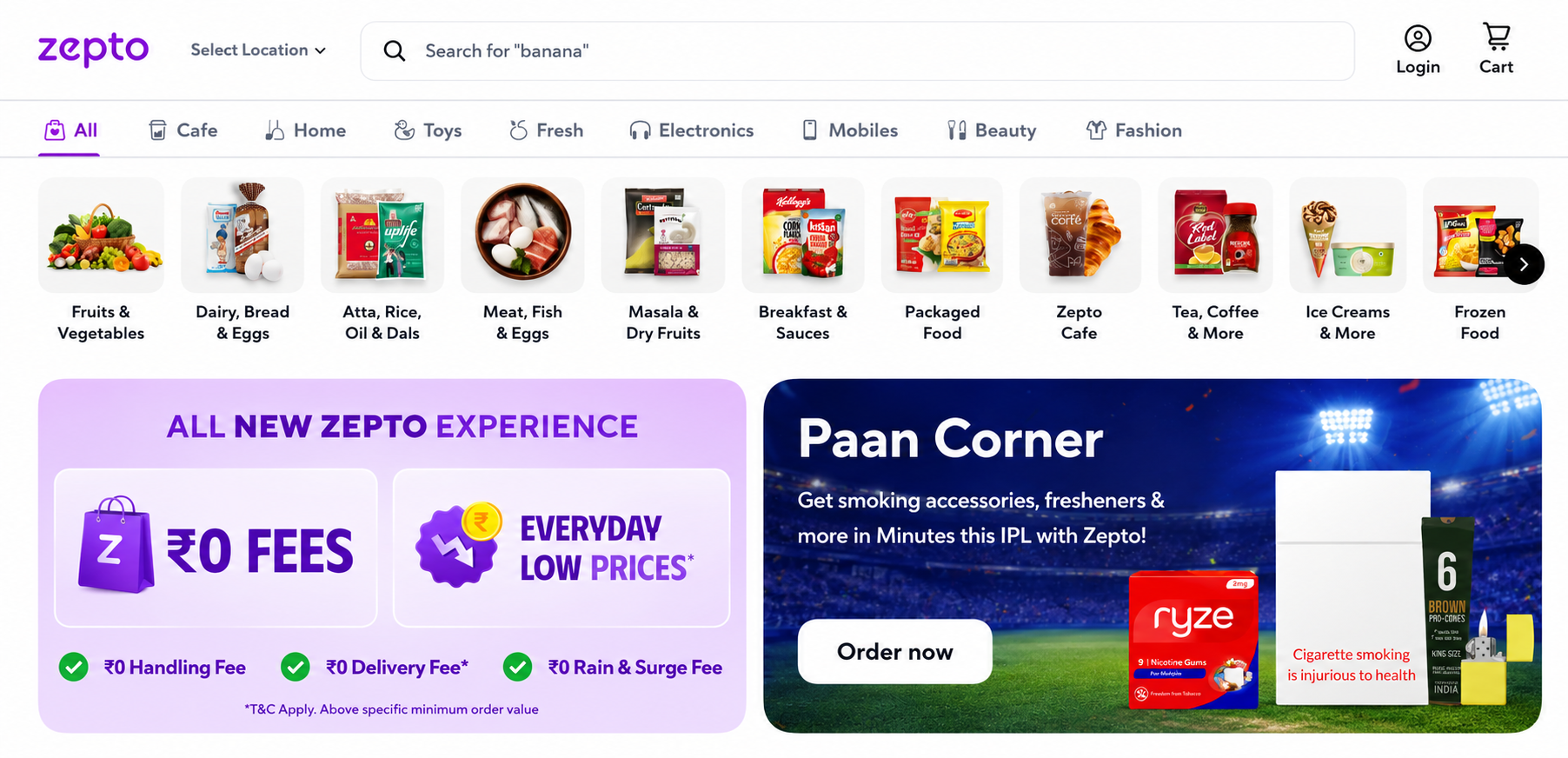
Zepto has grown from groceries into a broad range of categories. Knowing the range helps you understand what it’s for.
- Groceries and staples: Rice, flour, oil, packaged foods, and everyday kitchen essentials, the core of the service.
- Fresh produce: Fruits and vegetables, though quality can vary, a point the autopsy examines.
- Snacks and beverages: Chips, soft drinks, chocolates, ice cream, and impulse items, popular for quick cravings.
- Personal care and household: Toiletries, cleaning supplies, and home essentials for everyday needs.
- Pharmacy: Through Zepto Pharmacy, medicines and health products with fast delivery in major cities.
- Prepared food and coffee: Through Zepto Café, hot food, snacks, and coffee, though this vertical has faced restructuring.
- Other essentials: Baby care, pet supplies, stationery, and an expanding range of daily-need items.
This breadth makes Zepto a one-stop app for many immediate needs, which is convenient and a real draw. The core grocery and essentials categories are what it does best and most reliably, while newer areas like prepared food through Zepto Café have been less stable. For a user, Zepto is most dependable for common packaged groceries and essentials, where speed and stock are strong, and more variable for fresh produce, where quality differs, and prepared food, which has had operational challenges. Knowing which categories are Zepto’s strengths, packaged staples and household essentials, helps set realistic expectations for what to order with confidence and what to approach more carefully.
The Dropped 10-Minute Label
A notable recent change is that Zepto stopped using its famous 10-minute branding, which is worth understanding as it reflects wider issues in quick commerce.
In early 2026, Zepto dropped the 10-minute delivery branding that had been central to its identity, following a government directive related to gig worker safety. The concern was that promising delivery in such a tight window could pressure delivery riders to rush dangerously to meet the target. So while Zepto removed the explicit 10-minute promise, the actual speed has not changed much: deliveries in dense urban areas are still typically completed in around 10 to 15 minutes through the same dark-store and routing system. The label went, but the fast service remained.
For a user, this change is mostly cosmetic in terms of the service you receive, since orders still arrive quickly. But it reflects a broader and legitimate issue: the human cost of ultra-fast delivery on the gig workers who fulfill it. The pressure of speed targets on riders, who often work in difficult conditions for modest pay, has drawn criticism, including the dropping of explicit time promises. The honest framing is that the dropped label does not reduce the convenience you get, but it’s a reminder that the speed depends on gig workers under real pressure, an ethical dimension of quick commerce worth being aware of as a consumer, even if it doesn’t change the practical service you receive at your door. It’s a small window into the labor questions behind the convenience.
Zepto Pass and Subscriptions
Zepto offers a subscription, Zepto Pass, and understanding it helps you judge its value given the fee structure.
Zepto Pass is a paid subscription marketed to give benefits like reduced or waived delivery fees and exclusive discounts, aimed at frequent users who want to save on the fees that Zepto charges. The idea is that regular customers pay a small recurring or periodic fee and in return get cheaper deliveries and deals, which can make sense if you order often. For heavy users, a pass can offset some of the delivery costs that would otherwise add up across many orders.
The honest caveat, reflected in user feedback, is that the pass does not eliminate all charges. Notably, customers report that even with a Zepto Pass meant to remove delivery fees, other charges like surge fees during high demand can still apply, undermining the expected savings. So the pass reduces some costs but does not make ordering charge-free, and its value depends on how often you order and whether the savings truly exceed its cost given the other fees that remain. The fair take is that Zepto Pass can be worthwhile for frequent users who do the math and find the delivery savings outweigh the pass cost, but it should not be assumed to make orders free or fully predictable, since surge and other fees can still appear. Calculate your actual usage and savings before assuming the pass pays off.
How Zepto Makes Money
A natural question is how Zepto makes money delivering groceries so fast and cheaply, and the answer explains its fees and its push to broaden revenue.
Zepto earns from several sources. It makes a margin on the products it sells, buying in bulk and selling to you, though grocery margins are thin. It charges a growing set of fees, delivery, handling, platform, small-cart, and surge fees, which have become a significant and controversial revenue lever as it chases profitability. It earns from Zepto Pass subscriptions, from advertising and retail media, where brands pay for visibility in the app, an increasingly important higher-margin stream, and from private-label products it sells under its own brands at better margins. Newer ventures like prepared food and a brand analytics tool add further revenue. Importantly, Zepto has not been consistently profitable, operating at a loss as it invests in growth, though it reports improving store-level economics.
For a user, this revenue picture explains a lot, especially the fees. Because product margins are thin and the company is pushing toward profitability ahead of its IPO, Zepto has increasingly added and raised fees and leaned on advertising and private labels to make the economics work. This is the logical, if unwelcome, consequence of a business that long prioritized growth and cheap, fast delivery now needing to make money. The honest framing is that the rising fees and the advertising-heavy, private-label-pushing app are direct results of Zepto’s drive to become profitable, which is understandable as a business but creates the cost and experience frustrations the autopsy examines. Knowing this helps explain why the once-cheap, simple service now comes with a growing stack of charges.
| Why Your Zepto Bill Keeps Growing Grocery margins are thin and Zepto has not been consistently profitable, so as it pushes toward profitability ahead of its IPO, it has added and raised fees, delivery, handling, platform, small-cart, late-night, and surge, and leaned on advertising and private-label products. The rising fees are a direct result of the drive to make a fast, cheap delivery business profitable. This explains why a once-simple, cheap service now comes with a growing stack of charges, and why checking your full bill before paying matters. |
Quick Commerce in India and Zepto’s Place
To understand Zepto’s significance, it helps to understand the quick commerce wave it helped create, since Zepto is at the center of a major shift in how India shops.
Quick commerce, or q-commerce, is the model of delivering everyday goods in minutes rather than days, and India has become one of its most dynamic markets. The category has grown into a large and fast-expanding market worth tens of thousands of crores, led by a handful of players, Blinkit, Zepto, and Swiggy Instamart, with traditional retailers and giants like Amazon and Flipkart now entering too. India was fertile ground for this because online grocery penetration was very low, neighborhood kirana shops dominated, and dense urban populations made fast delivery from nearby dark stores viable. Zepto was one of the pioneers that proved the model could work at scale and made ultra-fast delivery a mainstream expectation.
Zepto’s place in this story is significant because, as one of the pure-play pioneers, it helped define the category and push the whole market toward faster delivery. Its dark-store-first approach became a template, and its success attracted enormous investment and competition into the space. For a user, this means Zepto is not a niche app but part of a fundamental shift in urban shopping, with the convenience, and the issues, of quick commerce now part of daily life for many. At the same time, the intense competition and the industry-wide push toward profitability help explain why fees are rising across all these apps, not just Zepto. The honest framing is that Zepto is a central player in a transformative and still-evolving category, which is why both its strengths and its problems matter, and why the fee and quality issues it faces are largely shared across the quick commerce industry as it matures from growth-at-all-costs toward making money.
The Gig Economy Behind the Speed
Behind Zepto’s fast delivery is a large workforce of gig delivery riders, and their conditions are an important and often overlooked part of an honest picture.
Zepto’s speed depends on delivery riders who pick up orders from dark stores and rush them to customers, typically working as gig workers rather than salaried employees. The pressure to deliver in very tight windows has raised concerns about rider safety and working conditions, since rushing through traffic to meet time targets can be dangerous, and gig work often comes with modest pay and limited benefits. These concerns are serious enough that they contributed to the dropping of explicit 10-minute delivery promises, and they have drawn public criticism about the human cost of ultra-fast convenience. The riders are the visible face of the service and the people who bear the physical demands of the speed.
For a consumer, this dimension is worth being aware of, even though it doesn’t change the practical service you receive. The convenience of getting groceries in minutes rests on gig workers operating under time pressure, often in difficult conditions, which is an ethical consideration behind the model. While a single consumer can’t solve these systemic issues, awareness matters, and small actions like being patient and respectful with riders, not penalizing them for delays outside their control, and tipping where possible are reasonable responses. The honest framing is that Zepto’s speed has a human cost in the demands placed on gig riders, an issue across quick commerce, and while it doesn’t change whether the app works for you, it’s a real part of the picture that a thoughtful consumer should hold in mind, recognizing the people behind the convenience and treating them well.
The Push Toward Profitability
A defining theme for Zepto in 2026 is its drive toward profitability ahead of its public listing, which directly shapes the experience you have as a user.
For years, Zepto and its quick commerce peers prioritized rapid growth over profit, subsidizing fast, cheap delivery to win customers and market share, funded by large investments. As the companies mature and head toward public listings, the priority has shifted to proving they can actually make money, which is much harder in a business with thin grocery margins and high delivery costs. This shift is why Zepto has introduced and raised fees, pushed advertising and private-label products, and worked to improve the economics of each dark store. The era of heavily subsidized, fee-free fast delivery is giving way to a model where the true cost is increasingly passed to customers.
For a user, understanding this shift explains the changing experience and helps set expectations going forward. The fees that frustrate customers are a direct result of this profitability drive, and the trend is likely to continue as the company seeks sustainable economics and faces public-market scrutiny after its IPO. The honest framing is that Zepto’s increasing fees and more commercial app are not arbitrary but reflect the fundamental challenge of making ultra-fast delivery profitable, a challenge the whole industry shares. For consumers, this means the value equation is changing: the service that was once remarkably cheap and convenient is becoming a more expensive convenience whose worth must be judged order by order. Recognizing that the cheap-and-fast era is ending, and that fees are likely here to stay and may grow, helps you use Zepto realistically, for real convenience worth paying for, rather than expecting the subsidized prices of its earlier days.
Part 2: The Autopsy
The autopsy weighs Zepto’s genuine strengths against its real, well-documented concerns. Zepto is an impressive, fast, convenient, market-leading service, and it has also drawn serious criticism over hidden fees, pricing practices, product quality, and customer service. Both are true, and because the concerns here are significant and well documented, they get full and honest treatment alongside the real strengths, with practical guidance.
What Zepto Gets Right
The strengths are real and explain Zepto’s popularity and market position.
Truly Impressive Speed
Zepto’s core achievement, delivering groceries and essentials in around 10 to 15 minutes, is real and remarkable. For immediate needs, a forgotten ingredient, a late-night craving, an urgent item, the speed is really useful and very hard to match by any other means, since no shopping trip or scheduled delivery can realistically compete with getting what you need in a matter of minutes.
Real Convenience
Getting daily essentials delivered in minutes without leaving home is a real convenience that saves time and effort, especially for busy urban users, and it’s a big part of the reason millions of urban Indians rely on it as a daily habit.
Wide and Growing Selection
Beyond groceries, Zepto offers personal care, household items, pharmacy, and more, making it a one-stop app for many immediate needs, with a broad and steadily growing range available fast from a single app.
Strong Operational Technology
The dark-store network and routing technology that power the speed are highly sophisticated, and for common items the service is fast and reliable, a real engineering achievement that took years of heavy investment in stores, software, and logistics to build and refine.
Market Leadership and Scale
As one of the top quick commerce players, well-funded and widely available across cities, Zepto is an established, serious service with the scale to deliver reliably in the areas it covers.
These strengths make Zepto a truly useful service for fast delivery, which is what most people use it for and where it delivers real value. The concerns that follow are serious and important to weigh, but they do not erase the genuine convenience of the core speed, which remains Zepto’s real strength.
Hidden Fees and Fee Stacking
The most prominent and documented criticism of Zepto is its fees, which stack up and can make a small order surprisingly expensive, and this deserves prominent, honest treatment with practical guidance.
Zepto was the first quick commerce platform in India to introduce a platform fee, and it now layers multiple charges onto orders. These can include a platform fee, a delivery fee that varies with order size and has replaced free delivery for many users, a handling fee, a small-cart fee if your order is below a threshold, a late-night handling fee for orders after a certain hour, and a surge fee during high-demand periods that customers often cannot predict. Individually some are small, but together they can add up to a significant portion of a small order, and reports describe handling fees alone reaching levels that make up a notable share of the total. A widely shared example involved a modest order where handling fees alone were a large fraction of the bill. The result is that the final amount is often higher and less predictable than the product prices suggest.
This is a real and legitimate frustration, and the honest guidance is practical. The fees are disclosed in the bill breakdown, but they’re easy to miss, so the key habit is to check the full bill details, usually a dropdown before payment, every time, so the total doesn’t surprise you. Be aware that ordering small amounts, late at night, or during peak demand adds fees, so consolidating orders and avoiding peak times can reduce them. Understand that even a Zepto Pass may not remove surge fees. The fair takeaway is that Zepto’s convenience now comes with a stack of fees that can make small or off-peak orders poor value, and the defense is awareness: always check the full bill before paying, order thoughtfully to minimize fees, and decide whether the convenience justifies the total cost for each order. The speed is real, but so is the growing cost, and an informed user checks the bill rather than assuming the old cheap, simple pricing.
| Always Check the Full Bill Before Paying Zepto stacks multiple fees: platform fee, delivery fee, handling fee, small-cart fee (under a threshold), late-night fee (after a certain hour), and surge fee (during high demand, often unpredictable). Together these can be a large share of a small order. They are shown in the bill breakdown but easy to miss, so open the Bill Details dropdown and check the full total before you pay, every time. Ordering larger baskets, avoiding late nights and peak demand, reduces fees. Note that even a Zepto Pass may not remove surge fees. Decide if the convenience justifies the total for each order. |
Pricing and Dark Pattern Concerns
Beyond the fees themselves, Zepto has faced criticism over pricing practices that some describe as dark patterns, which raise fairness and transparency concerns.
Reported concerns include differential pricing, where different users may see different prices, and instances where a discounted price appears to reset to the full maximum retail price at the final payment screen, so the saving you expected disappears at checkout. The surge fees, applied during high demand on terms the company defines and customers cannot see, add to the sense of unpredictable, opaque pricing. Such practices, design and pricing choices that can mislead or disadvantage customers, have drawn criticism and calls for greater transparency and regulation in quick commerce. These are serious concerns because they touch on whether the pricing is fair and clear, not just whether it’s high.
The honest framing is that these pricing concerns are legitimate and worth taking seriously, while keeping perspective. They are reported patterns and individual experiences rather than uniformly proven practices across every order, and pricing in apps can be complex. But the recurrence of complaints about prices changing at checkout, opaque surge fees, and differential pricing points to a real transparency problem that consumers should be alert to. The practical guidance is to watch your prices and bill carefully: note the price when you add an item and check it hasn’t changed at payment, be skeptical of unpredictable surge charges, and report pricing discrepancies through the app’s help section, where unfair charges during clear conditions can be flagged. The fair takeaway is that Zepto’s pricing has drawn genuine dark-pattern criticism, and the defense is vigilance, checking prices and bills closely and not assuming the displayed discount is what you’ll pay, since the documented concerns make careful attention worthwhile.
Product Quality Issues
A significant set of complaints concerns product quality, which is an inherent tension in a speed-first model and matters because you’re buying food and essentials.
Because Zepto’s dark stores prioritize rapid picking and packing for speed, quality control can be rushed, and complaints reflect this. Users report receiving wilted or dusty vegetables and raw or unripe fruit when expecting fresh, damaged or crushed items, leaking oil or milk packets, and melted ice cream or cold coffee from the prepared-food side. In more extreme reports, customers describe finding pests or contamination in packaged goods, which, while not the norm, are serious when they occur. The common thread is that the speed-first picking process can mean less careful quality checking than a shopper would do themselves, leading to variable quality, especially for fresh and perishable items.
The honest framing balances these real complaints with perspective. Product quality complaints are genuine and recurring, particularly for fresh produce and perishables, and reflect a real trade-off in the speed-first model, you don’t choose your own produce, so quality varies. At the same time, these are individual complaints on platforms that attract dissatisfied users, and many orders, especially packaged goods, arrive fine. The practical guidance is to be selective: Zepto is most reliable for packaged, non-perishable items, while for fresh produce and perishables, where quality varies, you may prefer to inspect in person or accept the variability, and to report and seek refunds for truly poor-quality items, keeping photos as evidence. The fair takeaway is that Zepto’s speed comes with variable quality, especially for fresh items, so order accordingly, lean on it for packaged essentials, be cautious with perishables, and document and report quality problems when they occur.
The Refund and Store Credit Problem
A specific and important concern involves how Zepto handles refunds, which can trap your money and matters whenever something goes wrong with an order.
When an order has a problem, missing items, poor quality, or cancellation, and a refund is due, Zepto often defaults to issuing the refund as Zepto Cash, store credit usable only within the app, rather than returning the money to your original payment method. This keeps your money inside Zepto’s ecosystem rather than back in your bank or card. Users also report difficulty getting refunds at all for missing or damaged items, and in some cases prepaid orders cancelled near delivery with refunds said to be initiated but not received. The store-credit default is a particular frustration because it effectively forces you to keep spending with Zepto to use money you’re owed.
The honest and practical guidance here is important and worth acting on. As a consumer, you are generally entitled to a refund in your original payment form, not forced store credit, so the key is to explicitly insist on it: in the app’s chat support, clearly state that you want the refund to your original payment source and not Zepto Cash, and ask for a live agent rather than accepting the automated default. Keep records of orders, issues, and communications. For unresolved refunds or persistent problems, you can escalate beyond the app, including through consumer grievance channels. The fair takeaway is that Zepto’s refund handling, defaulting to store credit and sometimes failing to refund, is a real problem, and the defense is to know your right to an original-source refund and insist on it firmly, escalating if needed, rather than accepting trapped store credit or an unresolved loss.
| Insist on Refunds to Your Original Payment Source When a refund is due, Zepto often defaults to Zepto Cash (store credit usable only in the app), keeping your money in its ecosystem. As a consumer, you are generally entitled to a refund in your original payment form. In the app’s chat support, clearly state you want the refund to your original payment source, not Zepto Cash, and ask for a live agent rather than accepting the automated default. Keep records of the order, the problem, and your messages. For unresolved refunds, escalate through consumer grievance channels. Do not passively accept trapped store credit for money you are owed. |
Customer Service Complaints
Underlying many of these issues is customer service, which draws heavy criticism and matters because it’s how problems get resolved, or not.
Zepto’s customer support is heavily automated, and users frequently report being stuck in loops of generic apology messages without a human actually addressing the problem. Complaints describe support that dismisses concerns, fails to resolve missing-item or quality issues, defaults to store credit, and is hard to reach a real person through. There’s no widely available 24-hour phone helpline, with support routed mainly through in-app chat. Some users describe feeling that the company is happy to take payment but slow to resolve problems, and that delivery experiences, including rider behavior, sometimes add to the frustration. For a service handling daily essentials and money, poor support when something goes wrong is a serious weakness.
Both sides deserve honest statement. Customer service is a real and significant weak point, and when an order goes wrong, getting effective, human help can be truly difficult, which compounds the other issues like fees, quality, and refunds. At the same time, most orders are delivered quickly without needing support, so the visible complaints, on platforms that attract dissatisfied users, overstate the typical experience. The practical guidance is to know the escalation paths: use in-app chat and insist on a live agent, use the call-rider option for delivery issues, keep records, and escalate to consumer grievance channels for unresolved serious problems. The fair takeaway is that Zepto’s support is a genuine weakness that matters most when something goes wrong, so while most orders are smooth, know how to escalate effectively, and be prepared to be firm and persistent if you need a problem properly resolved.
What You Cannot Fully Verify
In the interest of honesty, here is what’s hard to assess definitively about Zepto, and which varies by individual experience and location.
- The typical experience versus the complaint skew, since most orders are smooth and unreviewed while problems get reported.
- How consistent product quality is, which varies by store, item, and especially for fresh produce.
- The exact current fees, which change frequently and vary by order, time, and location.
- How a specific refund, quality, or service issue will be handled and resolved.
- How widespread the pricing and dark-pattern concerns are across all orders versus reported cases.
This is not a list of hidden flaws so much as a reminder that experiences vary and the core speed is reliable while fees, quality, and service are the weak points. A review can tell you Zepto is an impressive, fast, convenient service with serious, documented concerns about fees, pricing transparency, product quality, refunds, and support. It cannot predict your specific orders, which depend on your location, what you order, and whether problems arise. The honest guidance is to enjoy the genuine speed for suitable items, always check your bill, be selective with perishables, know your refund rights, and order with eyes open to both the convenience and the real frustrations.
Part 3: The Killcritic
The killcritic is the verdict. Who Zepto suits, who should be cautious, and how it compares to Blinkit, Swiggy Instamart, and regular grocery shopping.
Who Zepto Is For
Zepto suits specific needs and users well, with the fit depending on what and how you order.
Urban Users Needing Speed
If you live in a city Zepto serves and value getting essentials in minutes, for forgotten items, urgent needs, or convenience, Zepto delivers real value, and the speed is its real strength and the core reason to use it for immediate needs.
Busy People Short on Time
If your schedule makes shopping trips hard and the time saved is worth the cost, Zepto’s convenience can justify the fees, especially for packaged essentials you’d otherwise spend time buying.
Packaged-Goods Buyers
If you mainly order packaged, non-perishable items, snacks, staples, household supplies, Zepto is most reliable, since these have fewer quality issues than fresh produce and arrive fast.
Frequent Users Who Optimize
If you order often, do the math on a Zepto Pass, and order thoughtfully to minimize fees, you can get good convenience value, provided you stay aware of the fees and check bills.
For these users, especially urban, time-pressed people ordering packaged essentials who stay alert to fees and bills, Zepto offers real convenience, with its weaknesses manageable through awareness and selective ordering.
Who Should Be Cautious
Others should be cautious with Zepto or use it selectively, depending on their priorities.
Cost-Conscious Shoppers
If keeping costs down matters and the stacked fees bother you, Zepto can be poor value, especially for small or off-peak orders, and planned shopping elsewhere may save real money.
Fresh Produce Buyers
If you care about choosing fresh produce yourself and quality consistency, Zepto’s variable produce quality may disappoint, and buying perishables in person could serve you better.
Those Who Want Reliable Support
If responsive problem resolution matters to you, Zepto’s heavily automated, hard-to-reach support is a real drawback, and you should be prepared to be firm and persistent or expect frustration.
Anyone Sensitive to Pricing Tactics
If opaque fees, surge pricing, and prices changing at checkout trouble you, Zepto’s documented pricing concerns are worth weighing, and vigilance is required to avoid paying more than expected.
Zepto vs Blinkit
The main comparison is Blinkit, the quick commerce market leader, owned by Zomato, and the honest answer is that they’re closely matched on the core service.
| Factor | Zepto | Blinkit |
|---|---|---|
| Core model | Dark-store quick commerce | Dark-store quick commerce |
| Delivery speed | Around 10 to 15 min | Around 10 to 15 min |
| Market position | Top player, strong | Market leader |
| Backing | Independent, IPO-bound | Owned by Zomato |
| Fees | Heavy, drew criticism | Also charges fees |
| Quality and service | Variable, complaints | Variable, complaints |
| Pricing concerns | Faced dark-pattern criticism | Also scrutinized |
Both Zepto and Blinkit run the same dark-store quick commerce model with similar speeds and broadly similar fee and quality issues, since these are common across the industry. Blinkit, backed by Zomato, is generally regarded as the market leader with a slightly larger share, while Zepto is a strong independent challenger. For users, the practical differences often come down to which has better stock, pricing, and reliability in your specific area, which varies by location, and personal app preference. Many users keep both and choose per order based on availability and price. The honest take is that neither is decisively better overall; both offer fast delivery with similar fee and quality trade-offs, so comparing them in your specific area, and keeping both as options, is the sensible approach, since the better choice is often local and order-specific rather than universal.
Zepto vs Swiggy Instamart
Another key comparison is Swiggy Instamart, the quick commerce arm of Swiggy, which competes directly with Zepto.
Swiggy Instamart offers the same quick grocery delivery model and benefits from being part of Swiggy’s larger ecosystem, including food delivery and a combined subscription, which can add convenience and bundled value for existing Swiggy users. Zepto, as a pure-play quick commerce specialist, is intensely focused on this one thing, which is its strength. For users, the choice often depends on whether you’re already in the Swiggy ecosystem and value the bundle, and on which service has better stock, pricing, and speed in your area. Like the Blinkit comparison, the core service is similar, and the fee and quality issues are broadly common across quick commerce. The honest framing is that Swiggy Instamart and Zepto are closely matched on the core fast-delivery service, with the choice coming down to ecosystem preference and local performance, so many users compare both in their area and may use whichever performs better or offers better value for a given order.
Zepto vs BigBasket and JioMart
A different comparison is against more traditional online grocery services like BigBasket and JioMart, which offer a different trade-off.
Services like BigBasket and JioMart have traditionally focused on planned, scheduled grocery delivery, larger orders delivered in hours or on a chosen slot, rather than instant delivery, though they’re increasingly adding quick options too. The trade-off is that these can offer wider selection, often better prices for planned shopping, and for some users better quality control and clearer pricing, at the cost of speed. Zepto wins decisively on speed for immediate needs, while planned-shopping services can win on selection, value, and predictability for a weekly grocery haul. The honest framing is that the right choice depends on the need: for instant, small, urgent orders, Zepto’s speed is unmatched, while for planned weekly grocery shopping where price and selection matter more than speed, a service like BigBasket or JioMart may offer better value and a calmer, more transparent experience. Many households sensibly use both, quick commerce like Zepto for urgent top-ups and forgotten items, and planned services like BigBasket for the larger weekly or monthly shop where price and selection matter more than speed.
Zepto vs Regular Grocery Shopping
The most fundamental comparison is against simply shopping for groceries yourself, in person or with planned delivery.
Convenience and Time
Zepto saves the time and effort of going to a shop, delivering in minutes, which is its core value for busy people and urgent needs, a genuine convenience worth real money to some.
Cost and Quality Control
Shopping yourself lets you choose your own fresh produce, avoid the stacked delivery and handling fees, and often pay less, with full control over quality, which Zepto’s model cannot match for perishables.
The Honest Call
For urgent, small, or convenience-driven needs, Zepto’s speed clearly beats a shopping trip and can be worth the fees. For planned, larger, or cost-sensitive shopping, especially fresh produce, doing it yourself or via planned delivery is usually cheaper and gives better quality control. The sensible approach for many is to use Zepto for genuine convenience and urgent top-ups while doing the main, planned grocery shopping in a way that controls cost and quality. The honest point is that Zepto is a convenience tool, excellent for immediacy, that you pay a premium for in fees and sometimes quality, so using it deliberately for when speed truly matters, rather than as a default for all grocery needs, gets the benefit while limiting the cost, which is the balanced way to fit it into your shopping.
The Final Verdict
| Zepto Final Rating: 3.5 / 5 A truly impressive, fast, and convenient quick commerce service that pioneered 10-minute grocery delivery in India and remains a market leader, with real value for urgent and convenience-driven needs, especially for packaged essentials. Held back by a heavy and growing stack of fees that drew genuine criticism, documented pricing and dark-pattern concerns including prices changing at checkout and opaque surge fees, variable product quality especially for fresh items, a refund process that defaults to trapping money as store credit, and heavily automated customer service that struggles to resolve problems. Clearly useful for speed, but you must order with eyes open, check your bill, and know your refund rights. |
Use Zepto if you live in a city it serves, value getting essentials in minutes, mainly order packaged goods, and stay alert to fees and bills. For urgent and convenience-driven needs, especially packaged essentials, Zepto offers real value, and the speed is a real benefit when you need it.
Be cautious or use it selectively if you’re cost-conscious and the stacked fees bother you, you want to choose fresh produce yourself, you need reliable customer support, or opaque pricing tactics trouble you. In those cases, planned shopping or in-person buying may save money and frustration, and vigilance is essential when you do use Zepto.
Zepto earns genuine credit for a remarkable achievement, making ultra-fast grocery delivery a reliable reality in India, and for urgent, convenience-driven needs it delivers real value that’s hard to match. The 3.5 out of 5 reflects that genuine strength, tempered honestly by serious, well-documented concerns: a heavy stack of fees that can make small orders poor value, pricing practices criticized as dark patterns, variable product quality especially for fresh items, a refund process that defaults to trapping your money as store credit, and customer service that struggles to resolve problems. For speed and convenience, Zepto is truly useful and a market leader. The keys to using it well are to check your full bill before every order, lean on it for packaged essentials while being cautious with perishables, insist on refunds to your original payment source rather than store credit, and decide order by order whether the convenience justifies the total cost. Used deliberately and with awareness, Zepto is a useful convenience tool; used carelessly, the fees, quality issues, and refund traps can frustrate, and informed, vigilant use makes all the difference. The speed is real, and so are the caveats, so order wisely.
Frequently Asked Questions
This section answers the specific questions people search for about Zepto. Each answer is structured for direct factual extraction.
What is Zepto?
Zepto is an Indian quick commerce company that delivers groceries and daily essentials in around 10 to 15 minutes. You order through its app, and items are delivered fast from a small neighborhood warehouse called a dark store. Founded in 2021 by Aadit Palicha and Kaivalya Vohra, it pioneered ultra-fast grocery delivery in India and is one of the market leaders alongside Blinkit and Swiggy Instamart. It has expanded into pharmacy and prepared food, becoming a broader fast-delivery platform for urban consumers.
Is Zepto safe and legit?
Yes, Zepto is a legitimate, well-funded company and one of India’s leading quick commerce platforms, preparing for a public listing. For the core service, ordering and delivery, it’s a real, established business, not a scam. The concerns are not about legitimacy but about its stacked fees, pricing practices criticized as dark patterns, variable product quality, a refund process that defaults to store credit, and automated customer service. So it’s legitimate and useful, but you should order with awareness of the fees, check your bill, and know your refund rights.
Is Zepto really 10 minutes?
Often yes, in dense urban areas, deliveries are typically completed in around 10 to 15 minutes through Zepto’s dark-store and routing system, though exact times vary by location, demand, and conditions. Notably, in early 2026 Zepto dropped the explicit 10-minute branding following a government directive on gig worker safety, since tight time promises can pressure riders to rush. So the fast service remains, usually 10 to 15 minutes, but Zepto no longer formally promises 10 minutes specifically, and actual times depend on your area and the order.
Why does Zepto charge so many fees?
Grocery margins are thin and Zepto has not been consistently profitable, so as it pushes toward profitability ahead of its IPO, it has added and raised fees. These can include a platform fee, delivery fee, handling fee, small-cart fee for low-value orders, late-night fee, and surge fee during high demand. Together they can be a large share of a small order. The fees are how Zepto tries to make a fast, cheap delivery business profitable. Always check the full bill breakdown before paying, since the total is often higher than the product prices suggest.
What is the Zepto handling fee?
The handling fee is one of several charges Zepto adds to orders, reportedly ranging from a few rupees to around twenty or more, on top of delivery and platform fees. It’s part of the stack of fees that can make a small order surprisingly expensive, and in some widely shared cases handling fees alone formed a notable share of the bill. Like Zepto’s other fees, it’s shown in the bill breakdown but easy to miss. Check the full bill details before paying so the handling and other fees don’t surprise you at checkout.
Is Zepto Pass worth it?
It depends on how often you order. Zepto Pass is a paid subscription offering benefits like reduced or waived delivery fees and discounts, which can pay off for frequent users who save more on deliveries than the pass costs. However, users report that even with the pass, other charges like surge fees during high demand can still apply, so it does not make ordering charge-free or fully predictable. Calculate your typical ordering frequency and the actual savings against the pass cost, and don’t assume it eliminates all fees, before deciding it’s worth it.
How do I get a Zepto refund to my bank instead of store credit?
Zepto often defaults to refunding as Zepto Cash (store credit), but you are generally entitled to a refund in your original payment form. In the app’s chat support, select the order and issue, then clearly state that you want the refund to your original payment source, not Zepto Cash, and ask for a live agent rather than accepting the automated store-credit default. Keep records of the order, problem, and messages. If it’s not resolved, escalate through consumer grievance channels. Insist firmly rather than passively accepting trapped store credit.
Is Zepto product quality good?
It varies. Zepto is most reliable for packaged, non-perishable items, while fresh produce and perishables draw more quality complaints, since the speed-first picking can mean less careful selection and you don’t choose your own produce. Reports include wilted vegetables, unripe fruit, damaged items, and occasionally more serious issues. Many packaged orders arrive fine, but produce quality is inconsistent. Order packaged essentials with confidence, be more cautious with fresh items, and report and seek refunds for truly poor-quality products, keeping photos as evidence.
Is Zepto or Blinkit better?
They’re closely matched. Both run the same dark-store quick commerce model with similar speeds, fees, and quality issues, since these are common across the industry. Blinkit, owned by Zomato, is generally seen as the market leader with a slightly larger share, while Zepto is a strong independent challenger. The practical difference often comes down to which has better stock, pricing, and reliability in your specific area, plus app preference. Many users keep both and choose per order. Neither is decisively better overall, so compare them in your area and use whichever performs better.
Who owns Zepto and is it Indian?
Zepto is an Indian company, founded in India in 2021 by Aadit Palicha and Kaivalya Vohra, and incorporated as KiranaKart Technologies. It’s an independent venture, not owned by a larger group like Tata, though it’s backed by various investors including major global funds. In early 2026 it shifted its base to India and became a public company as it prepared for an IPO. So Zepto is an independent Indian company with institutional investors, run by its founders, not a subsidiary of another corporation.
Is Zepto profitable?
Not consistently, as of the latest available information. Zepto has operated at a loss while investing heavily in growth and expanding its dark-store network, though it reports improving store-level economics and is working toward profitability ahead of its planned IPO. This drive to become profitable is a key reason it has added and raised fees and leaned on advertising and private-label products. So Zepto is a large, well-funded market leader but not yet consistently profitable, which directly shapes its pricing and fee strategy as it pursues sustainable economics and faces the scrutiny that comes with a planned public listing.
What is Zepto Café?
Zepto Café is Zepto’s prepared-food and coffee vertical, delivering hot food, snacks, and beverages quickly alongside groceries. It aimed to extend Zepto’s fast delivery into ready-to-eat items, but it faced significant challenges, and in early 2026 around 200 of its roughly 600 outlets were temporarily shut due to supply chain strain and inconsistent demand, with staff redeployed to core grocery operations. So Zepto Café remains a part of the offering but has been less stable than the core grocery service, and prepared-food orders like coffee can be more prone to quality issues such as arriving cold.
Does Zepto deliver medicines?
Yes, through Zepto Pharmacy, launched to deliver medicines and health products quickly in major cities like Delhi, Mumbai, Bengaluru, and Hyderabad. This extends Zepto’s fast-delivery model to pharmacy needs, letting users order medicines for rapid delivery alongside groceries. As with any medicine purchase, ensure you order correctly and check products on delivery, and for prescription medicines, follow the required processes. Pharmacy is one of Zepto’s category expansions aimed at capturing more daily needs through its dark-store network, available in select cities.
Is Zepto cheaper than going to the store?
Often no, once fees are included. While Zepto’s product prices can be competitive, the stacked delivery, handling, platform, small-cart, and surge fees frequently make a Zepto order more expensive than buying the same items in a shop, especially for small orders. The trade-off is that you pay extra for the convenience and speed. For planned shopping where cost matters, buying in person or via planned delivery is usually cheaper. Zepto’s value is convenience and time saved, not lower prices, so weigh the stacked fees against what the convenience really saves you in time and effort before deciding it is worth it for a given order.
What is surge pricing on Zepto?
Surge pricing is an extra fee Zepto can add during periods of high demand, such as bad weather, peak hours, or busy times, on terms the company defines and customers generally cannot see in advance. It means the same order can cost more at certain times, contributing to the unpredictability of Zepto’s pricing. Even a Zepto Pass may not remove surge fees. To minimize it, avoid ordering during obvious peak or high-demand periods where possible, and always check the full bill before paying, since surge and other fees can push the total above what you expect.
How do I contact Zepto customer care?
Zepto’s support is mainly through in-app chat rather than a widely available phone helpline. In the app, tap your profile icon, then find Customer Support or Get Help, select the specific order, and report the issue, such as a missing item, damaged product, or delayed delivery. If the automated chat doesn’t resolve it, ask for a live agent. For delivery issues, the call-rider option on the active order screen can be faster. Keep records, and for unresolved serious problems, escalate through consumer grievance channels beyond the app.
Why was my Zepto order cancelled or item removed after payment?
This often happens due to what’s called phantom inventory, where the app showed an item as in stock but it was actually missing from the dark store’s shelves, due to clerical errors, breakage, or stock issues. After you pay, the system finds the item unavailable and removes it or cancels part of the order. It’s frustrating, especially for essential items. If this happens, you should receive a refund for the missing item, insist it goes to your original payment source rather than store credit, and for repeated issues, report it through support and keep records of the affected orders.
Is Zepto or Swiggy Instamart better?
They’re closely matched on the core fast-delivery service, with similar speeds, fees, and quality issues common across quick commerce. Swiggy Instamart benefits from being part of Swiggy’s larger ecosystem, including food delivery and a combined subscription, which adds value for existing Swiggy users. Zepto, as a pure-play specialist, is intensely focused on quick commerce. The better choice often depends on whether you’re already in the Swiggy ecosystem and on which has better stock, pricing, and speed in your specific area. Many users compare both apps and simply use whichever has better stock, pricing, and speed for a given order in their area, rather than committing to just one.
Does Zepto deliver 24 hours a day?
Zepto’s hours vary by location, and many areas offer late-night or extended delivery, though not always a full 24 hours everywhere. Where late-night delivery is available, ordering after a certain hour, often around 11 pm, can add a late-night handling fee. So availability depends on your city and area, with some places offering very late or near-round-the-clock service and others more limited hours. Check the app for delivery availability and timing in your specific location before you rely on it late at night, and be aware that very late orders may carry an extra late-night handling fee on top of the usual delivery, platform, and handling charges.
Can I trust Zepto with online payment?
For payment security, Zepto is an established platform using standard secure payment systems, so the core handling of online payments is structurally secure, and you can pay through usual methods like UPI and cards. The concerns with Zepto are not about payment security but about its refund handling, defaulting to store credit rather than your original payment source, its fees, and pricing practices. So paying online is reasonably safe, but the key precaution is on refunds: if a refund is due, insist it goes back to your original payment method rather than accepting trapped Zepto Cash store credit.
Common Mistakes and Tips When Using Zepto
This section captures the most common mistakes people make using Zepto and how to avoid each. Following these helps you get the convenience while limiting the costs and frustrations.
Mistake: Not checking the full bill before paying
Mitigation: Zepto stacks platform, delivery, handling, small-cart, late-night, and surge fees. Always open the Bill Details breakdown and check the total before paying, so the fees don’t surprise you and you can decide if the order is worth it.
Mistake: Placing small or off-peak orders
Mitigation: Small orders trigger small-cart fees, and late-night or peak-demand orders add late-night and surge fees. Consolidate into larger baskets and avoid peak and late-night times where possible to reduce the fees you pay.
Mistake: Accepting store credit for refunds
Mitigation: Zepto defaults to refunding as store credit, but you’re entitled to your original payment source. Explicitly request a refund to your original payment method, ask for a live agent, and escalate if needed rather than accepting trapped Zepto Cash.
Mistake: Ordering fresh produce expecting consistent quality
Mitigation: Produce quality varies since you don’t choose it yourself. Be cautious ordering perishables, consider buying fresh items in person, and report and seek refunds with photos for poor-quality produce when it arrives substandard.
Mistake: Assuming the displayed discount is final
Mitigation: Given pricing concerns, note item prices when adding them and check they haven’t changed at checkout, where discounts can reset. Watch the final total closely and report pricing discrepancies through the help section.
Mistake: Relying on Zepto for planned grocery shopping
Mitigation: For large, planned shopping, the fees and quality variability make Zepto poor value. Use it for urgent top-ups and convenience, and do your main grocery shopping via planned delivery or in person to save money and control quality.
Final Notes on This Review
This review was built using a query fan-out approach designed to answer the questions people actually search for about Zepto, organized into topic clusters that map to how Google’s AI Overview surfaces answers. Every claim is grounded in a source: Zepto’s own descriptions and public business information, independent reporting and analysis, and customer feedback, with the negative complaint skew noted honestly and documented concerns like fees and pricing practices reported as reported patterns rather than uniform certainties.
Figures, fees, and features reflect publicly available information as of mid-2026 and change frequently. Fees, policies, and the product range can change, so verify current details in the app and on zepto.com before ordering. This review is informational. Above all, use Zepto with awareness: check your full bill before paying, be selective about what you order, know your right to a refund in your original payment form, and decide order by order whether the convenience justifies the cost.
More brand reviews on brands.run
brands.run publishes honest, independent reviews of brands across every category, from food and technology to e-commerce and more. Explore the latest reviews on the brands.run homepage.
Review of Zepto | Last updated: June 2026 | Reviewer: brands.run editorial team | Independent review. Fees and features change often, so verify current details in the app, and always check your full bill before paying.
Zepto is a trademark of KiranaKart Technologies Private Limited. All product names, logos, and brands are the property of their respective owners. Use of these names here does not imply any affiliation or endorsement. This review is for general informational purposes only and reflects publicly available information and customer feedback as of mid-2026.