
An honest, deeply researched review of Swiggy covering how it works, the rising platform and delivery fees, Instamart and Bolt, customer service and refunds, how it compares to Zomato, and the verdict on whether it’s worth it in 2026
Thank you for reading this post, don't forget to subscribe!Published by brands.run | The independent brand review hub
Reviewed Brand: Swiggy | Sector: Food Delivery and Quick Commerce | Headquarters: Bengaluru, India | Website: swiggy.com
Swiggy is India’s biggest food delivery and quick commerce platform, alongside Zomato. It delivers restaurant meals across more than 700 cities, runs the 10-minute grocery service Instamart, the rapid food service Bolt, the dining service Dineout, and the Swiggy One membership. It went public in November 2024 at a valuation of around 11.3 billion dollars. This review is part of brands.run’s independent brand reviews, covering the brands people actually use.
Swiggy is used by millions every day, and for most of those orders it works exactly as promised: huge selection, fast delivery, live tracking, food at your door. That core reliability is real and worth saying up front. But Swiggy in 2026 also carries real and growing pain points, chiefly a stack of fees that has climbed sharply, and customer service complaints that show up again and again. An honest review has to hold both truths at once.
It’s built in three parts. Part 1, The Expose, covers what Swiggy actually is: its history and scale, the verticals from Swiggy Food to Instamart to Bolt to Swiggy One, how ordering works, and how the company makes its money, which is central to understanding the fees. Part 2, The Autopsy, weighs what works against what to scrutinize: the genuine strengths of selection, coverage, and speed, against the rising platform and delivery fees, the customer service and refund complaints, the in-app price markups, and what the reviews really say. Part 3, The Killcritic, is the verdict: who Swiggy suits, who might look elsewhere, how it compares to Zomato and to quick commerce rivals, and whether the convenience is worth the cost in 2026.
If you’re wondering whether Swiggy is worth using, what the fees really add up to, or how it stacks up against Zomato, this is the honest version, written to help you decide with eyes open.
| Review Methodology This review draws on Swiggy’s own disclosures and shareholder communications, its public business and financial data, independent reporting on its fees and operations, and customer reviews across platforms including Trustpilot. Where reviews skew negative, that selection bias is noted plainly, since people are more likely to review a delivery service after a bad experience. Financial and fee figures reflect publicly available information as of mid-2026 and change over time. Fees in particular have risen repeatedly, so check the current charges in the app before ordering. |
Part 1: The Expose
The expose lays out what Swiggy actually is: where it came from, how big it is, what it offers, how it works, and how it makes money, because the last point explains the fees that dominate the autopsy.
What Swiggy Actually Is
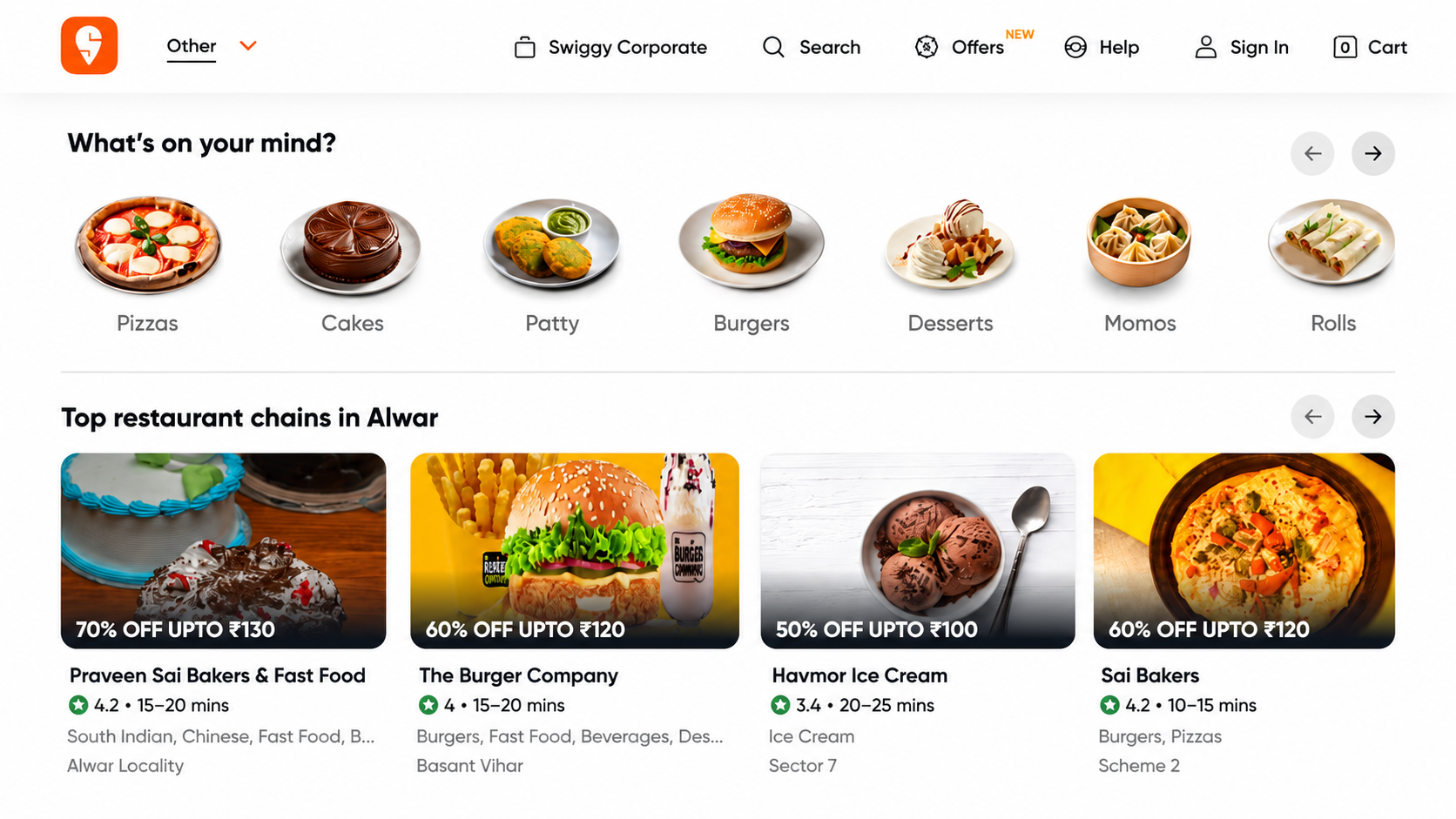
Swiggy is an Indian online food ordering and delivery company, headquartered in Bengaluru. At its core, it connects you with restaurants: you browse menus in the app, place an order, and a delivery partner brings the food to your door, with live tracking along the way. Over the years it has grown well beyond food into a multi-service platform that also delivers groceries and everyday items in minutes, books restaurant tables, and sells a membership.
In plain terms, Swiggy is a convenience platform. Its promise is that almost anything you might want, a restaurant meal, groceries, household items, can reach you quickly without leaving home. It’s one of the two dominant players in Indian food delivery, the other being Zomato, and together they define how tens of millions of Indians eat and shop. Swiggy is a useful, deeply embedded part of urban Indian life, which is exactly why its pricing and service decisions matter so much to so many people.
Understanding Swiggy means understanding that it’s no longer just a food delivery app. It’s a collection of services under one brand, each with its own model, and a business under intense pressure to become profitable, which shapes the fees and choices that customers feel directly. The sections below break down each piece.
History and Scale
Swiggy’s story helps explain its current scale and strategy. The company was incorporated in 2013, and the food delivery service launched in August 2014, founded by Sriharsha Majety, Nandan Reddy, and Rahul Jaimini, growing out of an earlier courier idea. From a single city, Bengaluru, it expanded rapidly: to eight cities by 2015, 500 cities by 2019, matching its rival Zomato, and more than 700 cities by 2025.
The pivotal recent moments shaped what Swiggy is today. In August 2020, during the pandemic, it launched Instamart for instant grocery delivery, which became its most important growth engine. In 2022, it acquired the dining and reservation platform Dineout. In November 2024, it went public, raising over 11,300 crore rupees in its IPO at 390 rupees per share, valuing the company at around 11.3 billion dollars. By 2025 it served tens of millions of users, with figures cited around 24.7 million weekly active users across 680-plus cities.
This scale matters for a review because it explains both Swiggy’s strengths and its pressures. The vast network and selection are a genuine advantage no small player can match. At the same time, as a newly public company that is not yet profitable, Swiggy faces intense pressure to improve its economics, which is the backdrop to the rising fees customers experience. The scale is real, and so is the financial strain driving its pricing, and both are felt by users.
The Swiggy Verticals
Swiggy is best understood as several services under one brand. Knowing what each does helps you use the platform and understand its costs.
Swiggy Food
The original and core service: restaurant food delivery. You order meals from a wide selection of restaurants and they’re delivered to you. This remains Swiggy’s primary business and, as the company itself notes, the engine that funds much of the rest.
Swiggy Instamart
The quick commerce arm, launched in August 2020, delivering groceries and household items in roughly 10 minutes from a network of local dark stores. Instamart has grown explosively and become strategically central, positioned as an everything store. It operated over 1,100 dark stores across more than 130 cities by late 2025, with a gross order value above 7,900 crore rupees in a single quarter.
Bolt
A 10-minute food delivery service for nearby, quick-to-prepare items from local favorites, distinct from Instamart’s groceries. Bolt has expanded to over 500 cities and reportedly accounts for around 12 percent of Swiggy’s food order volumes, showing strong demand for ultra-fast food.
Dineout
A restaurant reservation and dining-out service, acquired in 2022, offering table bookings and discounts at partner restaurants, extending Swiggy beyond delivery into in-person dining.
Snacc and Others
Swiggy has experimented with standalone apps like Snacc for snacks and quick bites. It has also discontinued services that did not fit its profitability focus, shutting Genie package delivery in May 2025 and the Minis D2C marketplace in August 2025.
Swiggy One
The paid membership program, with benefits like free deliveries on food and Instamart, and Dineout discounts. The membership base crossed 5.7 million in 2025, and it’s central to Swiggy’s customer retention, though as the autopsy notes, some fees still apply even to members.
This breadth is a real strength, since one app covers meals, groceries, dining, and more. It also means Swiggy’s costs and fees vary by service, and understanding which vertical you’re using helps you understand what you’re paying and why.
How Swiggy Works
The basic Swiggy experience is straightforward, which is part of its appeal. Here is the typical flow for a food order.
- Open the app, which uses your location to show restaurants that deliver to you.
- Browse menus, search for cuisines or dishes, and add items to your cart.
- Review your cart, where the item total, taxes, delivery fee, packaging charge, and platform fee are shown before you pay.
- Choose a delivery option, such as standard or, where available, Bolt for faster delivery, and apply any coupons.
- Pay through the app using your preferred method, or choose cash on delivery where offered.
- Track the order live as the restaurant prepares it and the delivery partner brings it, with an estimated arrival time.
- Receive the food, rate the experience, and contact support through the app if something goes wrong.
Instamart follows a similar flow for groceries, with delivery in minutes from a nearby dark store. The process is well-designed and easy, which is a genuine strength. The friction, as the autopsy covers, comes less from the ordering experience and more from the total cost once all fees are added, and from what happens when an order goes wrong and you need support.
How Swiggy Makes Money
Understanding Swiggy’s revenue model is essential, because it directly explains the fees customers feel. Swiggy earns money in several ways.
- Restaurant commissions: Restaurants pay Swiggy a commission on each order, a core revenue source, though margins on this are thin.
- Delivery fees: Customers pay a variable delivery fee based on distance, time of day, and weather, unless covered by membership.
- Platform fee: A flat per-order fee charged on top of everything else, which has risen sharply and is, by the company’s own logic, one of its most profitable levers because it has minimal associated cost.
- Packaging and small order fees: Charges for packaging, and a small order fee when the order value is below a threshold.
- Swiggy One memberships: Recurring subscription revenue from members, who pay for benefits like free delivery.
- Advertising and sponsored listings: Restaurants and brands pay to appear higher in search or be featured, a growing revenue stream.
- Instamart and quick commerce: Margins on grocery and everyday item sales, plus advertising, through Instamart’s everything-store model.
The key insight for a customer is that Swiggy, like Zomato, is under heavy pressure to become profitable, and the platform fee in particular has become a favored tool precisely because it goes almost straight to the bottom line. Swiggy’s losses remained around 1,065 crore rupees in a recent quarter despite revenue growing 54 percent, which is the context for why fees keep rising. The fees you pay are not arbitrary; they’re central to the company’s path to profitability, which is exactly why they’re unlikely to fall and important to understand before you order.
Swiggy Instamart Explained
Instamart deserves its own section, because it has become central to Swiggy and changes what the platform is for many users.
Instamart is Swiggy’s quick commerce service, delivering groceries and household items in roughly 10 minutes from local dark stores, small fulfilment hubs placed in dense urban areas. It launched in August 2020 and grew explosively, becoming Swiggy’s most important strategic asset. By late 2025 it ran over 1,100 dark stores across more than 130 cities, with a gross order value above 7,900 crore rupees in a single quarter, an average order value around 746 rupees, and nearly 13 million monthly active users. It holds roughly 25 to 27 percent of India’s quick commerce market, second to Blinkit and ahead of Zepto. The same 10-minute, on-demand model powers a wave of Indian services, including the home-help app covered in our Snabbit review.
For users, Instamart is truly convenient: groceries, snacks, and everyday items in minutes is a real upgrade over planning a store trip. Swiggy has pushed it as an everything store with a wider non-grocery selection. The trade-offs mirror the rest of the platform: quick commerce items can carry markups over store prices, and the same fee dynamics apply. Instamart is a strong, useful service and a major reason people open Swiggy, and it’s also a money-losing growth bet the company is pouring capital into, which feeds back into the platform’s overall fee pressure.
Swiggy Bolt and the 10-Minute Food Push
Bolt is Swiggy’s answer to demand for ultra-fast food, and it’s worth understanding both its appeal and its limits.
Bolt delivers food in around 10 minutes by focusing on nearby restaurants and quick-to-prepare items, distinct from Instamart’s groceries. It has expanded to over 500 cities and reportedly makes up around 12 percent of Swiggy’s food order volumes, showing real appetite for speed. For a quick snack or a simple meal from a close-by outlet, Bolt can be quite fast and convenient.
The honest caveat, which appears in customer complaints, is that the speed promise is not always met. Some users report Bolt orders advertised for 10 or 15 minutes arriving far later, sometimes over an hour, with support unable to help. Like any speed guarantee, Bolt works well when conditions align and disappoints when they don’t, and the gap between the promise and an occasional reality is a source of frustration. Bolt is a useful option for fast, simple orders, but treat the headline delivery time as a best case rather than a guarantee, and weigh that against the fees, which still apply.
Swiggy One Membership
Swiggy One is the platform’s paid membership, and whether it’s worth it depends on how often you order and on a notable catch.
Swiggy One offers benefits like free delivery on food and Instamart orders above certain values, plus discounts on Dineout, for a recurring fee. For frequent users, the delivery savings alone can outweigh the membership cost, making it truly worthwhile, and the 5.7 million-plus member base shows many find value in it. It’s Swiggy’s main tool for retention, rewarding regular ordering with lower per-order costs.
The important catch, which has frustrated members, is that the platform fee still applies even to Swiggy One subscribers. Paying for a membership does not exempt you from the per-order platform fee, which some members reasonably feel undercuts the value of paying for a premium tier. So Swiggy One can save you delivery fees if you order often, but it does not remove all charges, and you should calculate whether the delivery savings exceed the membership cost for your ordering frequency, knowing the platform fee remains on top either way. For heavy users it often pays off; for occasional users it may not.
Swiggy Dineout and the Move Into Dining
Dineout is the part of Swiggy that operates away from delivery, and it’s worth understanding as part of the full platform.
Dineout, which Swiggy acquired in 2022, is a restaurant reservation and dining-out service. It lets you book tables at partner restaurants and access discounts on the bill when you dine in, extending Swiggy beyond delivery into the in-person dining experience. For users who eat out, Dineout can offer real savings through its discounts and the convenience of booking ahead, and it gives Swiggy a foothold in the dining-out market that complements its delivery business.
For a customer weighing Swiggy as a whole, Dineout is a useful add-on rather than a core reason to use the platform, but it broadens what the app does. The discounts can make dining out cheaper, which is a contrast worth noting against delivery, where fees push costs up. In a sense, Dineout rewards going to the restaurant while delivery charges for staying home, which reflects the different economics of each. If you eat out regularly, checking Dineout for partner discounts before booking can save money, and it’s one of the ways the Swiggy app extends beyond food delivery into the wider eating-out experience.
The Dark Store Model Behind Quick Commerce
To understand Instamart and Bolt, it helps to understand dark stores, the infrastructure that makes 10-minute delivery possible.
A dark store is a small warehouse, not open to the public, stocked with the most commonly ordered items and placed in a dense urban area so that delivery to nearby customers can happen in minutes. When you order on Instamart, the items come from the nearest dark store rather than a traditional shop, which is how the 10-minute promise works. Swiggy operated over 1,100 of these across more than 130 cities by late 2025, and the density and location of this network determine delivery speed. The model is capital-intensive, requiring investment in real estate, inventory, and staff, which is part of why quick commerce loses money despite high demand.
For customers, the dark store model is invisible but explains both the speed and some of the limitations. Delivery is fast where dark store density is high, typically in larger cities and busier areas, and slower or unavailable where coverage is thin. The selection reflects what the local dark store stocks, so it can be narrower than a full supermarket, though Swiggy has expanded its range. Understanding this helps set expectations: Instamart is fastest and best-stocked where Swiggy has invested heavily in dark stores, and the experience can vary by location. The model’s high cost is also part of why the fees and the push for higher order values exist, since the company is working to make this expensive infrastructure pay off.
The Delivery Partner Side of Swiggy
Behind every Swiggy order is a delivery partner, and understanding this gig-economy layer adds context to the service and its costs.
Swiggy’s deliveries are carried out by a large network of delivery partners who work flexibly, picking up orders and bringing them to customers. This network is a core asset, enabling Swiggy’s reach and speed, and it’s shared across services, so the same logistics layer powers food delivery, Instamart, and Bolt. The flexibility offers earning opportunities for partners, while the company benefits from a scalable delivery force without traditional employment costs. Delivery fees customers pay are partly used to compensate this network, which is one reason those fees vary by distance, time, and weather, since these affect delivery cost and partner availability.
For customers, the delivery partner layer matters in a few ways. Service quality can depend on the individual partner, which is part of why experiences vary. Surge and rain charges reflect the higher cost and difficulty of securing deliveries in peak demand or bad weather, when partner availability tightens. And some complaints, such as disputes over undelivered or missing items, sit at the intersection of the partner, the restaurant, and Swiggy’s support. The honest point is that Swiggy’s convenience rests on this gig-economy logistics network, which generally works well at scale but introduces variability, and the delivery fees that fund it are a real and rising part of the total cost you pay.
Quick Commerce and How It Changed Swiggy
Quick commerce, the 10-minute delivery of groceries and everyday items, has reshaped Swiggy, and understanding the shift explains where the company is heading.
When Swiggy started, it was purely about restaurant food delivery. The launch of Instamart in 2020 added quick commerce, and that business has grown so fast that it now rivals food delivery in strategic importance, contributing a large share of revenue and absorbing most of Swiggy’s investment. The Indian quick commerce market has expanded rapidly, and Swiggy, Blinkit, and Zepto are racing to capture it, pouring capital into dark stores, selection, and marketing. This race is intense and money-losing for now, with all players prioritizing growth over profit in the segment.
For customers, this shift has real effects. Swiggy is increasingly an everything-delivery platform, not just a food app, which adds convenience but also intensifies the financial pressure that drives fees. The competition has improved selection and speed as players fight for share, a benefit to users, while the losses keep pressure on pricing across the platform. The honest read is that quick commerce has made Swiggy more useful and more central to daily life, and also more capital-hungry, which feeds the fee dynamics customers feel. Where this lands, whether quick commerce becomes profitable and how pricing evolves, will shape the Swiggy experience in the years ahead, and it’s the single biggest force reshaping the platform today.
The Discount and Pricing Game
A part of the Swiggy experience worth understanding is the constant interplay of discounts, coupons, and fees, which shapes what you actually pay and can be confusing.
Swiggy frequently offers discounts, coupons, and deals, which can substantially lower an order’s cost and are a real draw. At the same time, the fee stack pushes costs up, so the headline discount and the final price can differ significantly once delivery, packaging, platform fee, GST, and any surge charges are applied. Some users have reported coupons being removed when modifying an order, such as when swapping an unavailable item, which adds frustration. The result is a pricing experience where the advertised deal and the amount you pay are not always aligned, and the true cost requires reading the full bill.
For a customer, the practical approach is to always check the final total after all fees and discounts, rather than trusting the headline offer. Discounts can make Swiggy clearly cheaper on a given order, especially with well-timed coupons, but the fees can quietly offset them. Watching the complete bill, applying available coupons, and being aware that modifications can affect discounts helps you actually capture savings rather than assume them. The honest read is that Swiggy’s pricing is a moving target of deals and fees, and the discipline of checking the real total each time is how you avoid paying more than you expected. The deals are real, but so are the charges that can erode them.
Data and Account Considerations
As with any major app you use frequently and pay through, it’s worth being aware of the data and account side of Swiggy, kept in proportion.
Swiggy collects data on your orders, location, preferences, and payments to run the service, personalize recommendations, and power its advertising business, which is a growing revenue stream. This is standard for a platform of its kind, and the data enables the convenience features users value, like saved addresses, reorders, and tailored offers. As with any account holding your payment details and personal information, sensible practices apply: use a strong password, be cautious with saved payment methods, and review the permissions and privacy settings available in the app.
For most users, the data considerations are routine rather than alarming, comparable to other major consumer apps. The honest note is simply to be aware that frequent use builds a detailed profile of your habits, used partly to serve ads and offers, and to apply the same account security sense you would with any app handling your money and data. This is not a specific knock on Swiggy, which operates as major platforms do, but a reminder that convenience comes with data sharing, and that managing your account settings and security is worthwhile. Kept in proportion, it’s a standard consideration, not a reason for concern, but an informed user should know it.
Part 2: The Autopsy
The autopsy weighs Swiggy’s genuine strengths against its real and growing pain points. Swiggy is a dominant, reliable, hugely convenient service that works well for most orders, and it also charges a stack of rising fees and draws repeated customer service complaints. Both are true, and a fair review gives each its due, because the value of Swiggy depends on how you weigh convenience against cost and the risk of a bad experience.
What Swiggy Gets Right
The strengths are substantial and explain why so many people use Swiggy daily.
Unmatched Selection and Coverage
Swiggy offers a vast selection of restaurants and items across more than 700 cities, a breadth no smaller player can match. Whatever you want, the odds are Swiggy has it and delivers to you, which is a real, everyday advantage.
Speed and Quick Commerce
Standard delivery is generally reliable, and Instamart and Bolt add truly fast options, with groceries and simple meals in around 10 minutes. For convenience and speed, Swiggy is strong.
A Polished, Easy App
The ordering experience is well-designed: easy browsing, search, live tracking, and clear order flow. The app itself is a pleasure to use, which is part of why the platform is so embedded in daily life.
Multiple Services in One Place
Food, groceries, dining reservations, and more under one app and one membership is real convenience, letting you handle many needs without switching platforms.
Reliability for Most Orders
For the large majority of orders, Swiggy delivers what it promises: the food arrives, tracking works, and the experience is smooth. The complaints are real but represent a minority of a huge order volume, and the baseline reliability is a genuine strength.
These strengths are why Swiggy is a market leader and why, for most people, it’s a useful and dependable service. The concerns that follow temper but do not erase this; they’re about cost and the experience when things go wrong.
The Fees: The Biggest Pain Point
The single most important issue for Swiggy customers in 2026 is fees, which have climbed sharply and stack up in a way many users find frustrating and even predatory.
Consider the platform fee alone. It started at 2 rupees in 2023 as an experimental charge and has been raised repeatedly, reaching 17.58 rupees per order by March 2026, inclusive of GST. That fee is charged on top of the item cost, the delivery fee, a packaging charge, GST, and any surge or rain charges. The cumulative effect is significant: as one widely-shared example put it, a 200-rupee burger can end up costing around 350 rupees once platform fees, surge charges, rain charges, and delivery fees are added. The fees, once experimental, are now a fixed and growing part of ordering, and they tend to move in only one direction.
Several aspects make this especially frustrating for users. The platform fee applies even to Swiggy One members who pay for a premium tier. Swiggy and Zomato have raised this fee in lockstep, so switching between them offers no escape. And the fee is, by industry accounts, one of the cleanest profit levers the companies have, since it carries minimal cost and goes largely to the bottom line, which is why it keeps rising even as customers object. For frequent users, the platform fee alone can add up to hundreds of rupees a month, on top of all the other charges.
| The Fee Stack: What You Actually Pay On a Swiggy food order you may pay: the item price (sometimes marked up over dine-in prices), a delivery fee (variable by distance, time, and weather), a packaging charge, a platform fee (17.58 rupees as of March 2026, up from 2 rupees in 2023), GST, and surge or rain charges in busy conditions or bad weather. A small order fee applies below a threshold. The platform fee applies even to Swiggy One members. Always review the full bill before paying, and check current fees in the app, as they have risen repeatedly. |
The honest framing is that Swiggy’s convenience now comes at a materially higher and rising cost than it used to, and for frequent users the fees materially change the value equation. This is not unique to Swiggy, since Zomato charges almost identically, but it’s the defining customer frustration of the platform in 2026, and anyone deciding whether Swiggy is worth it should factor the full fee stack, not just the food price, into the calculation.
Customer Service and Refund Complaints
The second major pain point is customer service, which draws repeated, specific complaints, especially around refunds, delays, and unresponsive support.
Across review platforms, recurring themes appear. Users report being charged full price for orders they cancelled when the restaurant or delivery partner caused long delays. Some describe being denied refunds for items that were unavailable, and being asked to provide proof as if the company could not check its own system. Others report unresponsive support, with a chatbot that does not understand the issue, calls that get disconnected, and complaints going unanswered for days. The Bolt speed promise not being met, with support unable to help, also recurs. On Trustpilot, where Swiggy has over 1,100 reviews, the sentiment skews strongly negative, with many describing refund and support experiences as the core problem.
Two things must be said honestly here, holding both sides. First, these complaints are real, specific, and recurring, and they point to genuine weaknesses in Swiggy’s customer service and refund handling that can make a bad order worse. If something goes wrong, getting it resolved can be frustrating, and that’s a real risk of using the platform. Second, review platforms like Trustpilot suffer from strong selection bias for delivery services: people are far more likely to leave a review after a bad experience than a good one, so the negative skew overstates the typical experience relative to the millions of orders that go fine. Both are true: customer service is a real weak point worth knowing about, and the review scores are more negative than the average order would suggest. The fair takeaway is to use Swiggy knowing that most orders are smooth, but that if one goes wrong, support may test your patience.
In-App Price Markups
A subtler cost issue is that prices in the app are sometimes higher than ordering directly or dining in, which adds to the true cost beyond the visible fees.
Restaurants and platforms sometimes set higher menu prices in delivery apps than for dine-in or direct orders, partly to offset the commissions the platform charges. This means the item price you see on Swiggy may already include a markup before any delivery or platform fees are added. Combined with the fee stack, the gap between what you pay on Swiggy and what the same meal would cost in person can be substantial. This is an industry-wide practice rather than unique to Swiggy, but it compounds the overall cost.
For a customer, the practical point is that the true cost of a Swiggy order is the marked-up item price plus the full fee stack, which together can be considerably more than the restaurant’s in-person price. This does not make Swiggy bad value, since you’re paying for genuine convenience, but it’s worth being clear-eyed that the convenience premium is larger than the delivery and platform fees alone suggest. For occasional treats, it’s manageable; for frequent ordering, the markups and fees together make a real difference to your spending.
The Profitability Backdrop
It’s worth understanding Swiggy’s financial position, because it directly shapes the customer experience through fees and service decisions.
Swiggy is not yet profitable. Despite revenue growing 54 percent year on year, its losses remained around 1,065 crore rupees in a recent quarter, driven by heavy investment in Instamart, marketing, discounts, and intense competition, with expenses growing faster than revenue. Its main rival Zomato, through its parent Eternal, has already reached profitability, which puts additional pressure on Swiggy. The company is cash-rich after its IPO and a large fundraise, with reserves near 2 billion dollars, which it is deploying aggressively into quick commerce expansion.
For customers, this backdrop explains a lot. The pressure to improve economics is why fees keep rising and why the platform fee, a clean profit lever, climbs repeatedly. It’s also why Swiggy has cut services that did not fit its profitability focus. None of this is hidden; it’s openly discussed in the company’s communications. The honest implication is that the fee pressure customers feel is structural and unlikely to ease soon, since Swiggy needs to close the gap to profitability, and customers are one of the levers. Understanding this helps set realistic expectations: the convenience is real, and so is the upward pressure on its cost.
What You Cannot Fully Verify
In the interest of honesty, here is what’s hard to assess definitively about Swiggy, and which varies by individual experience.
- The typical experience versus the review skew, since most orders are not reviewed and the negative ones are overrepresented.
- How consistently delivery time promises, especially Bolt, are met in your specific area.
- How any given customer service issue will be handled, which varies case to case.
- The exact current fees, which change repeatedly and depend on order, location, time, and weather.
- The real price markup on a specific item versus dining in, which varies by restaurant.
This is not a list of hidden flaws; it’s a reminder that individual experiences vary and that the best test is your own use in your own city. A review can tell you Swiggy is a dominant, generally reliable, hugely convenient service with rising fees and real customer service weaknesses. It cannot predict your specific order experience, which depends on your location, the restaurant, the delivery partner, and the day. The honest guidance is to expect strong convenience, factor the full fees, and know that support is the weak link if something goes wrong.
Part 3: The Killcritic
The killcritic is the verdict. Who Swiggy suits, who might use it sparingly or look elsewhere, and how it compares to Zomato, to quick commerce rivals, and to the alternative of cooking or dining out.
Who Swiggy Is For
Swiggy suits a wide range of users, with the value depending on how you use it.
Convenience-First Urban Users
If you value speed and convenience and order in a city Swiggy serves well, it delivers a vast selection quickly and reliably for most orders. For the core promise of food and groceries at your door, it’s strong.
Frequent Orderers Who Get Swiggy One
If you order often, a Swiggy One membership can offset delivery fees enough to be worthwhile, lowering your per-order cost, as long as you account for the platform fee that still applies.
Quick Commerce Users
If you want groceries and everyday items in minutes, Instamart is a useful, market-leading service, and Bolt adds fast food options, making Swiggy a strong single app for speed.
Those Who Value Selection and Reliability
If breadth of choice and dependable delivery matter most, Swiggy’s scale and generally smooth experience for the majority of orders make it a solid default, fees aside.
For these users, Swiggy is a useful, dependable platform, provided they go in understanding the full fee stack and that customer service is the weak point if an order goes wrong.
Who Should Use It Sparingly or Look Elsewhere
Some users should think harder about how much they rely on Swiggy.
Highly Cost-Conscious Users
If minimizing cost matters most, the fee stack and item markups make frequent Swiggy ordering expensive. Cooking, dining in, or direct pickup is far cheaper, and Swiggy is better reserved for occasional convenience than daily use.
Those Who Order Rarely
If you order only occasionally, a Swiggy One membership may not pay off, and the per-order fees apply in full, so the convenience comes at a noticeable premium each time.
Anyone Reliant on Responsive Support
If smooth problem resolution is important to you, Swiggy’s customer service complaints are a real consideration, since a problem order can be frustrating to resolve. This is a weakness across the category, but it’s worth weighing.
Users Where Coverage Is Thin
In areas Swiggy serves less well, delivery times and selection may disappoint, and a local alternative or direct ordering may serve better.
Swiggy vs Zomato
The inevitable comparison is Zomato, Swiggy’s main rival, and the honest answer is that they’re very similar, with the fee situation nearly identical.
| Factor | Swiggy | Zomato |
|---|---|---|
| Core service | Food delivery | Food delivery |
| Quick commerce | Instamart | Blinkit (market leader) |
| Platform fee | 17.58 rupees | 17.58 rupees (incl GST) |
| Coverage | 700+ cities | Comparable |
| Profitability | Not yet profitable | Profitable (via Eternal) |
| Membership | Swiggy One | Zomato equivalent |
| Experience | Polished app, fee fatigue | Polished app, fee fatigue |
Both platforms offer similar selection, similar app quality, and now near-identical platform fees, which they’ve raised in step. Many users prefer one over the other based on local restaurant availability, app habits, or specific service experiences, and some report better luck with Zomato on support, though Zomato draws its own complaints. In quick commerce, Zomato’s Blinkit leads the market while Swiggy’s Instamart is second. The honest takeaway is that there’s no decisive winner for most users: the choice often comes down to which has better restaurant coverage and pricing in your area on a given order. Comparing both apps for the same order, fees included, is the practical way to choose, since neither offers a structural escape from the fee stack.
Swiggy Instamart vs Blinkit and Zepto
In quick commerce specifically, Swiggy’s Instamart competes with Blinkit and Zepto, and its position is strong but second.
Blinkit, owned by Zomato’s parent Eternal, leads the quick commerce market with roughly 40 to 45 percent share, while Instamart holds around 25 to 27 percent, ahead of Zepto. Instamart differentiates on a high average order value and an everything-store positioning with wide selection, and its delivery speed is competitive. For users, all three offer fast grocery delivery, and the better choice often depends on local dark store coverage, selection, and pricing in your area. Instamart is a strong, market-leading-tier option, and comparing it against Blinkit and Zepto for your specific needs and location is the practical approach, since availability and pricing vary. The same fee and markup dynamics apply across quick commerce platforms, so the convenience premium is a category feature, not unique to Instamart.
Swiggy vs New Challengers
It’s worth noting that challengers are emerging specifically to attack Swiggy and Zomato’s fee model, which may matter over time.
Rapido, known for bike taxis, launched a food delivery service called Ownly in Bengaluru with a no-platform-fee pitch, charging only a delivery fee, a direct challenge to the Swiggy and Zomato model. Flipkart has also been reported to be entering food delivery. Whether these challengers scale beyond initial markets or materially disrupt the duopoly remains to be seen, and as of early 2026 none had displaced the established players. For now, Swiggy and Zomato remain dominant, and the fee situation persists. But the emergence of fee-free challengers is worth watching, since it could eventually pressure the duopoly’s pricing. For today’s decision, Swiggy remains a top choice on selection and reliability, with the fee caveat, while keeping an eye on alternatives in your city is reasonable if fees frustrate you.
Swiggy vs Cooking or Dining Out
The most fundamental comparison, often overlooked, is against not using a delivery app at all: cooking at home or dining in or picking up directly.
Cost
Cooking at home is dramatically cheaper than Swiggy, and dining in or direct pickup avoids the delivery fee, platform fee, and often the in-app price markup. For pure cost, not using delivery wins decisively, and the gap has widened as fees have risen.
Convenience
Swiggy’s entire value is convenience: food or groceries with no travel, cooking, or queuing. For busy people, time-poor moments, or simple craving satisfaction, that convenience is truly worth paying for, which is why the platform thrives despite the cost.
The Honest Call
The sensible approach for most people is to treat Swiggy as a convenience to use deliberately rather than a default for every meal. For occasional treats, busy days, or quick grocery needs, it’s worth the premium and works well. For everyday eating, the fees and markups make it an expensive habit, and cooking or dining in saves significant money. Using Swiggy intentionally, aware of the full cost, captures its real convenience value without letting the fees quietly drain your budget. That balance, rather than heavy daily reliance, is how to get the most from the platform in a high-fee era.
The Final Verdict
| Swiggy Final Rating: 4 / 5 A dominant, reliable, and truly convenient market leader that delivers a vast selection of food and groceries quickly and smoothly for the large majority of orders, with strong services in Instamart and Bolt and a polished app. Held back by a stack of fees that has risen sharply, led by a platform fee that climbed from 2 rupees to 17.58 rupees and applies even to members, and by recurring customer service and refund complaints that make a problem order frustrating to resolve. A strong, useful platform worth using, best used deliberately with the full fee stack in mind. |
Use Swiggy if you value convenience and selection, you order in a city it serves well, and you go in understanding the full fee stack, with a Swiggy One membership if you order often enough to offset delivery fees. For most urban users, it’s a useful, dependable default for food and quick commerce, fees aside.
Use it sparingly, or lean on alternatives, if minimizing cost is your priority, you order only occasionally, you rely heavily on responsive support, or you live where its coverage is thin. In those cases, cooking, dining in, direct pickup, or comparing against Zomato and local options on each order will serve you better.
Swiggy is a truly strong, market-leading service, and for the core promise of fast, reliable food and grocery delivery with huge selection, it delivers for most people most of the time. The 4 out of 5 reflects that real strength, tempered honestly by the defining frustration of 2026, fees that keep climbing and now materially change the value equation, and by customer service that is the weak link when an order goes wrong. Used deliberately, with eyes open to the full cost, Swiggy is worth it for the convenience. Used as a daily default without watching the fees, it becomes an expensive habit. The platform is excellent at what it does; the question each user must answer is how much that convenience is worth to them at today’s prices.
Frequently Asked Questions
This section answers the specific questions people search for about Swiggy. Each answer is structured for direct factual extraction.
What is Swiggy?
Swiggy is India’s leading food delivery and quick commerce platform, alongside Zomato. It delivers restaurant meals across more than 700 cities, runs the 10-minute grocery service Instamart and the fast food service Bolt, offers dining reservations through Dineout, and sells a Swiggy One membership. Founded in 2014 and headquartered in Bengaluru, it went public in November 2024 at a valuation of around 11.3 billion dollars.
Is Swiggy legit and safe to use?
Yes, Swiggy is a legitimate, publicly listed company used by millions daily, and for most orders it works reliably with secure payments and live tracking. The main concerns are not legitimacy but cost and service: fees have risen sharply, and customer service and refund handling draw recurring complaints. It’s safe and legitimate to use, but go in understanding the full fee stack and that support can be frustrating if an order goes wrong.
Why is Swiggy so expensive now?
Swiggy’s cost has risen because of a growing stack of fees: a platform fee that climbed from 2 rupees in 2023 to 17.58 rupees by March 2026, plus delivery fees, packaging charges, GST, and surge or rain charges, on top of item prices that may be marked up over dine-in. Swiggy is not yet profitable and uses fees, especially the platform fee, as a clean profit lever, so they keep rising. A 200-rupee item can reach around 350 rupees after all charges.
What is the Swiggy platform fee?
The platform fee is a flat charge Swiggy adds to every order, separate from the delivery fee. It started at 2 rupees in 2023 and has been raised repeatedly, reaching 17.58 rupees per order by March 2026, inclusive of GST. It applies on top of delivery, packaging, GST, and any surge charges, and notably it applies even to Swiggy One members. It’s one of Swiggy’s most profitable charges because it carries minimal cost, which is why it keeps climbing.
Does the platform fee apply to Swiggy One members?
Yes. The platform fee applies even to Swiggy One subscribers who pay for the premium membership. Swiggy One gives benefits like free delivery on qualifying orders, but it does not exempt you from the per-order platform fee, which some members find undercuts the value of paying for membership. So Swiggy One can save delivery fees if you order often, but the platform fee remains on top regardless.
Is Swiggy One membership worth it?
It depends on how often you order. Swiggy One offers free delivery on qualifying food and Instamart orders plus Dineout discounts for a recurring fee, so for frequent users the delivery savings can exceed the membership cost, making it worthwhile. For occasional users, it may not pay off. Remember that the platform fee still applies even with membership, so calculate whether your delivery savings outweigh the membership price for your ordering frequency.
What is Swiggy Instamart?
Instamart is Swiggy’s quick commerce service, delivering groceries and household items in roughly 10 minutes from local dark stores. Launched in August 2020, it has become central to Swiggy, running over 1,100 dark stores across more than 130 cities by late 2025 and holding roughly 25 to 27 percent of India’s quick commerce market, second to Blinkit. It’s truly convenient, though items can carry markups and the same fee dynamics apply.
What is Swiggy Bolt?
Bolt is Swiggy’s 10-minute food delivery service, focusing on nearby restaurants and quick-to-prepare items, distinct from Instamart’s groceries. It has expanded to over 500 cities and accounts for around 12 percent of Swiggy’s food orders. It’s fast and convenient for simple orders, but the speed promise is not always met, with some users reporting much longer waits, so treat the headline delivery time as a best case rather than a guarantee.
Is Swiggy or Zomato better?
They’re very similar, with near-identical platform fees that they’ve raised in step, comparable selection, and similar app quality. Neither is a decisive winner for most users. The better choice often comes down to which has better restaurant coverage and pricing in your area on a given order, plus personal app preference and local service experiences. In quick commerce, Zomato’s Blinkit leads while Swiggy’s Instamart is second. Comparing both for the same order is the practical way to choose.
How do I get a refund on Swiggy?
Request a refund through the app’s help or support section for issues like undelivered orders, missing or wrong items, or cancellations not your fault. Be aware that refund handling draws recurring complaints: some users report being charged for cancellations after long delays, or denied refunds for unavailable items. Keep order details and be persistent. If in-app support and the chatbot don’t resolve it, escalate through available channels, though resolution can be slow.
Why was I charged for cancelling a Swiggy order?
Swiggy may charge for cancellations once a restaurant has started preparing the order or a delivery partner is assigned, even if delays are the restaurant’s or partner’s fault, which is a common complaint. The policy aims to cover costs already incurred, but users find it unfair when the delay was not theirs. Check the cancellation terms shown before confirming, and if you were charged unfairly due to a long delay, raise it with support, though refunds in these cases are not guaranteed.
What cities does Swiggy operate in?
Swiggy operates food delivery in more than 700 Indian cities and quick commerce through Instamart in over 130 cities as of late 2025, covering major metros and many smaller cities. Coverage and service quality are strongest in larger cities, where selection and delivery times are best, and can be thinner in smaller or newer markets. Check the app for your specific location to see available restaurants, Instamart, and Bolt options.
Are Swiggy prices higher than the restaurant?
Often yes. Menu prices in the app can be higher than dine-in or direct prices, partly to offset the commissions Swiggy charges restaurants. Combined with delivery and platform fees, the true cost of a Swiggy order can be considerably more than the same meal in person. This is common across delivery apps. For occasional convenience it’s manageable, but for frequent ordering the markups plus fees make a real difference to your spending.
How can I reduce my Swiggy costs?
Order less frequently and more deliberately, since the fees add up fast. Consider a Swiggy One membership only if you order often enough for the delivery savings to exceed its cost and the platform fee. Combine items into fewer, larger orders to spread fixed fees and avoid small order charges. Compare against Zomato and direct ordering or pickup for the same meal. And avoid ordering in surge or rain conditions when extra charges apply.
Is Swiggy profitable?
Not yet. Despite revenue growing 54 percent year on year, Swiggy’s losses remained around 1,065 crore rupees in a recent quarter, driven by heavy investment in Instamart, marketing, discounts, and competition. Its rival Zomato, through parent Eternal, has reached profitability. Swiggy is cash-rich after its IPO and a large fundraise and is investing aggressively in quick commerce. This profitability pressure is the backdrop to its rising fees.
What is a dark store and how does Instamart deliver in 10 minutes?
A dark store is a small warehouse, not open to the public, stocked with commonly ordered items and placed in a dense urban area so deliveries to nearby customers take minutes. When you order on Instamart, items come from the nearest dark store rather than a regular shop, which enables the 10-minute promise. Swiggy ran over 1,100 dark stores across more than 130 cities by late 2025. Speed and selection are best where dark store density is high, typically larger cities.
Why do Swiggy delivery fees change?
Delivery fees vary based on distance, time of day, and weather, because these affect the cost and difficulty of delivery and the availability of delivery partners. Longer distances, peak meal times, and bad weather raise the fee, while Swiggy One members get free delivery on qualifying orders. Surge and rain charges can add to this in busy or wet conditions. The variable fee reflects the real logistics cost of getting your order to you at that moment.
Is Swiggy cheaper than Zomato?
Not consistently. The two have near-identical platform fees, which they’ve raised in lockstep, and similar delivery fee structures, so neither is reliably cheaper overall. On a specific order, one may be cheaper due to different restaurant pricing, available coupons, or delivery fees in your area. The practical approach is to compare both apps for the same order, fees and discounts included, to see which is cheaper that time, rather than assuming one always wins.
What happened to Swiggy Genie and Minis?
Swiggy discontinued some services to focus on profitability. Swiggy Genie, the pickup-and-drop package delivery service, was shut down in May 2025. Minis, a marketplace for local boutique and D2C brands, was shut down in August 2025. These closures reflect Swiggy’s strategic shift toward its core food delivery and quick commerce businesses and away from services that did not fit its path to profitability, part of the broader cost discipline driving the company.
Does Swiggy deliver groceries and only food?
Swiggy delivers both. Swiggy Food handles restaurant meals, while Swiggy Instamart delivers groceries and household items in around 10 minutes, and Bolt delivers fast food from nearby outlets. Instamart has positioned itself as an everything store with a widening non-grocery selection too. So Swiggy is a multi-service platform covering restaurant food, groceries, and everyday items, plus dining reservations through Dineout, rather than just food delivery.
What is the safest way to save money on food delivery?
The most reliable savings come from using delivery deliberately rather than daily, since the fee stack adds up fast. Cook or dine in for everyday meals and reserve Swiggy for genuine convenience needs. When you do order, check the full bill after fees, apply available coupons, combine items into fewer larger orders to spread fixed fees, avoid surge and rain windows, and compare against Zomato and direct pickup. A membership helps only if you order often enough to offset its cost plus the platform fee.
Does Swiggy charge more during peak times or rain?
Yes. Swiggy applies surge charges during busy periods and rain charges in bad weather, on top of the standard delivery and platform fees, because demand rises and delivery becomes harder and costlier when partner availability tightens. The result is that the same order can cost noticeably more at peak meal times or during rain than at a quiet hour. If cost matters, ordering outside peak and avoiding wet weather keeps the total lower.
Is Swiggy good for ordering groceries?
For speed and convenience, yes. Swiggy Instamart delivers groceries and household items in around 10 minutes from local dark stores, which is a real convenience over a store trip, and it’s a market-leading-tier service second only to Blinkit. The trade-offs are that selection reflects the local dark store and can be narrower than a full supermarket, items may carry markups over store prices, and the same fee dynamics apply. For quick top-ups it’s excellent; for large, price-sensitive grocery hauls, a supermarket may cost less.
How reliable is Swiggy delivery time?
For standard delivery, Swiggy is generally reliable, and most orders arrive close to the estimated time. The bigger gap is with Bolt, the 10-minute service, where some users report much longer waits than promised. Delivery time also depends on your location, the restaurant’s speed, demand, and weather. Treat estimates as best cases, especially for ultra-fast options, and expect more variability during peak times, in bad weather, or in areas with thinner coverage.
Can I order from Swiggy without paying the platform fee?
Not on Swiggy itself. The platform fee applies to all orders, including for Swiggy One members, and Swiggy and Zomato have raised it in lockstep, so switching between them offers no escape. The only way to avoid platform fees entirely is to order directly from a restaurant, pick up in person, or use a challenger like Rapido’s Ownly, which launched with a no-platform-fee model in Bengaluru. For mainstream Swiggy use, the platform fee is currently unavoidable.
Is Swiggy worth it in 2026?
For most urban users, yes, with a caveat. Swiggy offers unmatched selection, wide coverage, and fast, generally reliable delivery, plus strong quick commerce through Instamart, which makes it very useful. The caveat is cost: a rising fee stack and item markups mean the convenience is more expensive than before, and customer service can disappoint if an order goes wrong. Used deliberately for real convenience needs, it’s worth it. Used as a daily default without watching fees, it becomes an expensive habit.
How does Swiggy compare to cooking at home on cost?
Cooking at home is dramatically cheaper than ordering on Swiggy. A Swiggy order includes a potentially marked-up item price plus delivery, packaging, platform fee, GST, and any surge or rain charges, so the total can be well above the cost of the same meal cooked yourself or even eaten at the restaurant. The gap has widened as fees have risen. Swiggy’s value is convenience, not cost, so it makes sense for time-poor moments and treats, while home cooking wins decisively for everyday, budget-conscious eating. A practical middle ground many people use is to cook most meals and reserve Swiggy for the days when time, energy, or a specific craving makes the convenience clearly worth the premium, which keeps the fees from quietly becoming a large monthly expense.
Does Swiggy One give free Instamart delivery?
Swiggy One offers free delivery on qualifying Instamart orders above certain values, along with free food delivery and Dineout discounts, which is part of its appeal for frequent users. As with food orders, though, the platform fee can still apply, so membership lowers delivery costs without removing every charge. Whether it pays off depends on how often you order across food and Instamart, so calculate your likely savings against the membership cost before subscribing.
Does Swiggy deliver alcohol or other restricted items?
Swiggy’s core offerings are restaurant food and, through Instamart, groceries and everyday household items, with availability of any category depending on local regulations and what the nearby dark store or restaurants stock. Some specialized or restricted categories may be limited or unavailable in your area depending on the rules that apply there. The simplest way to know what Swiggy can deliver to you is to check the app for your location, since the available restaurants, Instamart catalog, and Bolt options all reflect your specific city and area.
Common Mistakes When Using Swiggy
This section captures the most common mistakes people make using Swiggy and similar food delivery apps, and how to avoid each.
Mistake: Ignoring the full fee stack
Mitigation: Always review the complete bill before paying, since the item price is only part of it. Delivery, packaging, platform fee, GST, and surge charges can add a lot. Knowing the true total helps you decide whether the order is worth it.
Mistake: Treating Swiggy as a daily default
Mitigation: Heavy daily ordering makes the fees and markups an expensive habit. Use Swiggy deliberately for convenience when you need it, and rely on cooking, dining in, or pickup for everyday meals to save significant money.
Mistake: Buying Swiggy One without doing the math
Mitigation: A membership only pays off if your delivery savings exceed its cost, and the platform fee still applies. Calculate based on your real ordering frequency before subscribing, rather than assuming it saves money.
Mistake: Ordering in surge or rain conditions
Mitigation: Extra surge and rain charges apply in busy periods and bad weather. If cost matters, avoid ordering at peak times or during rain, when the fee stack is at its highest.
Mistake: Not comparing against Zomato or direct ordering
Mitigation: For the same meal, Zomato, direct restaurant ordering, or pickup may cost less. Comparing options on each order, fees included, ensures you’re not overpaying out of habit.
Mistake: Expecting Bolt speed as a guarantee
Mitigation: The 10-minute Bolt promise is a best case, not a guarantee, and can be missed. Don’t rely on it for time-critical needs, and factor in that support may not help if it’s late.
Final Notes on This Review
This review was built using a query fan-out approach designed to answer the questions people actually search for about Swiggy, organized into topic clusters that map to how Google’s AI Overview surfaces answers. Every claim is grounded in a source: Swiggy’s own disclosures and communications, its public business and financial data, independent reporting on its fees and operations, and customer reviews, with the negative review skew noted honestly as selection bias.
Figures reflect publicly available information as of mid-2026. Fees, services, and coverage change frequently, and the platform fee in particular has risen repeatedly. For current charges and options, check the Swiggy app directly before ordering, where the current charges for your order and location are always shown in full. This review aims to help you decide whether and how to use Swiggy with a clear understanding of both its real convenience and its real costs, so you can capture the value it offers without being caught out by the rising fees that now define the platform.
More brand reviews on brands.run
brands.run publishes honest, independent reviews of brands across every category. For more on India’s on-demand and consumer platforms, read our Snabbit review of the 10-minute home-help app, or our Meesho review of the value commerce platform. Explore more on the brands.run homepage.
Review of Swiggy | Last updated: June 2026 | Reviewer: brands.run editorial team | Independent review. Fees and features change often, so check the Swiggy app for current charges before ordering.
Swiggy is a trademark of Swiggy Limited. All product names, logos, and brands are property of their respective owners. Use of these names does not imply affiliation or endorsement. This review is for informational purposes and reflects publicly available information and customer feedback as of mid-2026.