
An honest, deeply researched review of Databricks, covering the lakehouse architecture, its products and pricing, the cost and complexity concerns, the Snowflake rivalry, the road to an IPO, and the verdict for 2026
Thank you for reading this post, don't forget to subscribe!Published by brands.run | The independent brand review hub
Reviewed Brand: Databricks | Sector: Data and Artificial Intelligence | Headquarters: San Francisco, USA | Website: databricks.com
Databricks is the company that built the modern data lakehouse, the platform that thousands of large enterprises use to store, manage, and analyze their data and to build artificial intelligence on top of it. Founded in 2013 by the creators of the open-source Apache Spark project at the University of California, Berkeley, Databricks has grown into one of the most valuable private technology companies in the world and a central player in how businesses use data and AI. This review is part of brands.run’s independent brand reviews, covering the platforms and companies that businesses actually rely on.
For technical capability and momentum, Databricks is exceptional. It pioneered the lakehouse architecture that combined two older approaches to data, it is widely seen as best-in-class for data engineering, machine learning, and AI workloads, and it is growing at a rate few software companies of its size have ever matched, while turning free cash flow positive. That record is real and earns real credit. But Databricks is not a simple product, and it carries real concerns: a consumption-based pricing model that can produce surprising bills, genuine complexity that demands skilled teams, governance and reliability gaps that its main rival is quick to highlight, and a private valuation so large that it raises real questions about expectations and risk. An honest review has to hold both the genuine excellence and the real concerns together.
This review is built in three parts. Part 1, The Expose, covers what Databricks actually is: its history, the lakehouse, its products, how it works, its scale, and how it makes money. Part 2, The Autopsy, weighs what Databricks gets right against what to scrutinize: the lakehouse innovation and its strength in data and AI, against the cost concerns, the complexity, the governance debates, the competition, and the valuation. Part 3, The Killcritic, is the verdict: who Databricks suits, who should be cautious, how it compares to alternatives, and how to use it wisely in 2026.
If you are wondering whether Databricks is worth the cost, how it compares to Snowflake, whether it is too complex for your team, what the lakehouse really is, or how to think about its enormous valuation and coming IPO, this is the honest version, written to help you decide with your eyes open and to handle the contested parts fairly, including the criticism that comes from competitors.
| Review Methodology This review draws on Databricks’ public information, independent reporting and analysis, public financial and market data, competitor comparisons, and user feedback. Where figures like valuation, revenue, and growth are cited, they reflect the most recent public data and move fast, so verify current numbers before relying on them. Pricing and product details change, so confirm current pricing directly with Databricks before committing. Some of the sharpest criticism of Databricks comes from its direct competitor, Snowflake, and is presented here as a rival’s perspective rather than neutral fact, with Databricks’ own responses noted. This review is informational and not investment or financial advice. As an enterprise platform, Databricks is assessed mainly from the point of view of the businesses and data teams that use it. |
Part 1: The Expose
The expose lays out what Databricks actually is: where it came from, the lakehouse idea at its core, what it builds, how it works, how big it has become, and how it makes money.
What Databricks Actually Is
Databricks is a data and artificial intelligence company that provides a cloud-based platform for storing, managing, analyzing, and building artificial intelligence on large amounts of business data, all in one place. In plain terms, big organizations generate enormous quantities of data, from sales records and customer information to website logs, images, sensor readings, and text, and Databricks gives them a single place to bring all that data together, clean and organize it, run analytics and reports on it, train machine learning and AI models with it, and increasingly build automated AI agents on top of it. It runs on the major cloud providers, meaning it works across Amazon, Microsoft, and Google’s clouds rather than being tied to a single one, and it is built on open-source foundations created by the company itself and shared with the wider industry. At its heart is a concept Databricks pioneered called the lakehouse, which combines two older ways of handling data into one unified platform.
What makes Databricks distinctive is the combination of its technical depth, its open-source roots, and its early, repeated bets on where data and AI were heading. It did not just build a product; it created influential open-source technologies and an architecture that much of the industry adopted, and it has consistently moved ahead of consensus on big shifts, from unifying data systems to embracing generative AI early. At the same time, Databricks is a powerful, sophisticated platform aimed at large organizations with skilled technical teams, not a simple tool for casual users, which means its strengths come with real demands and trade-offs. Databricks is, in short, both a truly innovative and dominant platform at the center of enterprise data and AI and a complex, costly system whose pricing, demands, and competitive position attract real scrutiny, and much of what this review examines comes from being both at once.
For a business or technical leader, the practical thing to understand is that Databricks is the platform serious organizations use to turn their data into analytics and AI, known for being powerful and flexible but also demanding. When people talk about Databricks, they usually mean the data and AI platform that large enterprises run their data engineering, analytics, and machine learning on, and that competes most directly with Snowflake. Understanding Databricks means appreciating both how truly capable and influential its technology is and how seriously its cost, complexity, and competitive challenges are weighed, which is the balance this review tries to strike fairly and factually, including where the criticism comes from rivals with their own interests.
History and Founding
Databricks was founded in 2013 by seven people who had created the open-source Apache Spark project at a research lab at the University of California, Berkeley, including Ali Ghodsi, Ion Stoica, Matei Zaharia, Patrick Wendell, Reynold Xin, Andy Konwinski, and Arsalan Tavakoli-Shiraji. Apache Spark was a powerful tool for processing large amounts of data quickly across many computers, and it became widely used across the industry, so the founders started Databricks to build a commercial business around it and around helping organizations make use of big data. The early years were not easy, because many companies were not yet ready to invest heavily in data and AI, and Databricks had to evolve its product and its sales approach. A pivotal early partnership saw its products bundled with Microsoft’s cloud, which helped it grow, and over time it expanded from its Spark roots into a much broader platform.
From that foundation, Databricks grew rapidly and repeatedly reinvented itself ahead of the market. It introduced the lakehouse architecture that unified data warehouses and data lakes, it created several more influential open-source projects used across the industry, it embraced generative AI early through an acquisition that brought it model-building capability, and it expanded into AI agents, databases built specifically for AI, and even security tools. It signed up tens of thousands of organizations, including a large share of the world’s biggest companies, grew its revenue at an extraordinary pace into the billions of dollars, and raised enormous amounts of money at ever-higher valuations, becoming one of the most valuable private companies in the world and a widely expected candidate for a major stock market debut. From a startup commercializing an open-source tool, it became a central pillar of enterprise data and AI.
This history matters for two reasons. First, the open-source, research-driven origin is the foundation of Databricks’ credibility and its technical depth, and understanding that the company was built by the creators of widely used data technology explains why it is taken so seriously by engineers and enterprises. Second, the pattern of repeatedly betting on big architectural shifts ahead of consensus, and being proven right, explains both Databricks’ dominance and the high expectations now built into its valuation, since investors are betting that the company will keep getting the future right, which is the question the autopsy examines. Both the success and the high stakes trace back to this founding story of technical ambition.
Leadership
Databricks is led by its co-founder and chief executive Ali Ghodsi, and understanding the leadership helps explain the company.
Ali Ghodsi, one of the original creators of Apache Spark and a former Berkeley researcher, became chief executive in 2016, taking over from co-founder Ion Stoica, and has led Databricks through its transformation into a dominant data and AI platform, guiding the strategic pivots, including the lakehouse and the early embrace of generative AI, that have repeatedly kept it ahead of the market. He is widely respected in technology for his technical depth and his strategic vision. Another co-founder, Ion Stoica, who was an early chief executive, stepped back into an academic role at Berkeley but remains executive chairman of the company, and Matei Zaharia, the original creator of Apache Spark, serves in a senior technical leadership role, so the founding technical team remains closely involved in the company’s direction. This deep, founder-led, technically grounded leadership has been central to Databricks’ identity and its repeated success at anticipating where data and AI were heading.
For a business or observer, the relevance is twofold. On one hand, Databricks benefits from truly capable, respected, founder-led leadership with deep technical roots and a strong track record of strategic foresight, which has guided it to its dominant position and gives confidence in its direction. On the other hand, the company’s enormous valuation and the high expectations built into it mean that leadership now faces the challenge of continuing to deliver extraordinary growth and getting the next big bets right, which is harder at scale. The honest framing is that Databricks’ founder leadership and technical depth have been a major strength behind its success and foresight, and that sustaining its momentum and justifying its valuation are the central challenges that leadership now faces, both of which are part of the picture.
The Lakehouse Architecture
The idea at the heart of Databricks is the lakehouse, and understanding it, at least simply, explains what the company pioneered and why it matters.
For years, organizations used two separate kinds of systems for their data, and had to maintain and pay for both. Data warehouses were good for structured data and fast business reporting but expensive and limited for other uses, while data lakes were good for storing huge amounts of raw and varied data cheaply but were messy and weak for reliable analytics and governance. Databricks pioneered the lakehouse, which combines the best of both into a single platform: the low cost and flexibility of a data lake with the reliability, structure, and performance of a data warehouse. This means organizations can keep all their data, both structured and unstructured, in one place and use it for everything from business reporting to machine learning and AI, without maintaining two separate systems and constantly copying data between them, which saves cost, time, and complexity. A key piece of this is an open-source technology Databricks created that adds reliability and structure to data lakes.
For a business, the lakehouse has a clear appeal. On one hand, it truly solves a real, expensive problem by unifying data systems, which can save significant infrastructure cost and complexity, eliminate the need to copy data between separate warehouses and lakes, and let an organization use all its data for both analytics and AI on one platform, which is a meaningful advantage. On the other hand, realizing these benefits requires a capable team and good practices, the unified approach is powerful but complex, and rivals argue that for some uses, particularly simpler business reporting, a dedicated, simpler system is easier, so the lakehouse is not automatically the right fit for every need. The honest framing is that the lakehouse is a truly influential and valuable architecture that Databricks pioneered and that solves real problems of cost and fragmentation, while being a powerful, complex approach best suited to organizations with the data needs and skills to use it well. Understanding that the lakehouse unifies data systems for both analytics and AI helps explain Databricks’ core value and why it became so influential.
The Product Suite
Databricks is a broad platform, and knowing its main parts helps you understand what it offers and why enterprises rely on it.
- The Lakehouse and Delta Lake: the core unified platform and the open-source technology that makes data lakes reliable, forming the foundation everything else builds on.
- Databricks SQL: tools for running business reporting and analytics with familiar query language on top of the lakehouse, competing directly with traditional data warehouses.
- Mosaic AI and Agent Bricks: tools for building, training, and serving machine learning and AI models, and for creating production AI agents on an organization’s own data, central to its AI push.
- Unity Catalog: the system for governing data, managing who can access what, and keeping data organized and secure across clouds, important for large, regulated organizations.
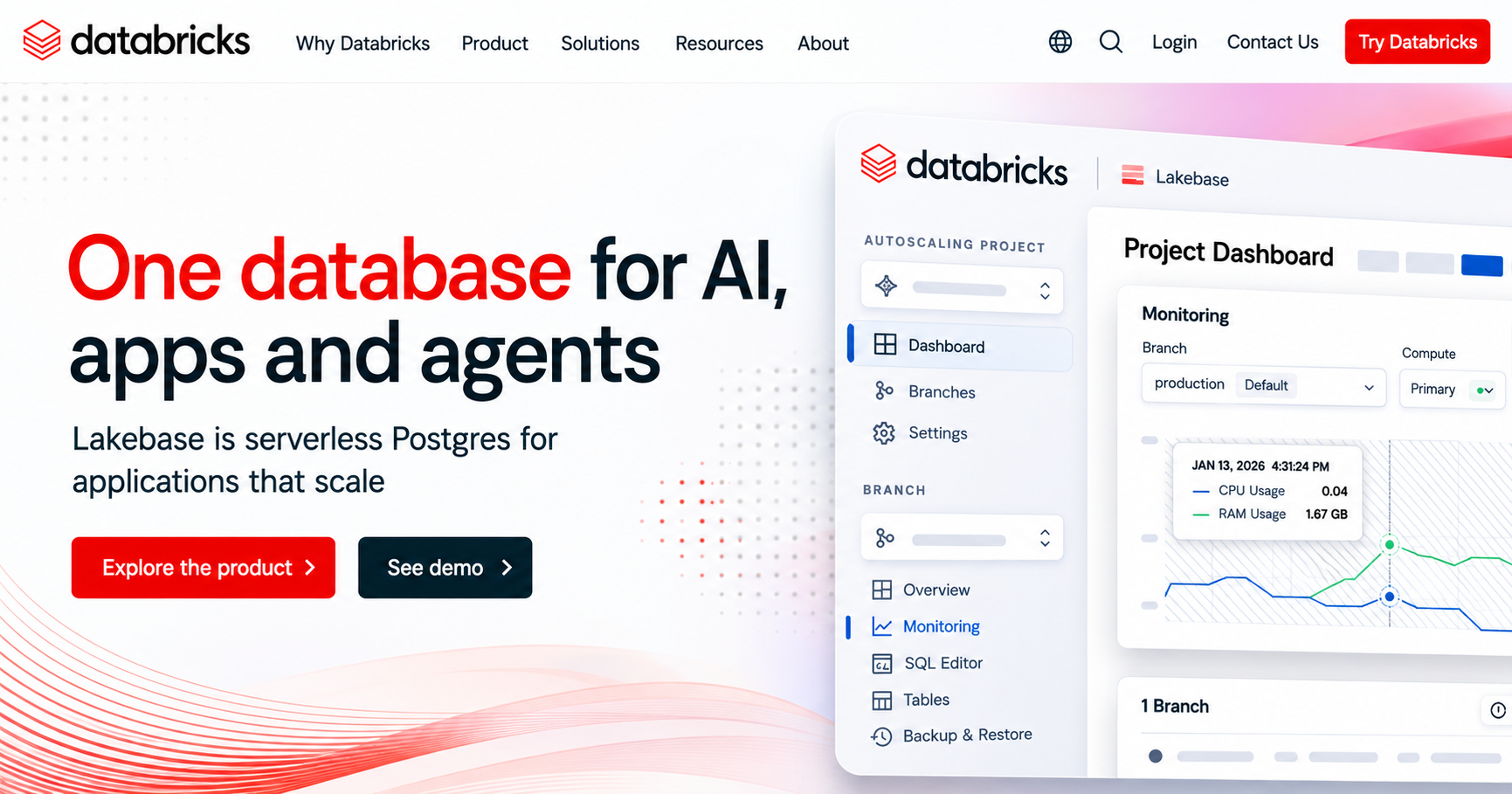
- Lakebase and Genie: a newer database built for AI agents, and a conversational assistant that lets employees ask questions of their data in plain language, both fast-growing recent additions.
- Open-source projects and data sharing: widely used open technologies the company created, plus tools to share data securely, reinforcing its open, multi-cloud approach.
This breadth shows that Databricks is a full data and AI platform, not a single tool, spanning storage, reliability, analytics, machine learning, AI agents, governance, databases, and data sharing. The lakehouse foundation and the strength in data engineering and AI are the core, while the wider suite lets organizations run much of their data and AI work in one place, which is a major reason large companies adopt it. For a business, the practical point is that Databricks can serve as the central platform for an organization’s entire data and AI strategy, and its rapid expansion into AI agents and AI-ready databases keeps it at the frontier, though using the full platform well requires skill and good cost management. The breadth and the AI focus are real and a major part of why Databricks is so valuable and widely used.
How Databricks Works and How It Charges
Understanding how Databricks works and bills, at least at a high level, is essential, because its pricing model is both a strength and a source of concern.
Databricks runs on the major cloud providers, Amazon, Microsoft, and Google, and lets organizations process their data using computing power they spin up on demand and release when finished. Crucially, it uses a consumption-based pricing model, meaning customers pay for what they actually use rather than buying fixed licenses or paying per-person seats, so the bill rises and falls with activity. Usage is measured in units the company calls Databricks Units, with different types of work and more advanced capabilities, like AI and machine learning, costing different and sometimes higher rates. Importantly, customers also pay their cloud provider separately for the underlying computing infrastructure that Databricks runs on, so the total cost combines Databricks’ own charges and the cloud costs beneath them. This means the real cost depends heavily on how much an organization uses the platform and how well it manages and optimizes that usage, which is the root of both its flexibility and the cost concerns the autopsy examines.
For a business, this model has real implications. On one hand, consumption pricing is flexible and fair in principle, since you pay for what you use and can scale up or down, and it can be cost-effective for the right workloads when managed well, which suits organizations with variable or growing needs. On the other hand, the combination of Databricks’ charges plus separate cloud costs, the different rates for different work, and the way costs scale with usage make the total bill truly hard to predict and easy to run up if usage is not carefully controlled, which is a widely cited concern. The honest framing is that Databricks’ consumption model is flexible and potentially cost-effective but also complex and unpredictable, rewarding organizations that actively manage their usage and surprising those that do not, which is why cost governance is so important and why the autopsy treats cost as a central consideration. Understanding that you pay for usage, plus the cloud costs beneath it, helps explain both the flexibility and the risk of surprising bills.
| Understanding Databricks Pricing Databricks uses consumption-based pricing measured in Databricks Units, where you pay for the processing you use, with different rates for different kinds of work and higher rates for advanced AI and machine learning. On top of this, you pay your cloud provider separately for the underlying computing power, so the total cost is the sum of both. This is flexible and can be efficient, but it makes costs hard to estimate in advance and easy to run up without discipline. To control spending, configure clusters to shut down automatically when idle, size them appropriately, monitor usage closely, tie costs to specific teams and projects, and consider committed-use discounts for predictable workloads. Because pricing is complex and varies by cloud, region, and workload, always model your expected costs carefully and check current pricing directly with Databricks. |
Who Uses Databricks
Databricks is used by a large number of major organizations, and knowing who relies on it shows both its dominance and its enterprise focus.
Databricks is used by more than twenty thousand organizations worldwide, including a large share of the biggest companies, with over sixty percent of the Fortune 500 relying on it, and hundreds of large enterprises each spending more than a million dollars a year on the platform, a sign of how deeply embedded it is in serious operations. Its customers span industries, from retail and manufacturing to finance, healthcare, media, and technology, and include many well-known global names across every sector. It is especially favored by organizations with serious data and AI ambitions and the technical teams to pursue them, since the platform’s depth suits complex data engineering, machine learning, and advanced AI work that simpler tools struggle with. Databricks is less aimed at small businesses or non-technical users and more at large, data-intensive organizations, which is reflected in its customer base of major enterprises with dedicated data teams.
This wide enterprise adoption signals that Databricks is truly dominant and trusted among the organizations that take data and AI most seriously, which is a strong endorsement of its technology. It also frames the autopsy’s considerations, because a platform aimed at large, sophisticated organizations with skilled teams is powerful but demanding, and its cost and complexity, while manageable for well-resourced enterprises, are real factors that the customer base reflects. For a business considering Databricks, the practical point is that it is a proven, widely trusted platform for serious data and AI work, which is reassuring, while being best suited to organizations with the scale, skills, and resources to use it well, rather than to small teams seeking simplicity. The dominance among serious enterprises is real, and so is the importance of having the right team and resources to match the platform.
How Big Databricks Has Become
The scale of Databricks is enormous, and the numbers explain why it matters so much, even if they move fast and should be checked against current sources.
By 2026, Databricks had become one of the most valuable private technology companies in the world, valued at well over a hundred billion dollars and reportedly in talks for an even higher valuation, placing it among the most valuable private companies anywhere, behind only a handful of others. Its revenue was growing at an extraordinary pace, reaching an annualized run rate in the billions of dollars and growing well over half year over year, with the company having turned free cash flow positive, a sign of financial health unusual for a company growing so fast. Both its AI products and its data warehousing business had each surpassed a billion dollars in annual revenue run rate, a rare milestone for two product lines inside one company at this stage, and it had more than twenty thousand customers. It remained private but was one of the most widely anticipated candidates for a major stock market debut, which many expected before long.
This scale signals that Databricks is one of the most important and successful data and AI companies in the world, central to how enterprises use data, financially strong, and growing remarkably fast. It also frames the autopsy’s considerations, because a company with such an enormous valuation faces high expectations that it must keep meeting, and the capital intensity of AI and the pressure on margins are real factors behind the numbers. For a business or observer, the practical point is that Databricks is a truly dominant, fast-growing, financially healthy company at the center of enterprise data and AI, and also one whose enormous valuation builds in high expectations and whose costs and competition are real considerations, which the later sections examine. The dominance and growth are real, and so are the expectations and risks that come with such a valuation.
How Databricks Makes Money
Understanding how Databricks makes money explains its model and its incentives.
Databricks makes money primarily through its consumption-based model, charging customers for the data processing and AI work they actually run on the platform, measured in its usage units called Databricks Units, rather than through fixed annual licenses or per-person seat fees. The more an organization uses the platform, across data engineering, analytics, machine learning, and AI, the more it pays, and more advanced AI and machine learning work, which uses more powerful and expensive computing, generally costs more per unit. This usage-based approach means Databricks’ revenue grows naturally as customers do more with their data and as AI workloads expand, which is a major reason its revenue has grown so fast as enterprises pour resources into AI. The model aligns Databricks’ revenue with how much value customers get from the platform in principle, while also tying its growth to the broader expansion of enterprise data and AI activity.
For a business, this model explains both Databricks’ pricing and its priorities. The consumption approach means costs scale with usage, which is flexible but requires management, and it gives Databricks a strong incentive to encourage more data and AI work on its platform, which aligns with helping customers do more but also means costs can grow. The push into AI agents and AI-ready databases reflects Databricks’ drive to capture the growing AI workloads of its existing customers. The honest framing is that Databricks makes money by charging for usage of its platform, a model that grows with customer activity and especially with AI, which is flexible and aligned with value but requires customers to manage their spending carefully. Understanding that Databricks earns more as you use it more, especially for AI, helps explain both its rapid growth and the importance of cost management that the autopsy examines.
Part 2: The Autopsy
The autopsy weighs Databricks’ genuine strengths against its real concerns. Its technology is best-in-class for data and AI and its dominance well earned, and it faces genuine questions about cost, complexity, governance, competition, and valuation. Both the excellence and the concerns are real, and because of that, both get full and even-handed treatment, including where the criticism comes from competitors with their own interests.
What Databricks Gets Right
The strengths are real and explain why Databricks is so dominant and admired among data and AI professionals and enterprises.
Pioneering the Lakehouse
Databricks created the lakehouse architecture that unified data warehouses and data lakes into a single system, an influential innovation that much of the rest of the data industry went on to adopt. This original contribution solved a real problem and remains the foundation of its strength and reputation.
Best-in-Class for Data and AI
Databricks is widely considered the strongest platform for serious data engineering, machine learning, and AI work, especially at large scale and with complex or unstructured data like text, images, sensor data, and event streams. For organizations building real, production AI on their own data, it is often the clear, best-in-class choice in the market.
Open-Source Foundations
Databricks built and maintains several widely used open-source technologies and emphasizes open data formats, which reduces lock-in concerns and earns trust among technical buyers. This open approach is a real strength that distinguishes it and reassures technically minded buyers.
True Multi-Cloud Flexibility
Databricks runs across all three major clouds with unified governance across them, letting organizations avoid being locked to a single provider and keep their options open. This real multi-cloud flexibility is a clear advantage for large enterprises that value choice and resilience.
Extraordinary Momentum and Innovation
Databricks grows faster than almost any software company its size, ships constant product innovation, and has repeatedly bet correctly on big shifts like the lakehouse and generative AI ahead of the market. This momentum and foresight keep it at the frontier and are a real strength.
Financial Health at Scale
Despite its rapid growth and heavy investment in new products, Databricks turned free cash flow positive, a sign of real financial discipline that is quite unusual for a company growing this fast. This financial health is a real strength that supports its staying power.
These strengths make Databricks a truly dominant, best-in-class, and influential data and AI platform whose technology and momentum are admired across the industry. The concerns that follow are real and important, especially around cost and complexity, but they do not erase the fact that Databricks pioneered an influential architecture and delivers excellent, leading capabilities for serious data and AI work, which is why it commands such a central place among the world’s biggest organizations.
The Cost and Bill Shock Concern
The most commonly cited concern about Databricks is cost, specifically how its consumption-based pricing can produce unexpectedly large and hard-to-predict bills, which deserves careful, balanced treatment since it matters greatly to anyone budgeting for the platform.
Because Databricks charges for usage, with its own charges layered on top of the separate cloud computing costs you pay to your provider, and because rates vary by the type of work, the total cost can be difficult to estimate in advance and easy to run up quickly without careful management. A common pattern is that organizations underestimate their costs at first and face sticker shock, with mid-sized data teams sometimes reporting bills of tens of thousands of dollars a month and large enterprises far more, particularly before they put usage discipline and cost monitoring in place. Costs can climb when computing clusters are left running while idle, when exploratory work becomes an always-on habit, when usage grows faster than oversight, or when AI workloads, which are more expensive, expand across the organization. Rivals point out that Databricks has historically offered less built-in cost governance, such as enforced spending limits, than some alternatives, though the company provides tools and discounts to help manage spending. The concern is real and widely reported, even though it is largely manageable with good practices.
The honest framing balances the real concern with the manageable context. On one hand, this is a genuine and widely cited issue: Databricks’ costs are hard to predict, can grow quickly, and have surprised many organizations, particularly those without strong cost discipline, and the dual nature of the billing, the company’s charges plus cloud costs, makes it harder to forecast than some simpler alternatives, so cost is a real consideration that prospective users must take seriously. On the other hand, consumption pricing is flexible and fair in principle, the costs are controllable with good practices like shutting down idle resources and monitoring usage, the platform can be cost-effective for the right workloads, and these dynamics are common to consumption-based cloud tools rather than unique to Databricks. The fair takeaway is that Databricks’ cost is a real, significant concern centered on unpredictability and the risk of running up large bills, while being largely manageable for organizations that actively govern their usage, so the issue is more about discipline and planning than fundamental overpricing. For a business, the practical point is to take cost management seriously from the start, follow the practices in the pricing callout, model your expected costs carefully, and treat governance as essential rather than optional.
Complexity and the Skills Barrier
A second major and genuine concern is that Databricks is complex and demands skilled people, which can make it difficult or impractical for some teams, and which deserves clear treatment.
Databricks is a powerful, flexible platform, and that power comes with real complexity that cannot be wished away. Using it well typically requires skilled data engineers familiar with its tools, including the underlying Apache Spark data-processing technology and the platform’s many components, and learning to use it effectively can take several weeks or longer for an engineer. Teams need to manage computing clusters, configure the platform correctly, and follow good practices to control both cost and performance, which requires dedicated technical expertise and ongoing attention rather than a one-time setup. By contrast, its main rival is widely seen as simpler and more accessible, especially for organizations whose needs are mainly business reporting with familiar query language, where a more managed, less hands-on platform is easier. This means Databricks can be more than a team needs, or more than it can handle, if the organization lacks the technical skills or has simpler requirements, which is a real barrier for some.
The honest framing keeps this in proportion. On one hand, the concern is genuine: Databricks’ complexity demands skilled teams and real effort, its learning curve is steeper than simpler alternatives, and it can be overkill or impractical for organizations without strong technical resources or with mainly simple reporting needs, so the skills barrier is a real consideration that affects who should use it. On the other hand, the complexity is the flip side of genuine power and flexibility, well-resourced organizations with skilled teams handle it readily and benefit from the depth, and the platform’s capability for serious data and AI work justifies the demands for those who need that capability. The fair takeaway is that Databricks’ complexity and skills requirements are a real barrier that makes it best suited to organizations with strong technical teams and serious data and AI needs, and a poor fit for those wanting simplicity or lacking the skills, so the right match depends heavily on a team’s capabilities and goals. For a business, the practical point is to honestly assess whether your team has the skills and whether your needs justify the complexity, and to consider simpler alternatives if your requirements are mainly basic reporting.
Governance and Reliability Debates
Databricks faces criticism, much of it from its main competitor, over certain governance, reliability, and enterprise-readiness gaps, which deserves even-handed treatment given the source.
Its main rival, Snowflake, argues that Databricks falls short in several enterprise areas: that business continuity and disaster recovery require significant do-it-yourself effort and time rather than being built in, that its governance system has gaps in fine-grained access controls and advanced privacy features that more established catalogs include, that managing it across multiple clouds and regions adds complexity, and that it lags in built-in cost governance like enforced spending limits and query-level cost attribution. These are pointed criticisms from a direct competitor with a clear interest in winning customers, so they should be weighed as a rival’s framing rather than neutral fact, and Databricks disputes or addresses many of them and continues to improve these areas. Still, they touch on real considerations for large, regulated organizations that need strong governance, reliability, and disaster readiness out of the box, and prospective enterprise buyers should evaluate these capabilities carefully for their own needs.
The honest framing weighs the criticism and its source together. On one hand, the concerns point to real, legitimate considerations: large enterprises do need strong governance, reliable disaster recovery, and cost controls, and to the extent Databricks requires more effort or has gaps in these areas, that is a genuine factor for buyers with strict requirements, so the criticisms are not baseless. On the other hand, much of this criticism comes directly from Snowflake, a competitor with an obvious interest in portraying Databricks unfavorably, Databricks disputes or has addressed many of the points and keeps improving, and these capabilities can often be implemented with effort, so the framing should be treated with appropriate skepticism rather than accepted at face value. The fair takeaway is that Databricks faces real, legitimate questions about out-of-the-box governance, disaster recovery, and cost controls for demanding enterprises, while much of the sharpest criticism comes from a competitor and should be verified independently rather than taken as neutral truth. For a business, the practical point is to evaluate Databricks’ governance, reliability, and disaster-recovery capabilities carefully against your own requirements, using independent testing rather than either vendor’s marketing, since the truth depends on your specific needs.
The Lock-In Question
A nuanced consideration is vendor lock-in, where Databricks both reduces and creates dependence, which deserves balanced treatment.
Databricks emphasizes open data formats, meaning your data can in principle be read by other tools and engines rather than being trapped in a proprietary format only Databricks can open, which truly reduces one important kind of lock-in and is a real advantage over more closed approaches. However, lock-in is not only about data formats. Organizations that build extensively on Databricks develop dependence through their workflows, their governance setup, the skills their teams build around the platform, and the institutional knowledge of its particular ways of working, all of which make switching costly even when the underlying data is portable. This is true of major platforms generally, including its rivals, so it is not unique to Databricks, but it means that adopting Databricks deeply, like adopting any major platform, creates real practical dependence over time despite the open formats.
The honest framing notes both sides. On one hand, Databricks truly reduces data-format lock-in through its open approach, which is a real and meaningful advantage that gives organizations more freedom and is better than proprietary alternatives, so its open philosophy deserves credit. On the other hand, deep adoption of any major platform, including Databricks, creates practical lock-in through workflows, skills, and institutional knowledge, so the open formats reduce but do not eliminate dependence, and switching remains costly in practice. The fair takeaway is that Databricks is truly more open than many alternatives and reduces an important kind of lock-in, while deep adoption still creates real practical dependence common to all major platforms, so its openness is a real benefit but not a guarantee of easy switching. For a business, the practical point is to value Databricks’ openness while recognizing that committing deeply to any platform involves real switching costs, and to weigh that dependence as part of a long-term decision.
The Valuation and IPO Question
For a company carrying such an enormous valuation and widely expected to go public, Databricks’ valuation and the expectations built into it are a real consideration, especially for anyone thinking about its eventual stock, and it deserves clear, factual treatment as information rather than advice.
Databricks’ valuation has risen to well over a hundred billion dollars, and was reportedly climbing further in new funding talks, making it one of the most valuable private companies in the world, behind only a small handful of others, and it is widely expected to go public before long. Such a high valuation builds in expectations of continued extraordinary growth, and analysts note that justifying it requires Databricks to keep growing fast across data and AI, to fend off intense competition, and to manage the heavy capital costs of AI infrastructure, which are pressuring margins as AI usage grows. The company’s strong growth, financial health, and dominant position support the optimism, but the law of large numbers makes sustaining such growth harder as the company gets bigger, and any stumble could matter a great deal given the high expectations. As with any company approaching a public listing, the valuation reflects both real strength and significant assumptions about the future.
The honest framing presents this as genuine consideration, neutrally and without giving advice. On one hand, the valuation builds in high expectations that carry real risk: Databricks must keep growing extraordinarily fast, win against strong competition, and manage rising AI costs and margin pressure to justify its worth, which is a demanding bar, and the law of large numbers makes that progressively harder. On the other hand, Databricks has truly strong fundamentals, remarkable growth, financial health, a dominant position, and a track record of getting big bets right, which support the optimism more than for many highly valued companies. The fair takeaway is that Databricks is a truly strong, dominant, fast-growing company whose enormous valuation also builds in high expectations and real risk, so its future, while promising, is not guaranteed and depends on continued exceptional execution. For anyone considering its eventual stock, the practical point is that this will be a high-expectation, high-potential proposition whose valuation assumes continued strong performance, and decisions should involve careful research and professional financial advice, since this review is informational and not a recommendation.
What You Cannot Fully Verify
In the interest of honesty, here is what is hard to assess definitively about Databricks, and which depends on circumstances and on factors that are not fully public or settled.
- Your specific costs, which depend heavily on your workloads, usage patterns, cloud choices, and how well you manage and optimize spending.
- How Databricks truly compares to rivals for your needs, since much comparison comes from the vendors themselves and real performance depends on your specific workloads.
- Whether Databricks will sustain its extraordinary growth and justify its valuation, which depends on execution and competition no one can guarantee.
- How its newer products and many acquisitions will integrate and perform over time.
- The exact, current figures for valuation, revenue, growth, and pricing, which move fast and should be checked against the latest sources.
This is not a list designed to undermine truly excellent technology so much as a reminder that adopting Databricks, like any major platform, involves real commitment, cost, and some uncertainty. A review can tell you that Databricks offers best-in-class, influential, and truly powerful data and AI capabilities used by most of the world’s biggest companies, and that it carries real concerns around cost, complexity, and the expectations built into its valuation. It cannot predict your exact costs, how it will perform for your specific needs, or whether its growth will continue. The honest guidance is to use Databricks for its genuine strengths while managing its cost and complexity carefully, ensuring you have the right team, evaluating it against your real needs with independent testing, and going in with clear eyes about both the strong capabilities and the real considerations.
Part 3: The Killcritic
The killcritic is the verdict. Who Databricks suits, who should be cautious, and how it compares to the alternatives.
Who Databricks Is For
Databricks suits many organizations extremely well, with the fit depending on your data needs, your team, and how you weigh the cost and complexity.
Data Engineering and AI Teams
If your organization does serious data engineering, machine learning, or AI on large or complex data, Databricks is often the best, most capable platform available, with depth that simpler tools cannot match. For data and AI heavy work, it is frequently the clear choice.
Large, Data-Intensive Enterprises
If you are a large organization with significant data, skilled technical teams, and the resources to manage the platform, Databricks offers the capability, scale, and governance to serve as your central data and AI platform, making it well suited to major enterprises.
Organizations Embracing AI
If you are investing seriously in building AI on your own data, including AI agents, Databricks’ AI tools and lakehouse foundation are best-in-class for that purpose, making it an excellent fit for organizations pursuing real, production AI.
Multi-Cloud and Open-Format Adopters
If you value multi-cloud flexibility and open data formats to avoid being tied to one vendor, Databricks’ open, multi-cloud approach is a genuine strength, making it well suited to organizations that prioritize choice and portability.
For these organizations, especially data-engineering and AI heavy enterprises with skilled teams, Databricks offers real, often best-in-class value, provided they manage cost and complexity well and match the platform to real needs.
Who Should Be Cautious
Others should approach Databricks with extra care or consider alternatives, depending on their needs, skills, and resources.
SQL-First Reporting Teams
If your needs are mainly business reporting and analytics with familiar query language, Databricks may be more complex than necessary, so consider whether a simpler, more managed data warehouse better fits simple reporting work without the added complexity.
Teams Without Strong Technical Skills
If your organization lacks skilled data engineers comfortable with the platform, Databricks can be difficult to use and manage, so weigh whether you have the skills or whether a simpler, more accessible tool suits your team better.
Cost-Sensitive Organizations Without Governance
If you cannot commit to active cost management, Databricks’ consumption pricing can produce surprising bills, so either invest in strong cost governance from the start or consider more predictable alternatives, since uncontrolled usage can become expensive.
Small Businesses and Simple Needs
If you are a small business or have modest, simple data needs, Databricks is likely more platform than you require, so consider lighter, simpler, cheaper tools rather than adopting a powerful enterprise platform built for large, complex organizations.
Databricks vs the Alternatives
The most practical comparison is Databricks against other data platforms, and the honest answer is that Databricks leads on data engineering and AI while alternatives suit simpler analytics better.
| Option | Best For | Trade-offs |
|---|---|---|
| Databricks | Data engineering, ML, and AI | Complexity, cost management, skills needed |
| Snowflake | SQL analytics and simple BI | Less depth for ML and custom AI work |
| Cloud-native tools | Single-cloud, integrated needs | Less portable, tied to one provider |
| Traditional warehouses | Established reporting setups | Older, less suited to AI and scale |
| Running both | Engineering plus governed BI | Higher complexity and dual cost |
For most organizations, the choice depends on the kind of work they do. Databricks is the strongest platform for heavy data engineering, machine learning, and AI, especially with complex or large-scale data, which is its core advantage. Its main rival, Snowflake, is widely seen as simpler and better for organizations focused mainly on business reporting and analytics with familiar query language, where ease of use matters most. Cloud providers offer their own integrated data tools that suit organizations committed to a single cloud but are less portable. Traditional data warehouses still serve established reporting needs but are less suited to modern AI and scale. Many large organizations run both Databricks and a simpler warehouse, using each for what it does best, at the cost of added complexity. The honest take is that Databricks is the best choice for serious data engineering and AI, while simpler alternatives suit simple analytics better, so the right choice depends on your workloads, team, and priorities. For organizations doing real data and AI work, Databricks is truly the leading option, balanced against the cost and complexity this review covers.
Is Databricks Worth the Cost
A practical question many organizations ask is whether Databricks is worth its cost, and the honest answer depends on your needs and management.
The Real Value
For organizations doing serious data engineering and AI on significant data, Databricks delivers real, often best-in-class capability that can justify its cost by enabling work simpler tools cannot, especially when the platform is used well and its value is high.
The Cost Reality
Databricks’ consumption pricing can become expensive and unpredictable without discipline, so its value depends heavily on managing usage well, and for simpler needs or poorly governed usage, the cost may not justify the platform over simpler alternatives.
The Honest Call
For organizations with serious data and AI needs, skilled teams, and good cost management, Databricks is often worth the cost, delivering capability and value that justify the investment. For those with simpler needs, weaker technical skills, or no commitment to cost governance, the expense and complexity may not be worth it compared with simpler tools. The key is to match the platform to real needs and to manage cost actively, so you capture Databricks’ genuine value without being surprised by the bill. The fair framing is that Databricks is worth the cost for organizations that need its capabilities and manage it well, and less so for those with simpler needs or uncontrolled usage, so its value depends on your needs and discipline rather than being universal. Used well by the right organization for the right work, Databricks delivers real, often exceptional value.
The Final Verdict
| Databricks Final Rating: 4 / 5 A truly dominant and best-in-class data and AI platform, Databricks pioneered the influential lakehouse architecture, leads in data engineering, machine learning, and AI, embraces open formats and multi-cloud flexibility, grows faster than almost any software company its size, and has turned free cash flow positive, which is why most of the world’s biggest companies rely on it. It is held back from a perfect score by real concerns: a consumption-based pricing model that can produce surprising, hard-to-predict bills without strong discipline, genuine complexity that demands skilled teams and makes it overkill for simpler needs, governance and reliability questions that rivals highlight, and an enormous valuation that builds in high expectations and real risk. Truly excellent, influential, and the leading choice for serious data and AI work, with real and important considerations around cost, complexity, and expectations that every prospective user should weigh and plan for. |
Use Databricks if your organization does serious data engineering, machine learning, or AI, has skilled technical teams, and can manage cost and complexity well. For data and AI heavy enterprises, Databricks offers real, often best-in-class value, and its capabilities and momentum are exceptional.
Be cautious or consider alternatives if your needs are mainly simple reporting, your team lacks strong technical skills, you cannot commit to cost governance, or you are a small business with modest needs. In those cases, weigh the complexity and cost carefully against simpler tools.
Databricks earns genuine and substantial credit for pioneering the lakehouse, leading in data and AI, and growing into a dominant, financially healthy platform that most of the world’s biggest companies rely on. The 4 out of 5 reflects that real, best-in-class capability and influence, tempered honestly by real concerns: a consumption pricing model that can produce surprising bills without discipline, genuine complexity that demands skilled teams and suits serious needs rather than simple ones, governance and reliability questions that rivals raise and that buyers should verify independently, and an enormous valuation that builds in high expectations and real risk. For technical capability, innovation, and momentum, Databricks is exceptional. The keys to using it well are to match the platform to real data and AI needs, ensure you have the skills, manage cost actively from the start, and evaluate it against alternatives with independent testing rather than vendor marketing. Used well by the right organization for the right work, Databricks is a strong, leading, and often exceptional platform, while the real considerations around cost, complexity, and expectations mean it should be adopted with clear eyes and good planning rather than blindly. The excellence is real, and so are the important caveats, so build on it with both in view.
Frequently Asked Questions
This section answers the specific questions people search for about Databricks. Each answer is structured for direct factual extraction.
What is Databricks?
Databricks is a data and artificial intelligence company that provides a cloud-based platform for storing, managing, analyzing, and building artificial intelligence on large amounts of business data, all in one place. Founded in 2013 by the creators of the open-source Apache Spark project at the University of California, Berkeley, it pioneered the lakehouse architecture, which unifies data warehouses and data lakes into one platform. More than twenty thousand organizations, including over sixty percent of the Fortune 500, use Databricks for data engineering, analytics, machine learning, and AI. It runs across the major clouds, is built on open-source foundations, and is one of the most valuable private technology companies in the world.
Who owns Databricks?
Databricks is a private company owned by its founders, employees, and a large group of investors. It was founded by seven creators of Apache Spark from the University of California, Berkeley, including Ali Ghodsi, who is chief executive, and Ion Stoica, who is chairman. Over the years it has raised enormous amounts of money from many prominent venture capital, investment, and strategic firms, which hold significant stakes. Because Databricks is private, its shares are not traded on public markets, though it is widely expected to go public before long. The founders remain closely involved in leading the company, and its ownership is spread across founders, staff, and its many investors.
Is Databricks publicly traded?
No, Databricks is not yet publicly traded, but it is one of the most widely anticipated candidates for a major stock market debut. As of 2026 it remains private, having raised very large amounts of money through private funding rounds at ever-higher valuations, reaching well over a hundred billion dollars. Its chief executive has indicated the company is ready to go public and has not ruled out doing so when market conditions are favorable, and many analysts and investors expect a listing before long. Until that happens, Databricks shares cannot be bought on a public exchange, though its eventual initial public offering is among the most anticipated in technology.
Who founded Databricks?
Databricks was founded in 2013 by seven people who created the open-source Apache Spark project at the University of California, Berkeley: Ali Ghodsi, Ion Stoica, Matei Zaharia, Patrick Wendell, Reynold Xin, Andy Konwinski, and Arsalan Tavakoli-Shiraji. They started the company to build a business around Apache Spark and to help organizations use large-scale data. Ali Ghodsi became chief executive in 2016 and has led the company through its growth into a dominant data and AI platform. Ion Stoica, an early chief executive, stepped back into academia but remains chairman, and Matei Zaharia, the creator of Spark, serves in a senior technical role, so the founding team remains closely involved in the company.
What is a data lakehouse?
A data lakehouse is an approach to managing data that Databricks pioneered, combining the strengths of two older systems into one platform. Traditional data warehouses were good for structured data and fast reporting but expensive and limited, while data lakes stored large amounts of varied raw data cheaply but were messy and weak for reliable analytics. The lakehouse combines the low cost and flexibility of a data lake with the reliability, structure, and performance of a data warehouse, letting organizations keep all their data in one place and use it for everything from business reporting to machine learning and AI. This avoids maintaining two separate systems and constantly moving data between them, saving cost and complexity, which is why the lakehouse became influential.
How much does Databricks cost?
Databricks uses consumption-based pricing, meaning you pay for the data processing and AI work you use rather than fixed licenses or per-person fees, measured in units called Databricks Units, with different rates for different kinds of work and higher rates for advanced AI and machine learning. Importantly, you also pay your cloud provider separately for the underlying computing power, so the total cost combines both. This makes costs flexible but hard to predict and easy to run up without careful management, with mid-sized teams sometimes spending many thousands of dollars a month and large enterprises far more. Because pricing is complex and varies by cloud, region, and workload, model your expected costs carefully and check current pricing directly with Databricks.
Is Databricks better than Snowflake?
It depends on your needs. Databricks is generally better for serious data engineering, machine learning, and AI, especially with large or complex data, where its depth and flexibility lead, making it the stronger choice for organizations building real AI on their data. Snowflake is widely seen as simpler and better for organizations focused mainly on business reporting and analytics with familiar query language, where ease of use and low management matter most. Both are leaders, and many large organizations use both, applying each to what it does best. For data and AI heavy work, Databricks is usually the better choice, while Snowflake may suit simple analytics better, so the right pick depends on your workloads, team skills, and priorities rather than one being universally better.
What is Unity Catalog?
Unity Catalog is Databricks’ system for governing data, meaning it manages who can access what data, keeps data organized and secure, and provides oversight across an organization’s data, including across multiple clouds. For large and regulated organizations, this kind of governance is essential, since they need to control access to sensitive data, track its use, and ensure security and compliance. Unity Catalog aims to provide this unified governance for everything in the Databricks platform. Its main rival argues that it has gaps in certain advanced controls compared with established alternatives, a competitor’s criticism that buyers should evaluate independently, but it remains a central part of how Databricks supports enterprise data governance and security.
What is Mosaic AI and Agent Bricks?
Mosaic AI and Agent Bricks are Databricks’ tools for building artificial intelligence on an organization’s own data. Mosaic AI provides capabilities for building, training, and serving machine learning and AI models, which Databricks strengthened through an acquisition that brought generative AI expertise. Agent Bricks is a newer offering for building production AI agents, software that can perform tasks using an organization’s data, on top of the Databricks platform. Together they reflect Databricks’ major push into AI, letting organizations build and deploy AI applications and agents using their own governed data within the lakehouse. These AI capabilities are central to Databricks’ strategy and are among the fastest-growing parts of its business as enterprises invest heavily in AI.
Is Databricks hard to learn?
Databricks can be challenging to learn, especially for those new to its underlying data-processing technology, with the learning curve often taking weeks or longer for engineers to become proficient. It is a powerful, flexible platform that requires skilled data engineers to use and manage well, including configuring computing clusters and following good practices for cost and performance. By contrast, its main rival is widely seen as simpler and more accessible for simple analytics. This means Databricks suits organizations with strong technical teams and serious data needs, and can be difficult for those without such skills or with simpler requirements. Investing in skilled people and training is important to use Databricks effectively, which is part of weighing whether it fits your organization.
Common Mistakes and Tips When Using Databricks
This section captures the most common mistakes organizations make with Databricks and how to avoid each. Following these helps you capture the platform’s value while avoiding the most common problems.
Mistake: Ignoring cost management until the bill arrives
Mitigation: Databricks’ consumption pricing can produce surprising bills. Set up cost governance from the start, configure clusters to shut down automatically when idle, monitor usage closely, tie costs to teams and projects, and use committed-use discounts for predictable workloads, rather than discovering costs only after they have climbed.
Mistake: Adopting Databricks without the right skills
Mitigation: The platform demands skilled data engineers. Ensure your team has or can build the necessary expertise, invest in training, and consider whether a simpler tool fits better if you lack the skills, rather than adopting a powerful, complex platform your team cannot use well.
Mistake: Using Databricks for simple needs better served elsewhere
Mitigation: Databricks can be overkill for simple business reporting. Honestly assess whether your needs justify its complexity, and consider a simpler, more managed data warehouse if your work is mainly simple analytics, rather than over-adopting a platform built for complex data and AI.
Mistake: Leaving computing clusters running while idle
Mitigation: Idle clusters that keep running drive up costs needlessly. Configure automatic shutdown for idle resources, size clusters appropriately for the work, and review usage regularly, since leaving compute running when not in use is one of the most common and avoidable sources of high bills.
Mistake: Trusting vendor comparisons at face value
Mitigation: Much comparison between Databricks and rivals comes from the vendors themselves. Evaluate the platforms against your own needs with independent testing and trials rather than relying on either side’s marketing, since real performance and cost depend heavily on your specific workloads and team.
Mistake: Underestimating the value of open formats and governance
Mitigation: Databricks’ open formats reduce lock-in, and good governance is essential at scale. Take advantage of open data formats to preserve flexibility, and invest properly in governance and access controls for security and compliance, rather than neglecting these foundations as your data and AI use grow.
Final Notes on This Review
This review was built using a query fan-out approach designed to answer the questions people actually search for about Databricks, organized into topic clusters that map to how Google’s AI Overview surfaces answers. Every claim is grounded in a source: Databricks’ public information, independent reporting and analysis, market data, competitor comparisons, and user feedback, with criticism that comes from competitors such as Snowflake clearly identified as a rival’s perspective rather than neutral fact, and with Databricks’ own responses noted where relevant.
Figures for valuation, revenue, growth, and pricing reflect publicly available information as of mid-2026 and change fast. Pricing, products, and the company’s status can change, so verify current details directly with Databricks before committing or making any decisions. This review is informational and not investment or financial advice. Above all, use Databricks for its genuine, best-in-class strengths while managing its cost and complexity carefully, ensuring you have the right team, evaluating it against your real needs with independent testing, and going in with clear eyes about both the strong capabilities and the real considerations this review covers.
More brand reviews on brands.run
brands.run publishes honest, independent reviews of brands across every category, from data and AI platforms to finance, food, and more. Explore the latest reviews on the brands.run homepage.
Review of Databricks | Last updated: June 2026 | Reviewer: brands.run editorial team | Independent review. Figures, pricing, and the company’s status change fast, so verify current details before relying on them. Not investment advice.
Databricks and its product names are trademarks of Databricks, Inc. Snowflake and other names mentioned are trademarks of their respective owners. All product names, logos, and brands are the property of their respective owners. Use of these names here does not imply any affiliation or endorsement. This review is for general informational purposes only and reflects publicly available information, competitor comparisons, and user feedback as of mid-2026. It is not investment or financial advice. Criticism attributed to competitors is presented as such and should be independently verified.