
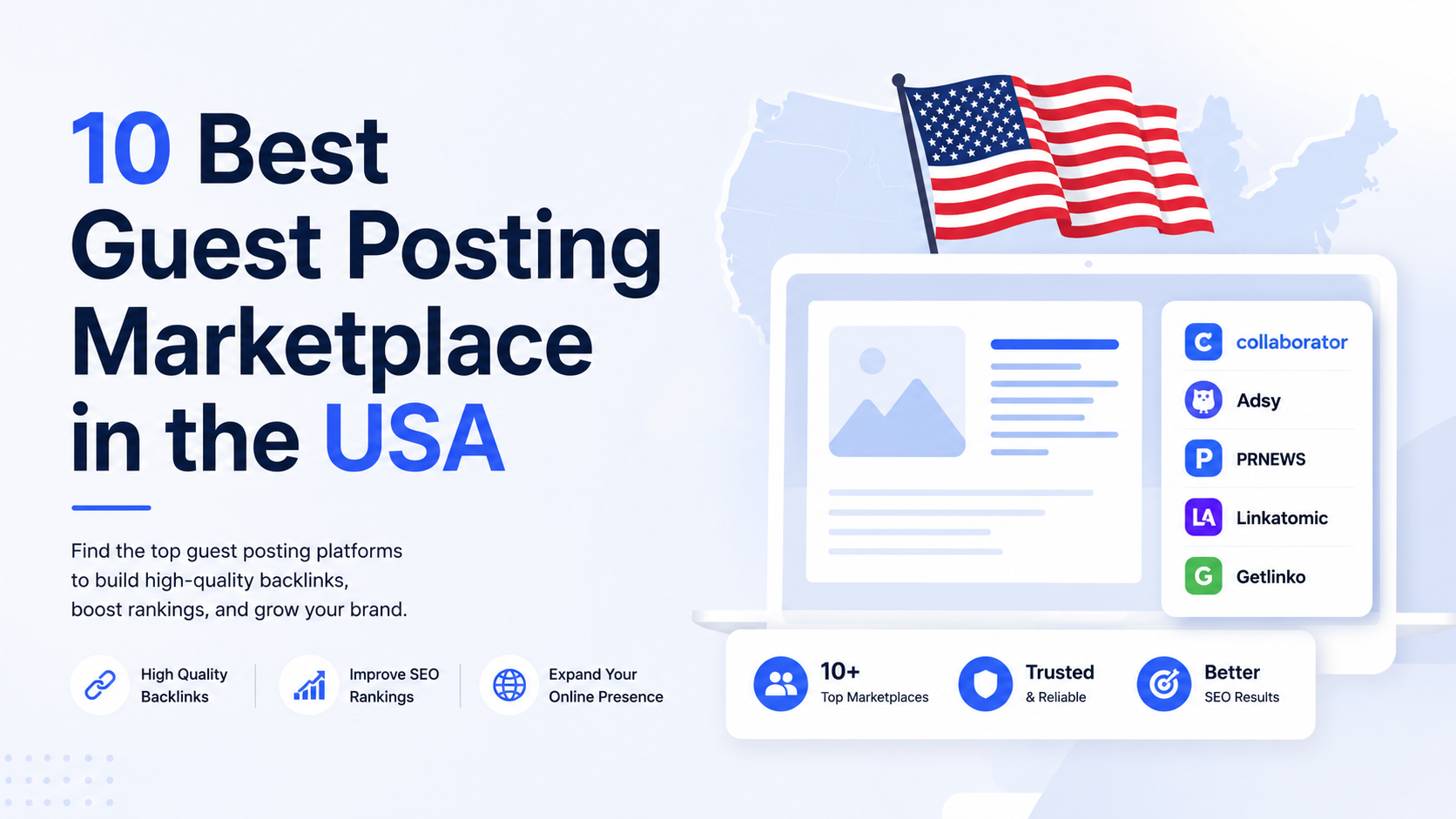
An honest, non-biased comparison of the top guest posting marketplaces and services for US buyers, ranked on publisher quality, real traffic, pricing, transparency, and speed, with a clear best pick and a buyer’s guide
Thank you for reading this post, don't forget to subscribe!By Gary Vee | brands.run | The rundown on every brand
Independent guide. We are not paid to rank any platform. Prices and features change, so confirm current details on each provider’s site before buying.
Quick Answer
The best guest posting marketplace in the USA for most buyers is Collaborator, because it pairs a large, vetted publisher network with verified Google Analytics and Search Console traffic data, deep filtering, fast turnaround, and free link protection. It fits SEO teams and agencies that want control and clean data without cold outreach.
| Best Guest Posting Marketplaces in the USA, at a Glance Best overall: Collaborator, for verified traffic data, filtering, and speed. Best for scale and budget: Adsy, for one of the largest self-serve inventories and low entry prices. Best US-based managed service: The HOTH, for hands-off, package-based ordering with content included. Best premium managed: Loganix, for manually vetted, higher-authority placements. Best for agencies and white label: FatJoe, for fast blogger outreach and reseller-ready delivery. Best for white-hat manual placement: PRPosting, for human-checked posts across a very large global network. |
The rest of this guide explains what a guest posting marketplace is, how the main options compare for US buyers, how to judge quality, what a fair price looks like, and the mistakes that waste budget. Every pick below is chosen on the merits. We do not take payment for placement in this list.
What Is a Guest Posting Marketplace?
A guest posting marketplace is an online platform where businesses buy placements on third-party websites, and publishers list their sites for sale. Instead of emailing hundreds of blogs to pitch a guest post, you browse a catalog, filter sites by niche, traffic, and SEO metrics, and order a placement directly. The platform handles the connection, the payment, and often the content, then the article goes live with your link inside it.
This model is different from two other ways people build links. Manual outreach means finding sites and pitching editors yourself, which costs time but no marketplace fee. A managed service or agency does the work for you, picking sites, writing the content, and placing the link, for a higher price. A marketplace sits in the middle: more control and lower cost than a full agency, but faster and simpler than doing outreach from scratch. Some platforms blend these, offering both self-serve browsing and done-for-you packages.
For US buyers, marketplaces matter because the American market is competitive and publisher prices vary widely. A good marketplace shows you real traffic and metrics up front, so you can avoid dead blogs and inflated authority scores, and buy placements that actually help rankings and brand visibility. A weak one is full of private blog networks, fake numbers, and zero-traffic sites that can hurt you. The whole point of this guide is to separate the two.
Marketplace vs Managed Service vs Manual Outreach
Before the rankings, it helps to know which buying model fits you, because the best platform depends on how much work you want to do and how much control you want to keep.
| Model | You Control | Cost | Best For |
|---|---|---|---|
| Self-serve marketplace | Site choice and content | Lower | SEO teams that can vet sites |
| Managed service | Goals only, they execute | Higher | Busy teams and beginners |
| Manual outreach | Everything, hands-on | Time, not fees | Small budgets, niche control |
If you know SEO and want to pick each site yourself, a self-serve marketplace like Collaborator or Adsy is usually the better value. If you would rather hand over a target and get results back, a managed service like The HOTH or Loganix saves you the sourcing work. If your budget is tiny and you have time, manual outreach still works, it just does not scale well. Many US teams mix these, using a marketplace for volume and an agency for high-authority placements.
How We Ranked These Guest Posting Marketplaces
This list is based on the criteria that actually separate a strong platform from a risky one. We weighed each option on the same points, using public information, independent reviews, and the standards that matter for US campaigns in 2026.
- Publisher quality and vetting: does the platform check sites for real traffic, spam signals, and content standards, or does anyone with a domain get listed?
- Real traffic over vanity metrics: does it show verified traffic, ideally from Google Analytics and Search Console, instead of only a domain authority score that can be faked?
- Niche relevance and filtering: can you filter by topic, country, and language to find sites that fit a US audience and your industry?
- Pricing transparency: are prices clear before you buy, with no surprise fees, and is the value fair for the quality?
- Turnaround and support: how fast do posts go live, and is there help when an order stalls or a link drops?
- Buyer protection: are there link guarantees, replacements, or escrow so you are not left out of pocket?
No single platform wins on every point, so the picks below are grouped by what each one does best. Match the tool to your goal rather than chasing the one with the loudest claims.
The Best Guest Posting Marketplaces in the USA
Here are the platforms worth your budget in 2026, ranked by overall value for US buyers, with clear notes on who each one suits and where it falls short.
1. Collaborator, Best Overall
Collaborator is the strongest all-round guest posting marketplace for most US buyers. It connects you directly with tens of thousands of websites, plus a large set of Telegram channels, and lets you order placements without any cold outreach. What sets it apart is data honesty: it shows traffic verified through Google Analytics and Search Console, not just a domain score, so you can see whether a site actually gets visitors before you spend. The filtering is deep, with dozens of parameters for topic, country, language, traffic, and more, which makes finding relevant US sites fast.
Speed is another strong point, with a large share of orders going live within about two days, and it includes free link protection for several months, extendable further, so you are covered if a link drops. Content writing is available if you do not want to supply your own article. The main trade-offs are that the interface can feel busy at first because of all the filters, and its deepest inventory strength is international, so if you only want US sites you will still find plenty but will filter through a global catalog. For SEO teams and agencies that want control, clean data, and speed, it is the platform to start with.
Best for: SEO teams and agencies that want verified data and control. Watch for: a filter-heavy interface and a globally weighted catalog.
2. Adsy, Best for Scale and Budget
Adsy is the platform to pick when you want reach and low entry prices. It offers one of the largest self-serve inventories in the category, with a very large number of publisher sites across many niches, and a strong presence in the US and UK markets, which makes it a common reference point for American buyers. The dashboard is built for high-volume filtering by domain rating, traffic, and category, and it bakes in metrics like Moz and Ahrefs scores plus analytics traffic, so you can sort quickly. It also offers content writing and a link guarantee with monitoring.
The catch is that scale comes with more vetting on your side. With so many listings, quality varies, so you have to read the metrics carefully and avoid the weaker sites. The buying experience is not quite as smooth or curated as the very top platforms, and prices climb for higher-authority placements. Still, for startups, affiliates, and agencies that want volume without a big per-link cost, and are willing to filter, Adsy delivers more options for less than almost anything else.
Best for: high-volume, budget-conscious US and UK campaigns. Watch for: variable quality that needs careful vetting.
3. The HOTH, Best US-Based Managed Service
If you would rather not pick sites yourself, The HOTH is the most established hands-off option based in the United States. It has been in SEO for over twenty years, runs on preset packages where you choose how many links and what content you want, and then handles the writing, outreach, and placement for you. It offers guest posts, niche edits, and link insertions, sorted by domain rating tier, plus a self-service dashboard with reporting so you can track everything in one place. That structure makes it popular with small and mid-sized US businesses and with agencies managing many clients.
Because it is a managed, productized service, it costs more than pure self-serve marketplaces, and you give up some control over exactly which sites get used, though you choose the authority tier. Placements start in the mid-hundreds per post and rise with authority. For beginners, busy owners, and agencies that want reliable, repeatable delivery without sourcing sites, The HOTH is a safe, well-known choice with a long track record.
Best for: hands-off buyers and agencies wanting packaged delivery. Watch for: higher cost and less site-level control.
4. Loganix, Best Premium Managed
Loganix is the pick when placement quality matters more than price. It is a US-based fulfillment partner used by many agencies, and it manually vets every publisher for traffic, spam score, and topical authority before placing a link, which is exactly the kind of care that keeps a backlink profile clean in 2026. It works well as a white-label service, so agencies can resell it, and it focuses on consistent, higher-authority placements rather than cheap volume.
The trade-off is simple: this is a premium service, so it costs more per link than a budget marketplace, and it is built for buyers who value quality and low oversight over the lowest possible price. If you are an agency or an established brand that wants vetted, reliable placements with minimal hand-holding, Loganix is one of the most trusted names for the job.
Best for: agencies and brands wanting vetted, premium placements. Watch for: premium pricing, not for tight budgets.
5. FatJoe, Best for Agencies and White Label
FatJoe is built for agencies and resellers that need a fast, dependable supply chain. Its marketplace-style platform makes ordering blogger outreach and niche edits quick, with content included in most packages and a workflow designed to be white-label ready, so agencies can deliver under their own brand. It covers a wide range of authority tiers and niches, and it is known for a simple ordering process that scales across many client campaigns at once.
As with any productized outreach service, you are trusting FatJoe’s network and process rather than hand-picking each site, and very high-authority or highly specialized placements may need a more bespoke provider. But for digital agencies that want to fulfill guest posts and niche edits at volume, without building an in-house outreach team, FatJoe is one of the most practical options available to US agencies.
Best for: agencies and white-label resellers at volume. Watch for: less control over individual site selection.
6. WhitePress, Best for International Reach
WhitePress suits US brands that also need placements beyond the United States. It is a large content marketing and guest posting platform with particular strength in Europe and in multilingual campaigns, connecting advertisers with publishers across many countries and languages. For an American company expanding into other markets, that breadth is hard to match, and the platform is well regarded by agencies running cross-border work.
For a purely US campaign, its international weighting means you may sort through a lot of non-US inventory, and some other platforms have a tighter US focus. But if your growth plan includes Europe or other regions, WhitePress gives you one place to run multi-country guest posting with local-language options, which makes it a strong specialist pick rather than a pure US play.
Best for: US brands running international or multilingual campaigns. Watch for: heavier non-US inventory to filter through.
7. PRPosting, Best for White-Hat Manual Placement
PRPosting is a good fit for buyers who care about manual, human-checked placement across a very large network. It offers access to more than twenty thousand websites across many countries, with every post placed by real people rather than automation, which appeals to teams focused on white-hat SEO and brand-safe links. It shows metrics from several SEO tools, supports regional targeting and niche filters, and offers content writing, with clear order tracking.
The very large, global catalog means you should still lean on the metrics and relevance filters to keep placements tight and US-appropriate, and the interface rewards buyers who know what they are looking for. For SEO practitioners who want manual placement, wide reach, and transparent tracking, PRPosting is a solid, control-friendly marketplace.
Best for: white-hat buyers wanting manual placement and reach. Watch for: a large global catalog that needs filtering.
8. Linkhouse, Strong Agency Marketplace
Linkhouse is a capable marketplace that agencies often shortlist for its balance of filtering, speed, and campaign management. It lets you browse publishers, check metrics, and manage placements across clients, with tools aimed at teams running many campaigns at once. It sits alongside Collaborator as a self-serve option that keeps buyers in control while streamlining the ordering and reporting side.
As with other self-serve platforms, quality control still depends partly on your own site selection, so read the data before you buy. But for agencies and in-house teams that want a data-led marketplace with solid campaign tools, Linkhouse is worth testing next to the top picks.
Best for: agencies wanting a data-led, self-serve marketplace. Watch for: quality depends on your own vetting.
9. GuestPostSale, a Budget-Friendly Marketplace Option
GuestPostSale is a guest posting marketplace and managed link building service that positions itself around accessible pricing and done-for-you placement, aimed at small businesses and agencies that want guest posts and niche edits without running outreach themselves. It offers both marketplace-style ordering and managed help, which can suit buyers who want a single provider for content and placement. As a smaller and less independently reviewed brand than the market leaders, it belongs on a shortlist to test rather than an automatic first choice.
As with any newer or less-established platform, the sensible approach is the same one you would use anywhere: ask for sample sites, check the real traffic and relevance of proposed placements, start with a small pilot order, and confirm the link guarantee and reporting before scaling. Judge it on the placements it actually delivers, not on the pitch, exactly as you would judge any provider on this list.
Best for: buyers testing a budget marketplace with managed options. Watch for: less independent track record, so pilot first.
10. Budget Entry Points: iCopify, Serpzilla, and Adbassador
If price is the main constraint, a few platforms let you start very cheaply. iCopify offers a large network of sites with low starting prices and manual placements, which suits small tests. Serpzilla provides wide inventory across price tiers and a hybrid buy-or-manage model. Adbassador starts at only a few dollars per placement, which makes it useful for testing two or three publishers before committing real budget. The catch across all budget platforms is that the cheapest listings often carry the highest risk of weak traffic or low quality, so vet carefully and treat low prices as a reason to check the metrics harder, not to skip that step.
Best for: small tests and tight budgets. Watch for: cheap listings that can hide weak or risky sites.
Honorable Mentions
A few more platforms are worth knowing depending on your needs. PRNEWS.IO focuses on PR and content distribution with authority publications. Bazoom uses a pay-as-you-go model across a large media network, which helps agencies control budgets. Authority Builders is a hands-off option for SEO professionals. GuestPostNow and INSERT.LINK are transparent, data-forward marketplaces, with INSERT.LINK adding AI-assisted site discovery. PressWhizz is a newer, fast marketplace with quick turnaround. None of these is a wrong choice; they simply serve narrower needs than the main picks above.
Guest Posting Marketplace Comparison
Here is a side-by-side view of the main picks to help you shortlist quickly. Prices are rough starting ranges and change often, so confirm current pricing on each site.
| Platform | Best For | Model | Content Included |
|---|---|---|---|
| Collaborator | Overall value, verified data | Self-serve | Optional add-on |
| Adsy | Scale and budget | Self-serve | Optional add-on |
| The HOTH | Hands-off, US-based | Managed | Yes |
| Loganix | Premium placements | Managed | Yes |
| FatJoe | Agencies, white label | Managed | Yes |
| WhitePress | International reach | Self-serve | Optional add-on |
| PRPosting | White-hat manual | Self-serve | Optional add-on |
| GuestPostSale | Budget, managed options | Both | Available |
Use this as a starting shortlist, not a final answer. The right platform depends on your niche, budget, and whether you want to pick sites yourself or hand the work over. A smaller network with tight quality control often beats a giant catalog full of weak sites.
How to Choose the Right Guest Posting Marketplace
The best platform for you comes down to a few practical questions. Answer these before you spend.
How much do you want to do yourself?
If you can read SEO metrics and pick sites, a self-serve marketplace gives you more value and control. If you would rather hand over a goal, a managed service does the sourcing and writing for a higher fee. Be honest about your time, because a cheap marketplace you never optimize can cost more in wasted placements than a managed service that just works.
Does the platform show real traffic?
This is the single most important filter in 2026. A domain rating or authority score can be inflated with fake links, but real organic traffic is much harder to fake. Favor platforms that show verified traffic, ideally from Google Analytics and Search Console, and treat a high authority score with low traffic as a warning sign, not a bargain.
Is the site actually relevant to your niche?
A link from a site that matches your topic and audience is worth far more than a high-authority link from an unrelated blog. Filter by niche and check that the site publishes real content in your area. For US campaigns, also filter by country and language so your placement reaches an American audience where that matters.
What protection and reporting do you get?
Look for clear pricing, a link guarantee or replacement policy, and reporting that shows where your link went and whether it stayed live. Escrow or buyer protection reduces the risk of paying for a placement that never appears. If a platform is vague about any of this, treat that as a reason to be cautious.
A quick tip on comparing prices: because the same or similar publisher can appear on several marketplaces at different prices, some buyers use backlink price-comparison tools that aggregate listings across platforms to check they are not overpaying. Used carefully, that can save money, but relevance and real traffic still matter more than price alone.
Red Flags to Avoid
Guest posting is safe when you use real sites, and risky when you do not. These are the warning signs that a placement will waste money or, worse, hurt your rankings.
- Private blog networks: sites that exist only to sell links, with thin content and no real audience. Google targets these, and links from them can trigger penalties.
- Fake or inflated metrics: a high domain score with almost no organic traffic usually means the authority was manipulated. Trust traffic over scores.
- Zero-traffic blogs: a site nobody reads passes little value, no matter how cheap the placement is.
- Auto-approved content: if a platform publishes anything without editor review, quality control is weak and your link may sit next to spam.
- Over-optimized anchor text: stuffing exact-match keywords into every anchor looks unnatural to Google. Vary your anchors and keep them relevant.
- Instant bulk links: a sudden flood of links looks manipulative. Steady, natural growth is safer and more durable.
Run a small pilot with any new platform before you scale. A few well-chosen placements on relevant, real-traffic sites will do more for your SEO than dozens of cheap links on weak ones.
How Much Does a Guest Post Cost in the USA?
Prices vary widely because you are really paying for the quality of the site, not the post itself. On self-serve marketplaces, low-authority placements can start around a few dollars to a few tens of dollars, mid-range sites with real traffic often run from roughly forty to a few hundred dollars, and high-authority or news-style placements can reach several hundred to a few thousand dollars each. Managed services usually start in the mid-hundreds per placement because they include site selection and content, and premium providers charge more for vetted, higher-authority links.
The cheapest option is rarely the best value. A ten-dollar placement on a dead blog does nothing, while a well-chosen hundred-dollar placement on a relevant, real-traffic site can move rankings. Set a budget, decide your target authority and relevance, and buy fewer, better placements rather than chasing volume. For most US small and mid-sized businesses, a handful of quality guest posts a month beats a large batch of cheap ones.
Is Guest Posting Still Worth It in 2026?
Yes, when it is done well. As AI-generated content floods the web, search engines put more weight on truly earned, editorially placed links from sites with real audiences and topical authority. That is exactly what a good guest post is: a relevant article on a real site that links to you in context. Editorial guest posts on quality publishers remain one of the safer, more scalable ways to build authority and to get your brand cited across search and AI-driven answers.
What has changed is the bar. Volume for its own sake no longer works, and low-quality or manipulative links are a liability. The winning approach in 2026 is quality and relevance: fewer links, on better sites, with natural anchors and real editorial standards. Used that way, guest posting through a reputable marketplace is a legitimate, effective part of an SEO and brand-visibility strategy, not a shortcut or a risk.
Frequently Asked Questions
What is the best guest posting marketplace in the USA?
For most US buyers, Collaborator is the best overall guest posting marketplace, because it shows traffic verified through Google Analytics and Search Console, offers deep filtering by niche and country, delivers most orders within about two days, and includes free link protection. For scale and budget, Adsy is the strongest self-serve option, while The HOTH and Loganix are the best US-based managed services for buyers who want the work done for them. The right choice depends on whether you want to pick sites yourself or hand the job over.
Are guest posting marketplaces safe for SEO?
Yes, guest posting marketplaces are safe when you choose relevant sites with real traffic, quality content, and natural editorial links. The risk does not come from the marketplace model itself, but from low-quality sites, private blog networks, fake metrics, and over-optimized anchor text. Stick to platforms that vet publishers and show verified traffic, buy placements on sites that match your niche, keep your anchors natural, and avoid the cheapest listings on dead blogs. Used that way, marketplace guest posts are a safe, white-hat way to build links.
How much does a guest post cost?
A guest post in the USA can cost anywhere from a few dollars on low-authority sites to several thousand dollars on major publications, with most quality placements falling roughly between forty and a few hundred dollars. Self-serve marketplaces are cheaper because you pick the sites and often the content, while managed services cost more because they handle sourcing and writing. Price mainly reflects the site’s quality and traffic, so focus on relevance and real audience rather than the lowest number. Fewer, better placements usually beat many cheap ones.
What is the difference between a marketplace and an agency?
A guest posting marketplace is a self-serve platform where you browse publishers, check metrics, and order placements yourself, giving you more control at a lower cost. An agency or managed service does the work for you, choosing sites, writing content, and placing links, for a higher fee and less hands-on effort. Marketplaces suit teams that know SEO and want control and value, while agencies suit busy teams and beginners who want results without the sourcing work. Many US buyers use both, a marketplace for volume and an agency for premium placements.
Do guest post backlinks still work in 2026?
Yes, guest post backlinks still work in 2026, as long as they come from relevant, real-traffic sites and are placed editorially. Search engines now put more weight on truly earned links as AI content spreads, which actually raises the value of quality guest posts on authoritative, topically relevant publishers. What no longer works is bulk, low-quality, or manipulative link building. Focus on fewer, better placements with natural anchor text on sites your audience actually reads, and guest posting remains an effective way to build authority and visibility.
How do I avoid low-quality guest posting sites?
To avoid low-quality sites, judge every placement on real organic traffic rather than domain scores alone, since scores can be faked but traffic is harder to fake. Check that the site publishes real content in your niche, has a genuine audience, and reviews submissions with editors rather than auto-approving them. Avoid private blog networks, zero-traffic blogs, and platforms that hide their metrics. Start with a small pilot order, review the placements you get, and only scale with platforms that consistently deliver relevant, real-traffic sites.
Self-serve or managed: which should I choose?
Choose self-serve if you understand SEO metrics, want to control which sites get used, and want lower costs, which fits in-house SEO teams and experienced marketers. Choose managed if you would rather hand over a goal and get results back, which fits busy owners, beginners, and agencies that need to scale without extra staff. Self-serve marketplaces like Collaborator and Adsy give control and value, while managed services like The HOTH and Loganix trade higher cost for convenience. Many teams use both, depending on the campaign.
The Bottom Line
For most US buyers, Collaborator is the best guest posting marketplace to start with, thanks to verified traffic data, strong filtering, fast delivery, and link protection. Choose Adsy for scale and budget, The HOTH or Loganix when you want a US-based managed service, FatJoe for agency and white-label work, and WhitePress or PRPosting for international reach and manual placement. Test smaller and budget options like GuestPostSale, iCopify, or Adbassador with a pilot before scaling.
Whatever you pick, the rules are the same: buy relevance and real traffic, not vanity scores, keep your anchors natural, start with a small pilot, and grow steadily. Guest posting through a reputable marketplace is still one of the most effective, white-hat ways to build authority in 2026, as long as you choose quality over volume every time.
More SEO and brand guides on brands.run
brands.run publishes honest, independent guides and reviews across every category. Explore more marketing and SEO guides on the brands.run blog, or browse the latest across all categories on the brands.run homepage.
Best Guest Posting Marketplace in the USA | Last updated: June 2026 | Author: Gary Vee, brands.run | Independent guide. We are not paid to rank any platform. Prices, features, and site quality change often, so verify current details on each provider’s site before buying.
All brand names, platforms, and trademarks mentioned are the property of their respective owners and are referenced for informational and comparison purposes only. Mention here does not imply affiliation or endorsement, and rankings reflect the author’s assessment based on publicly available information and independent reviews as of mid-2026. This guide is informational and is not a paid placement.