
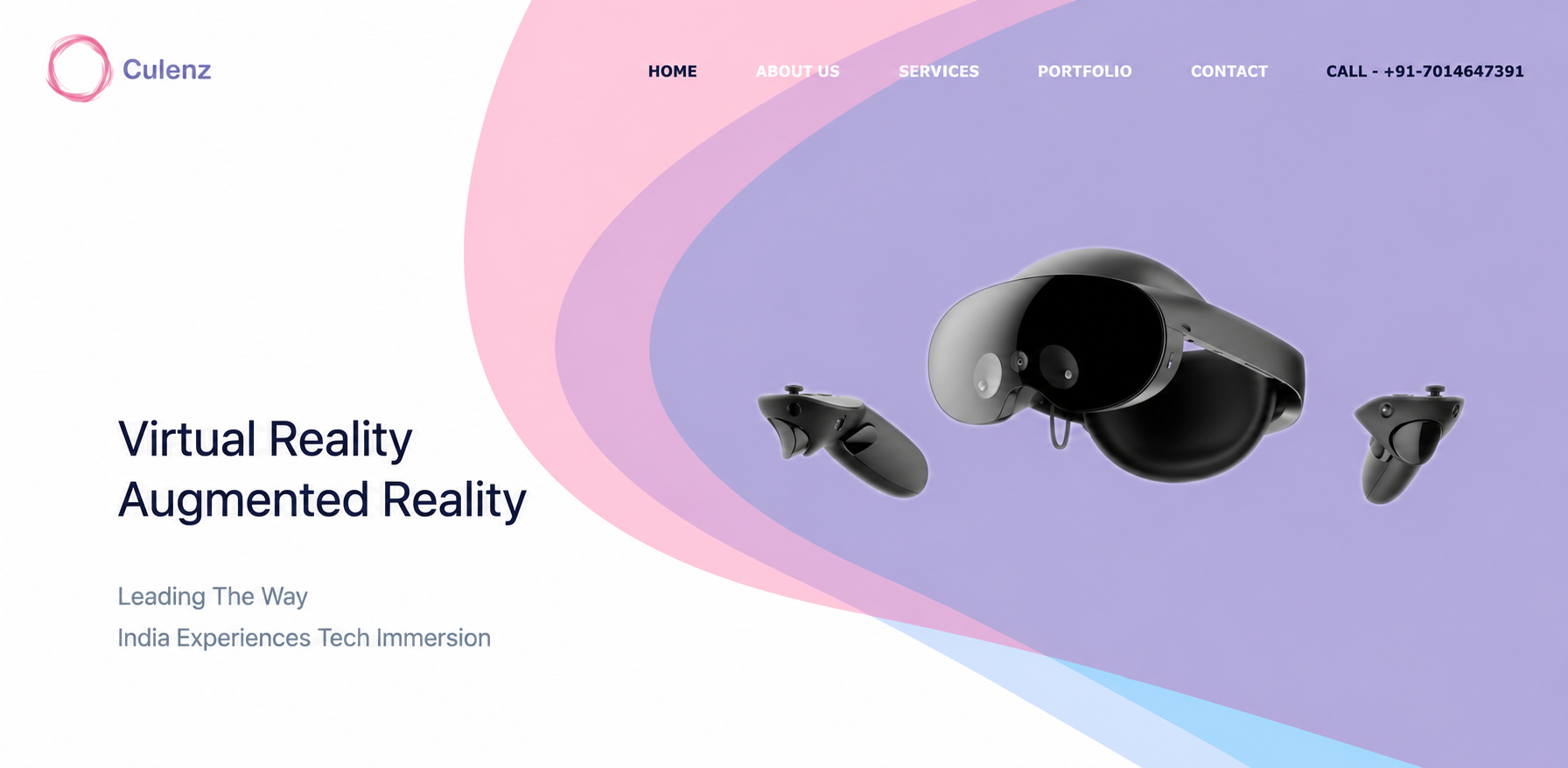
An honest, deeply researched review of Culenz covering its VR, AR, and MR services, the client list, VR live streaming, pricing, the missing review base, and the verdict on whether it deserves your project
Thank you for reading this post, don't forget to subscribe!Published by brands.run | The independent brand review hub
Reviewed Brand: Culenz | Sector: Virtual Reality, AR, and MR Development | Founded: Around 2019 | Headquarters: Jaipur, India | Website: culenz.com
Culenz is a virtual reality, augmented reality, and mixed reality company based in Jaipur, Rajasthan, with an additional office in Hyderabad. Founded by Rajat Jain and Abhinandan Nahata, it builds immersive VR and AR experiences and 360-degree content for businesses, and it became one of India’s more active VR live streaming providers during the pandemic. Its client list includes notable names such as Doordarshan, BMW, Audi, the Jaipur Literature Festival, and Jashn-e-Rekhta. This review is part of brands.run’s independent brand reviews.
That’s the capability picture. This review tests it and is honest about what the available evidence does and does not show.
It’s built in three parts. Part 1, The Expose, covers what Culenz actually is beneath the marketing: the founders, what VR, AR, and MR really mean, the service catalog, the client list, the VR live streaming specialty, the technology, and how it prices and runs projects. Part 2, The Autopsy, examines what works and what to scrutinize: the strength of the client list against the near-total absence of independent client reviews, the early-stage and small-team reality, the unverified superlative marketing claims, the real adoption challenges of VR, and what you cannot confirm from outside. Part 3, The Killcritic, is the verdict: who Culenz suits, who should look elsewhere, and how it compares to larger and more reviewed VR firms, to freelancers, and to not using VR at all.
If you’re a business considering Culenz for a VR, AR, or 360-degree project, this is the honest version, written to help you decide with clear eyes rather than to echo the marketing.
| Review Methodology This review draws on the Culenz website and its own materials, founder interviews and startup profiles in YourStory, SiliconIndia, and other outlets, its listings on Clutch and Techreviewer, the publicly reported client list, and the broader context of the AR and VR development industry in India. Self-reported figures and superlative claims are labeled as company-stated. The near-absence of independent client reviews is noted plainly. Figures reflect publicly available information as of June 2026 and may change. |
Part 1: The Expose
The expose strips away the marketing. What is Culenz, who runs it, what does it actually build, for whom, and how.
What Culenz Actually Is
Culenz is a virtual reality and immersive technology company. In plain terms, it’s a specialist agency that builds VR, AR, and mixed reality experiences for businesses, along with 360-degree video and live streaming. A company hires Culenz when it wants to let people experience something immersively: walk through a property before it’s built, explore a car in 3D, attend an event virtually, or train staff in a simulated environment.
The company describes itself as making people dream with their eyes open, and its core promise is demonstration. Instead of telling a customer about a product or place, Culenz builds an immersive experience that lets the customer feel they’re inside it. Its experiences are cloud-based and shared through simple web links, which the company highlights as making them accessible across devices without special plugins.
So Culenz is a business-to-business immersive technology studio. It does not sell a product you buy off a shelf. It takes on projects for clients who want VR, AR, 360-degree, or live streaming work built to their specific needs. That project-based, custom, B2B nature shapes everything about how you would evaluate and engage it, which the rest of this review reflects.
The Founders and the Name
Culenz was founded by Rajat Jain and Abhinandan Nahata, who, by their own account, met on a project as vendor and client before deciding to build the company together. Rajat Jain handles the technology and marketing side and has followed technology developments since the mid-2000s. Abhinandan Nahata, who has a business administration background, handles the finance and business side. This split of a technical founder and a business founder is a common and sensible structure for a young technology company.
The name itself is a coined word. According to the company, Culenz combines cu, taken from ocular, with Lenz, a reworked spelling of lens. The intent is a name evoking sight and lenses, fitting for a company built around visual immersion. The founders describe themselves as in the business of a connected, immersive world, and as still defining the brand globally, which is an honest acknowledgment that Culenz is an emerging name rather than an established one.
Understanding the founders matters because Culenz is a small, founder-led company. As with any young agency, the founders’ direct involvement and the small team around them shape the experience of working with the company, a point the autopsy returns to in the context of scale and capacity.
What VR, AR, and MR Actually Mean
To evaluate Culenz, you need to understand the technologies it works in, because they’re often confused and the differences matter for what you’d hire Culenz to build.
- Virtual Reality (VR): A fully digital environment that replaces the real world. You wear a headset and are placed inside a computer-generated or 360-degree filmed space, able to look around and sometimes move and interact. Examples include a virtual property walkthrough or an immersive event experience.
- Augmented Reality (AR): Digital content overlaid on the real world, usually viewed through a phone or tablet. The real environment stays visible, with digital elements added on top. Examples include AR filters, AR product previews placed in your room, or AR navigation.
- Mixed Reality (MR): A blend where digital and real elements coexist and can interact, typically through advanced headsets. It sits between VR and AR, anchoring digital objects into the real space so they behave as if present.
- 360-degree content: Video or images captured so the viewer can look in any direction, viewable on a headset or a regular screen. This is the backbone of much VR content and of virtual tours and live streaming.
Culenz works across all of these, with a particular strength in VR and 360-degree content and live streaming. Knowing the distinctions helps you brief any immersive-tech company accurately, because asking for VR when you actually need AR, or vice versa, leads to a mismatch in cost, device requirements, and outcome. Culenz’s role is to advise on and build the right one for your goal.
The Culenz Service Catalog
Here is what Culenz offers, based on its website and profiles.
VR Content and Experience Creation
Custom virtual reality experiences for demonstration and engagement, such as virtual property walkthroughs, automotive showcases, and immersive brand experiences. This is the core offering.
360-Degree Content and Virtual Tours
Filming and producing 360-degree video and virtual tours that let viewers explore a space from any angle, used in real estate, tourism, and events.
VR Live Streaming
Live streaming of events in VR and 360 degrees, allowing remote audiences to attend immersively. This is the capability Culenz is most associated with, built up during the pandemic.
AR Development
Augmented reality experiences and applications that overlay digital content on the real world through mobile devices.
Mixed Reality and Simulations
Mixed reality work and simulation environments, including training and product-demonstration simulations, and AI-driven immersive applications.
Immersive Installations and Events
Experiential offerings the company has promoted, including 360-degree dome theaters for group immersive experiences, VR painting, VR gaming setups, and VR fitness experiences for events and activations.
The catalog is broad for a small studio, spanning content, development, live streaming, and experiential installations. The breadth is a marketing strength, signaling a one-stop immersive partner. The honest read, developed in the autopsy, is that a small team offering a wide range means you should confirm depth in the specific service you need rather than assuming equal strength across all of them.
The Client List: Culenz’s Strongest Credential
Culenz’s most persuasive evidence is its client list, and it’s notable for a company of its size. Across its own materials and multiple independent startup profiles, the consistently reported clients include Doordarshan, BMW, Audi, the Jaipur Literature Festival, Jashn-e-Rekhta, Superbond, JC Antiques and Craft, and the Bardiya Group.
Two of these stand out. First, Doordarshan: Culenz has stated it managed 360-degree live streaming of the Republic Day Parade, a high-profile national broadcast event that demands real technical capability and reliability under pressure. Second, the automotive and cultural names: BMW and Audi are global brands with high standards, and the Jaipur Literature Festival and Jashn-e-Rekhta are major, well-known cultural events. Delivering immersive work for clients of this caliber is a meaningful capability signal that many small VR studios cannot claim.
This client list is the single strongest reason to take Culenz seriously. It demonstrates that real, demanding organizations have trusted the company with visible projects. The important caveat, covered in the autopsy, is that a strong client list shows capability and access, but it is not the same as a body of detailed client reviews describing what the working relationship and the outcomes were actually like, which is the evidence Culenz notably lacks.
The VR Live Streaming Specialty
If Culenz has a signature capability, it’s VR and 360-degree live streaming, and the story behind it is worth understanding.
When the pandemic stopped in-person events, Culenz pivoted to live streaming events in VR and 360 degrees, letting audiences attend from home immersively. The company describes itself as having become one of India’s most experienced VR live streaming providers as a result, and the Doordarshan Republic Day Parade streaming is the flagship example of this capability at scale. Live streaming an event in 360 degrees is technically demanding, requiring specialized cameras, reliable encoding and delivery, and real-time execution with no second takes.
This specialty is a genuine differentiator. Many VR studios build pre-recorded experiences; fewer have real, proven experience running live 360-degree streams of major events. For a client whose need is specifically immersive live streaming of an event, Culenz’s track record in exactly that is directly relevant and is among the strongest reasons to consider it. For other kinds of immersive work, the live streaming pedigree is reassuring but you’d still assess the specific capability you need.
Industries Culenz Serves
Culenz positions its work across a range of industries where immersive experiences add value.
- Real estate, for virtual property walkthroughs that let buyers explore properties remotely.
- Automotive, for immersive vehicle showcases and demonstrations.
- Travel and tourism, for virtual destination experiences and tours.
- Events, for VR and 360-degree live streaming and experiential activations.
- Education and e-learning, for immersive learning and training content.
- Medical, for simulation and visualization use cases.
The common thread is demonstration and training: situations where letting someone experience something immersively beats describing it. This breadth across industries is typical of a VR studio, since the underlying technology applies widely. For a prospective client, the relevant question is not whether Culenz claims your industry, but whether it has specific, demonstrable work in a use case like yours, which you confirm by asking to see relevant past projects.
The Technology and How It Is Delivered
Culenz emphasizes several technical characteristics of its work, which are worth understanding as a buyer.
Its experiences are described as cloud-based, device-independent, and accessible through simple shareable web links without requiring special plugins. The practical benefit is distribution: a client can share an immersive experience with their own customers through an ordinary link, viewable on common devices, rather than requiring everyone to have a headset or install software. The company also highlights features like full 360-degree coverage with no blind spots and remote accessibility.
For immersive work, delivery and accessibility matter as much as the experience itself, because an impressive VR experience that’s hard for your audience to access has limited business value. Culenz’s emphasis on link-based, device-flexible delivery addresses a real adoption barrier in VR. As a buyer, it’s worth clarifying exactly how an experience will be delivered to your end users, what devices it supports, and whether a headset is needed for the full effect, so the distribution matches how your audience will actually use it.
The Team and Locations
Culenz is headquartered in Jaipur, at an address in the Mansarovar industrial area, with an additional office reported in Hyderabad. The company has described operating with a team of around ten professionals.
A team of roughly ten is a small studio, which is important context for setting expectations. The upside of a small, founder-led team is focus and direct access to the people doing the work. The realistic limits are capacity and resilience: a ten-person studio can handle a certain volume of projects at once, and a very large or highly complex engagement may stretch it. The second office in Hyderabad suggests some expansion beyond a single location, which is a positive sign of growth. For a buyer, the team size is not a problem in itself, but it should inform the scale and timeline of project you’d entrust to the company, and it makes capacity a fair question to raise.
Pricing: What Is and Is Not Public
Culenz does not publish pricing. Like most custom VR and AR development studios, it works on a per-project basis, quoting based on the specific scope, complexity, technology, and timeline of each engagement. Its profiles invite prospective clients to send a message about project needs, price, and timeline to get a custom quote.
This is normal for the category, because immersive projects vary enormously, from a single 360-degree virtual tour to a complex multi-experience installation or a live-streamed event. For context on the broader market, industry data on comparable Indian VR studios shows project costs that can range widely, with larger custom VR engagements at established firms reaching tens of thousands of dollars, while smaller pieces of 360-degree content cost far less. Culenz’s specific pricing is not disclosed and would depend on your project.
The honest guidance for buyers is the same as for any custom-quote service: get a clear, written scope and quote before committing, with the deliverables, timeline, revisions, and what is and is not included spelled out. The absence of public pricing is not a red flag for custom work, but it does place the burden on you to nail down scope and cost in writing, which the autopsy and buyer-tips sections emphasize.
| What to Confirm on Pricing and Scope For any VR or AR project, get written answers before you commit: exactly what will be delivered and in what format, how the experience reaches your end users and on what devices, how many rounds of revisions are included, the timeline and milestones, what happens if scope changes, and the full cost including any ongoing hosting or maintenance. Custom pricing is normal; an unclear scope is what causes disputes. |
The Government Recognition Claim
Culenz markets itself prominently as government recognized and highlights collaboration with the Government of India and the Government of Rajasthan. This claim deserves honest unpacking, because government association is a strong trust signal that buyers should understand precisely.
What is verifiable and meaningful is that Culenz has done real work connected to government bodies, most notably the Doordarshan Republic Day Parade 360-degree streaming, which is a genuine, high-profile government-broadcast engagement. Doing visible work for a national broadcaster is a real credential. What the marketing phrasing does not, by itself, clarify is the exact nature and extent of any formal recognition or certification, versus having completed project work for government clients. Working for a government body and holding a formal government certification are different things, and the marketing language blends them.
The honest reading is that Culenz has real, demonstrable government-linked project experience, which is a legitimate strength, while the broad government recognized phrasing is marketing that you should interpret as project credentials rather than assume to mean a specific formal accreditation. If a formal certification matters to your decision, ask Culenz directly what it holds and request documentation, rather than relying on the marketing phrase.
VR vs AR vs MR: Choosing the Right One for Your Goal
Since Culenz works across VR, AR, and MR, and since choosing the wrong one wastes budget, it’s worth a practical guide to which fits which goal.
Choose VR when you want to fully transport someone into an environment: a property walkthrough, an immersive event, a training simulation, or a destination experience, where total immersion is the point and a headset or 360-degree viewer is acceptable. Choose AR when you want to enhance the real world that the user is in: previewing a product in their actual space, an interactive brochure, AR navigation, or a marketing filter, where you want reach through ordinary phones and no headset. Choose MR when you need digital and physical elements to interact in a shared space, typically for advanced training or visualization, accepting that it requires more specialized hardware and budget.
The practical decision rests on three questions: what experience you want the user to have, what devices your audience actually has, and your budget. VR is the most immersive but most device-dependent; AR is the most accessible through phones; MR is the most advanced and costly. A good immersive partner helps you choose based on these realities rather than selling you the most impressive-sounding option. When briefing Culenz or any studio, lead with your goal and audience, and let the technology choice follow from that.
VR Live Streaming Explained
VR live streaming is Culenz’s signature capability, so it’s worth understanding what it involves and where it adds value.
VR or 360-degree live streaming captures an event with special 360-degree cameras and broadcasts it in real time so remote viewers can look around the venue as if present, on a headset or a regular screen. It’s used for events where physical attendance is limited, for reaching a wider audience, or for adding an immersive option to a broadcast. The technical demands are significant: 360-degree camera rigs, real-time stitching and encoding, reliable high-bandwidth delivery, and flawless execution, because live means no retakes.
The value of VR live streaming is reach and presence. It lets an organization extend an event to audiences who cannot attend physically, with a more immersive feel than a flat video stream. It became especially relevant when in-person gatherings were restricted, which is exactly when Culenz built its experience in it. For an organization whose need is to stream an event immersively, this is a specialized capability where proven experience, like Culenz’s Doordarshan and festival work, clearly reduces risk compared with a provider doing it for the first time.
How a VR or AR Project Actually Works
Engaging a VR or AR studio follows a general path, and knowing it helps you manage the relationship and avoid surprises.
- Discovery, where you explain your goal, audience, and budget, and the studio advises on whether VR, AR, MR, or 360-degree content fits, and proposes an approach.
- Proposal and scope, where the studio defines deliverables, technology, timeline, and cost, ideally in a clear written document.
- Content capture or creation, where 360-degree footage is filmed, or 3D environments and assets are built, depending on the project.
- Development, where the experience is assembled, interactions are built, and it’s prepared for the target devices and delivery method.
- Review and revisions, where you test the experience and request changes within the agreed number of revision rounds.
- Delivery and deployment, where the final experience is delivered in its agreed format, often as a shareable link, and deployed for your audience.
- Support and maintenance, covering hosting, updates, or fixes, which should be clarified up front as included or separate.
The steps where buyers most often get caught are scope and revisions and ongoing maintenance. Confirming exactly what is delivered, how many revisions are included, how the experience reaches your audience, and who maintains it after launch prevents the most common misunderstandings. A capable studio welcomes this clarity, and the buyer-tips section details what to lock down before you sign.
The Technology Stack Behind Immersive Work
It helps to understand, at a high level, the tools that underpin VR and AR work, so you can ask informed questions of any studio.
Immersive development commonly uses game engines like Unity and Unreal Engine to build interactive 3D environments, AR frameworks like ARKit and ARCore for mobile augmented reality, and WebXR for browser-based experiences. 3D modeling tools like Blender and Maya create the assets and environments, while 360-degree work relies on specialized cameras and stitching software. Cloud platforms deliver experiences at scale, and increasingly AI is used for interactivity and real-time features.
You don’t need to master these as a buyer, but knowing them lets you ask a studio what it uses and why, which surfaces real expertise. Culenz emphasizes cloud-based, link-shareable, device-flexible delivery, which points to a web and cloud-oriented approach suited to broad distribution. For a complex interactive or simulation project, you’d want to confirm the studio’s depth in the relevant engines and frameworks. Asking about the stack is a simple way to gauge whether a studio’s technical capability matches your project’s complexity.
Virtual Reality in Real Estate
Real estate is one of the clearest use cases for the kind of work Culenz does, so it’s worth examining in detail as an illustration of where immersive technology earns its cost.
In real estate, VR and 360-degree virtual tours let a prospective buyer or tenant walk through a property from anywhere, exploring rooms, sightlines, and layout without a physical visit. For under-construction properties, VR can show a finished space that does not yet exist, helping buyers commit before completion. For remote or international buyers, a virtual tour removes the need to travel to shortlist properties. The business value is concrete: wider reach, faster shortlisting, fewer wasted site visits, and the ability to sell space that is not yet built.
This is exactly the kind of application where immersion solves a real problem rather than adding novelty, which is the test that separates worthwhile VR from gimmickry. For a developer or agency, a virtual tour from a studio like Culenz can be a practical sales tool. The honest guidance is to confirm how the tour is delivered to buyers, since a tour viewable through an ordinary web link on a phone reaches far more people than one requiring a headset, and Culenz’s emphasis on link-based delivery fits this need. As always, ask to see a real estate tour the studio has produced before commissioning your own.
Virtual Reality in Automotive and Retail
Culenz lists BMW and Audi among its clients, so automotive immersive work is worth understanding as a use case where it has stated experience.
In automotive, VR and AR let customers explore a vehicle in immersive 3D, configure colors and features, and experience the car without a physical showroom visit, while AR can place a life-size vehicle in the customer’s own driveway through a phone. For retail more broadly, immersive technology supports virtual product demonstrations, letting customers examine and interact with products in detail. The value is engagement and reach: an immersive showcase can demonstrate a premium product more compellingly than photos, and can reach customers who cannot visit a showroom.
Premium brands like automotive manufacturers have high production standards, so a studio that has delivered immersive work for them has met a demanding bar, which is part of why Culenz’s automotive client credentials are a meaningful signal. For a business considering automotive or retail immersive work, the relevant questions are how the experience will be distributed to customers, what devices it targets, and whether the studio can show comparable work it has produced. The use case is proven; the execution is what you verify through demos and references.
Virtual Reality in Events and Culture
Culenz’s work with the Jaipur Literature Festival, Jashn-e-Rekhta, and Doordarshan places events and culture at the heart of its track record, and this is a use case worth understanding on its own.
For events, immersive technology serves two main purposes: extending reach through VR and 360-degree live streaming so remote audiences can attend, and enhancing on-site experiences through immersive installations like 360-degree dome theaters or VR activations. Cultural events in particular benefit from immersive documentation and streaming, preserving and broadcasting performances and sessions to audiences far beyond the venue. The value is reach and preservation: an event that exists for a few days in one location can reach a national or global audience and live on afterward.
This is arguably Culenz’s strongest demonstrated domain, given its festival and broadcast client work and its live streaming specialty. For an event organizer or cultural institution wanting to extend reach immersively, Culenz’s specific experience in exactly this area is among the most relevant credentials it has. The practical guidance remains consistent: ask to see immersive event work it has delivered, understand how audiences accessed it, and confirm the scope and reliability arrangements for any live event, where execution must be flawless because it happens in real time.
Virtual Reality in Training and Education
Training and education are among the most substantiated value cases for VR across the industry, so they merit attention even where they are not a company’s headline work.
VR training places learners in realistic simulated environments to practice skills safely and repeatedly, from equipment operation to procedural training, where real-world practice would be costly, dangerous, or impractical. Educational VR lets students experience places and concepts immersively, from historical sites to scientific visualizations. The value is effective, memorable, and safe practice: studies across the sector consistently find that immersive training can improve retention and confidence for certain hands-on and scenario-based skills.
Culenz lists education and e-learning among its served industries and references simulations and AI-driven applications. For an organization considering VR training, the key is specificity: training simulations are a distinct discipline from event streaming or virtual tours, so you’d want to confirm a studio’s concrete experience building training content like yours. The honest guidance is to treat each immersive discipline separately and ask for directly relevant examples, rather than assuming broad VR capability transfers equally to specialized training work.
Measuring the Return on an Immersive Project
Because immersive projects carry real cost, it’s worth thinking clearly about how to measure whether one is worth it, which applies to any studio including Culenz.
The return on an immersive project comes from a specific business outcome, not from the impressiveness of the experience. Depending on the use case, that outcome might be wider reach for an event, faster property shortlisting and fewer wasted visits, higher engagement or conversion on a product, or improved training outcomes and reduced training cost or risk. The discipline is to define the outcome you expect before commissioning the work, then judge the project against it. An immersive experience that wins awards but does not move a real business metric has not delivered a return.
This framing protects you from the most common immersive-technology mistake, which is investing in novelty. Before commissioning Culenz or any studio, articulate what success looks like in concrete terms, who your audience is and whether they’ll engage with the format, and how you’ll measure the outcome. A good immersive partner will engage with these questions rather than dodge them, and a project scoped around a real outcome is far more likely to be worth its cost than one scoped around spectacle. Clear success criteria, agreed up front, are the single best way to ensure an immersive investment pays off.
The Indian AR and VR Market Context
Culenz operates within India’s growing but still-maturing AR and VR industry, and understanding that context helps you judge where the company sits.
India’s immersive technology sector has expanded as businesses across real estate, education, automotive, and events explore VR and AR, and a number of studios now compete for this work, ranging from small specialist teams to larger funded firms. The market is real and growing, but it’s still early relative to more established technology sectors, which means quality and track records vary widely between providers, and buyers must vet carefully. Adoption is led by specific high-value use cases rather than broad consumer demand, and the providers with the strongest positions tend to combine demonstrable client work with verifiable client feedback.
Within this landscape, Culenz is a small, early-stage player distinguished by a notable client list and a live streaming specialty, competing against both larger funded firms and other small studios. Its client credentials place it above many small competitors on demonstrable work, while its thin public review base places it behind the more established, heavily reviewed firms on verifiable feedback. For a buyer, the takeaway is that the Indian VR market rewards careful vetting, and Culenz should be assessed the same way you’d assess any provider in a maturing market: on concrete, relevant evidence and direct references, not on market hype or self-description.
The Convergence of AI and Immersive Technology
Culenz references AI-driven applications among its capabilities, and the convergence of AI with immersive technology is a real trend worth understanding as a buyer.
AI is increasingly used alongside VR and AR to make experiences more interactive and responsive, powering features like intelligent virtual environments, real-time personalization, conversational elements within immersive spaces, and automated content generation. For immersive training, AI can adapt scenarios to the learner; for virtual experiences, it can make interactions feel more natural. This convergence is expanding what immersive technology can do, though it also adds complexity and cost, and the depth of genuine AI capability varies enormously between providers who mention it.
For a buyer evaluating any studio that references AI, including Culenz, the practical guidance is to ask specifically what AI capability a project would actually use and why, rather than treating AI as a buzzword. Real AI integration solves a specific problem in your experience; a passing mention of AI in marketing may signal little concrete capability. If AI-driven interactivity matters to your project, ask the studio to show you a working example of comparable AI-enabled immersive work it has built. This keeps the focus on demonstrated capability rather than on a fashionable term.
Why Choosing the Right Immersive Partner Matters
Immersive projects are custom, visible, and often costly, so the choice of partner carries real weight, and it’s worth closing the expose with why this decision deserves care.
Unlike buying a standardized product, commissioning an immersive experience means trusting a studio to translate your goal into something built from scratch, on time, on budget, and accessible to your audience. The gap between a strong immersive partner and a weak one is large: the right partner delivers an experience that serves a real business outcome and reaches your audience, while the wrong one delivers something that impresses in a demo but fails to perform in the real world, or that runs over budget and behind schedule. For a visible project, like a client-facing tour or a live-streamed event, execution failures are public and costly.
This is why the verification this review repeatedly emphasizes matters so much, especially for a studio like Culenz with strong credentials but thin public reviews. The notable client list tells you Culenz can win and deliver visible work, which is real and positive. Confirming through demos, direct references, and a clear contract tells you whether it’s the right partner for your specific project. The two together, capability evidence plus your own verification, are how you make a confident immersive-technology decision, with Culenz or any provider in this maturing market.
Part 2: The Autopsy
The autopsy weighs the strengths honestly against what the available evidence leaves uncertain. Culenz has a notable client list and a real specialty, and it also has a near-total absence of independent client reviews and the normal risks of an early-stage studio. Both sides are laid out plainly, because for a B2B project decision you need the honest balance.
What Culenz Gets Right
The strengths are real and worth crediting.
A Notable Client List
Doordarshan, BMW, Audi, the Jaipur Literature Festival, and Jashn-e-Rekhta are real, demanding clients, and delivering visible immersive work for them is a strong capability signal that few small VR studios can match. This is Culenz’s best evidence.
Proven VR Live Streaming Experience
The Republic Day Parade 360-degree streaming and festival work demonstrate real, tested experience in live 360-degree streaming, a technically demanding specialty where proven execution reduces real risk.
Broad, End-to-End Immersive Capability
Covering VR, AR, MR, 360-degree content, live streaming, and experiential installations under one roof makes Culenz a potential one-stop immersive partner, convenient for clients who want a single provider.
Accessible, Link-Based Delivery
The emphasis on cloud-based, device-flexible, link-shareable experiences addresses a real VR adoption barrier, making it easier for a client’s audience to actually access the work without headsets or installs.
Multi-City Presence and Pandemic Adaptability
A Jaipur headquarters plus a Hyderabad office, and the demonstrated agility of pivoting to live streaming when events stopped, show a company that can grow and adapt rather than a static operation.
These strengths are real, and the client list in particular sets Culenz apart from many small studios. The rest of the autopsy is about the evidence that’s missing, which you should weigh just as honestly.
The Missing Review Base
Here is the most important gap, and it’s a significant one for a B2B service decision. Despite a notable client list, Culenz has almost no independent client reviews anywhere public.
Its Clutch profile, on the main platform businesses use to vet development agencies through verified client reviews, shows no reviews added. Its Trustpilot presence shows no rating. A listing on Techreviewer shows a 3.5 figure, but with no substantive verified client reviews behind it to explain what that reflects. In short, there is no body of detailed, verified client feedback describing what it’s actually like to work with Culenz, how projects went, whether they were delivered on time and on budget, and whether clients were satisfied with the outcomes.
This matters because a client list and a review base are different kinds of evidence. The client list shows that notable organizations engaged Culenz, which is real and positive. A review base would show how those and other engagements actually went, which is what you most need to know before hiring. Competing Indian VR studios on Clutch, such as Treeview and Lucid Reality Labs, have substantial verified review records describing project management, delivery, and outcomes. Culenz’s absence of comparable reviews is a genuine gap, not because it implies anything negative, but because it means you cannot verify the working experience through independent feedback and must rely more heavily on direct references and your own diligence.
| What This Means for You Because Culenz has a strong client list but almost no independent reviews, do not rely on its star ratings or marketing. Ask directly for detailed references from recent project clients you can speak with, request case studies and demos of work similar to yours, and confirm scope, timeline, and deliverables in a clear contract. The client list earns Culenz a conversation; references and a clear scope should drive your decision. |
The Early-Stage Reality
Culenz is an early-stage company. Public startup databases list it at a pre-seed funding stage, and it operates with a team of around ten. This shapes what you should realistically expect.
Early-stage status is not a flaw, and many excellent specialist studios are small and lean. But it carries real implications. A pre-seed, ten-person studio has limited financial and operational resources compared with a larger, funded firm, which affects capacity to take on very large or many simultaneous projects, resilience if key people are unavailable, and the depth of support infrastructure. It also means less of a long, public track record to assess. For a small or moderate project, none of this need be a problem, and the personal attention of a small team can be an advantage. For a large, mission-critical, or long-term engagement, the early-stage scale is a fair consideration, and you’d want confidence in the company’s capacity to deliver and support it over time.
The Superlative Marketing Claims
Culenz markets itself with strong superlatives, describing itself as the best and top AR, VR, and MR development company in India and as government recognized VR experts. These claims warrant honest scrutiny.
Self-proclaimed superlatives like best and top in India are marketing, not verified rankings. Many companies describe themselves this way, and there is no independent basis presented for Culenz being the single best or top VR company in a country with numerous capable VR studios, several of which have stronger public review records. Similarly, as discussed, the government recognized phrasing blends real government project work with the implication of formal recognition. None of this means Culenz is not good; it means the marketing language overstates what the evidence establishes, which is common but worth seeing clearly.
The honest approach for a buyer is to discount the superlatives and judge Culenz on concrete evidence: its actual client work, demos relevant to your project, direct references, and a clear proposal. A company’s claim to be the best matters far less than what it can show you it has built and what its real clients say. Treat the marketing as marketing, and ask for the substance behind it.
The VR Adoption Challenge
A fair autopsy must address the industry Culenz operates in, because VR’s real-world adoption challenges affect the value of any VR investment. Culenz’s own founders have identified user adaptability as the biggest obstacle in their path, which is an honest and accurate observation.
VR and immersive technology have promised mass adoption for years, and while they’ve found real, valuable niches, in training, real estate visualization, events, and specific demonstrations, broad consumer adoption has been slower and patchier than the hype suggested. Headset ownership is not universal, and some audiences are unfamiliar with or resistant to immersive formats. This matters for a buyer because the business value of a VR project depends on your audience actually using and benefiting from it. An immersive experience that impresses but that your customers don’t engage with delivers little return.
This is not a criticism of Culenz specifically; it’s the reality of the medium. The practical implication is to be clear-eyed about why VR fits your specific use case and audience, and to favor applications where immersion delivers concrete value, like remote property tours, event reach, or training, over novelty for its own sake. Culenz’s emphasis on accessible, link-based, headset-optional delivery is partly an answer to this adoption challenge, and it’s a sensible one. Still, you should validate that immersive technology truly serves your goal before investing in it, with Culenz or anyone.
The Project-Based B2B Risks
Hiring any custom development studio carries standard risks, and naming them helps you guard against them whoever you choose.
- Scope ambiguity: Custom immersive projects can balloon if scope is not pinned down. Define deliverables, formats, and inclusions precisely in writing before starting.
- Timeline slippage: Immersive development can take weeks to months. Agree milestones and a timeline, and understand what drives delays.
- Revision limits: Clarify how many rounds of revisions are included, since unlimited changes are rarely realistic and disputes often arise here.
- Delivery and access: Confirm exactly how the experience reaches your audience and on what devices, so the output matches real-world use.
- Ongoing costs: Clarify hosting, maintenance, and update costs after launch, which are easy to overlook in the initial quote.
Culenz is not flagged for any of these specifically; they’re the standard risks of commissioning custom immersive work. With a young studio that lacks a public review base, managing them through a clear contract and direct references is especially important, which is exactly what the buyer-tips section focuses on.
What You Cannot Verify From Outside
In the interest of honesty, here is what this review, or any external review, cannot confirm about Culenz, and which you should therefore check directly.
- How its projects actually went in terms of delivery, timeline, budget, and client satisfaction, since there’s almost no independent review evidence.
- The depth of its capability in any specific service versus its broad marketed range.
- How it handles problems, delays, or scope changes during a project.
- Its current capacity, financial stability, and ability to support long-term engagements as an early-stage studio.
- The exact nature of its government recognition versus government project work.
This is not a list of problems; it’s a list of unknowns that you close through demos, direct references, and a clear contract. A review can tell you Culenz has a strong client list, a real specialty, and no visible red flags, which is a positive starting point. It cannot replace speaking to its recent clients and seeing work relevant to your project, and it should not pretend to.
Part 3: The Killcritic
The killcritic is the verdict. Who Culenz suits, who should look elsewhere, and how it compares to the alternatives.
Who Culenz Is For
Culenz is a credible fit for specific clients.
Organizations Needing VR or 360-Degree Live Streaming
If your need is immersive live streaming of an event, Culenz’s proven experience, including national-broadcast and major-festival work, is directly relevant and among the strongest reasons to consider it. This is its clearest specialty.
Businesses Wanting Immersive Demos and Tours
If you’re in real estate, automotive, tourism, or events and want VR walkthroughs, 360-degree tours, or experiential activations, Culenz’s catalog and client work fit that need, subject to seeing relevant demos.
Clients Who Value a Single Immersive Partner
If you want one studio to handle VR, AR, 360-degree, and live streaming rather than juggling specialists, Culenz’s broad capability is convenient, provided you confirm depth in your specific service.
Those Comfortable With a Small, Founder-Led Studio
If you value direct access to a hands-on founding team and a small studio’s focus, and your project is a reasonable fit for a ten-person team, Culenz offers that personal engagement.
For these clients, Culenz’s notable client list, live streaming pedigree, and broad capability make it a reasonable studio to shortlist, provided you verify through demos, references, and a clear contract given the thin public review base.
Who Should Look Elsewhere
Other clients should consider other options.
Large, Mission-Critical, or Long-Term Engagements
If your project is very large, business-critical, or requires long-term support, an early-stage ten-person studio may not offer the capacity, resilience, or track record you need. A larger, funded, more reviewed firm may be the safer choice.
Buyers Who Require Verified Client Reviews
If you rely on a substantial body of independent, verified client reviews to choose a vendor, Culenz’s near-absence of them is a real gap. Competing studios with strong Clutch review records may better suit your due-diligence requirements.
Clients Whose Audience Won’t Use VR
If your audience is unlikely to engage with immersive formats, or your use case doesn’t clearly benefit from immersion, reconsider whether VR is the right investment at all, with any provider, before commissioning it.
Those Wanting Transparent, Standardized Pricing
If you want clear published pricing and standardized packages, custom-quote VR studios including Culenz require more upfront scoping effort. Be prepared to invest in defining scope to get a firm quote.
Culenz vs Larger, More Reviewed VR Firms
The most direct comparison is against Indian VR studios with substantial verified review records, such as Treeview and Lucid Reality Labs.
| Factor | Culenz | Larger reviewed VR firms |
| Client list | Notable (Doordarshan, BMW) | Often strong, varies |
| Verified reviews | Almost none | Substantial on Clutch |
| VR live streaming | Proven specialty | Varies by firm |
| Scale and stage | Early-stage, ~10 people | Often larger, funded |
| Pricing | Custom quote | Custom, some publish ranges |
| Best for | Live streaming, regional projects | Large, review-vetted projects |
Larger reviewed firms win on the depth of independent verification and, often, on scale and resources. Culenz’s edge is its specific live streaming track record and its notable client list. For a review-driven, large-project decision, a firm with a strong verified record is the safer pick. For an event live streaming need or a regional immersive project where Culenz’s specialty and client credentials fit, it’s a credible candidate, verified through references.
Culenz vs Freelancers and Marketplaces
Some buyers consider hiring individual VR or 360-degree freelancers through marketplaces instead of a studio.
Freelancers can be cheaper and fine for small, well-defined pieces of work, like a single 360-degree tour, but quality and reliability vary widely, there’s little accountability, and a solo freelancer can’t match a studio’s range or capacity for a complex, multi-part project. A studio like Culenz offers an end-to-end team, a notable client track record, and a single accountable partner, which matters for anything beyond a simple one-off. The honest call is that for a small, simple immersive task on a tight budget, a vetted freelancer can work, while for a complex, visible, or multi-experience project, a studio with real client credentials like Culenz is the more sensible choice, provided you verify it.
Culenz vs Not Using VR At All
The most important comparison is against not commissioning immersive work in the first place, using conventional photos, video, or in-person experiences instead.
When Conventional Methods Are Enough
For many purposes, good photography, standard video, or a physical visit deliver the message effectively and cheaply, and VR adds cost without proportionate benefit. If your audience won’t engage with immersion or your use case doesn’t need it, conventional media is the rational choice.
When Immersion Adds Real Value
Immersion earns its cost where it solves a real problem: letting remote buyers tour a property or event they can’t visit, training people in realistic simulated scenarios, or demonstrating something that flat media cannot convey. In these cases, a capable VR partner delivers value conventional methods can’t.
The Honest Call
Decide based on whether immersion truly serves your goal and audience, not on novelty. For event reach, remote tours, and certain training and demonstration needs, immersive work like Culenz’s can be worth it. For straightforward communication, conventional media is often the better-value option. Be honest about which your situation is before investing in VR with Culenz or anyone.
The Final Verdict
| Culenz Final Rating: 3.5 / 5 A real, capable VR, AR, and MR studio with a notable client list, including Doordarshan, BMW, and major festivals, and a proven specialty in 360-degree live streaming, held back by a near-total absence of independent client reviews, early-stage scale, and overstated superlative marketing. A credible candidate for immersive projects, especially live streaming and regional work, provided you verify capability through demos, direct references, and a clear contract rather than relying on the marketing or ratings. |
Choose Culenz if you need VR or 360-degree live streaming or immersive demos and tours, you value its notable client credentials and a hands-on founder-led team, and you’re prepared to verify the specifics through demos, references from recent clients, and a clear written scope, given the thin public review base.
Look elsewhere if your project is very large, mission-critical, or long-term and needs a bigger funded firm, if you require a substantial body of verified client reviews to choose a vendor, if your audience is unlikely to engage with immersive formats, or if conventional media would serve your goal better and cheaper.
Culenz’s client list and live streaming track record are real and impressive for a studio its size, and there are no visible red flags. The honest caveats are not accusations; they’re the genuine uncertainties of hiring an early-stage studio with strong credentials but almost no independent reviews, which you resolve through demos, references, and a clear contract. Verify the specifics, see work relevant to your project, and lock the scope in writing, and Culenz is a credible immersive partner. The 3.5 out of 5 reflects strong capability signals paired with thin independent validation and early-stage maturity, balanced honestly.
Frequently Asked Questions
This section answers the specific questions buyers search for about Culenz. Each answer is structured for direct factual extraction.
What does Culenz do?
Culenz is a virtual reality, augmented reality, and mixed reality company based in Jaipur, India. It builds immersive VR and AR experiences, 360-degree content and virtual tours, and VR live streaming for businesses, serving industries like real estate, automotive, tourism, events, education, and medical. Its signature capability is 360-degree live streaming of events, and its clients include Doordarshan, BMW, and major cultural festivals.
Is Culenz a good VR company?
Culenz has genuine strengths: a notable client list including Doordarshan, BMW, Audi, and the Jaipur Literature Festival, and proven 360-degree live streaming experience. The honest caveat is that it has almost no independent client reviews on platforms like Clutch, and it’s an early-stage studio of around ten people. It’s a credible candidate, especially for live streaming, but verify it through demos, direct references, and a clear contract rather than relying on its marketing.
Who are the founders of Culenz?
Culenz was founded by Rajat Jain and Abhinandan Nahata, who met as vendor and client on a project before starting the company. Rajat Jain handles technology and marketing, and Abhinandan Nahata, who has a business background, handles finance and business. It’s a founder-led studio with a small team.
Where is Culenz located?
Culenz is headquartered in Jaipur, Rajasthan, in the Mansarovar industrial area, with an additional office reported in Hyderabad. It operates with a team of around ten professionals and serves clients across India.
How much does Culenz cost?
Culenz does not publish pricing. Like most custom VR and AR studios, it quotes per project based on scope, complexity, technology, and timeline, and invites prospective clients to send their project needs for a custom quote. For context, custom VR projects across the industry range widely, from modest 360-degree content to large engagements costing tens of thousands of dollars. Get a clear written scope and quote before committing.
Who are Culenz’s clients?
Culenz’s publicly reported clients include Doordarshan, BMW, Audi, the Jaipur Literature Festival, Jashn-e-Rekhta, Superbond, JC Antiques and Craft, and the Bardiya Group. Notably, Culenz has stated it managed 360-degree live streaming of the Republic Day Parade for Doordarshan, a high-profile national broadcast project.
What is the difference between VR, AR, and MR?
VR (virtual reality) fully replaces the real world with a digital environment, usually through a headset. AR (augmented reality) overlays digital content on the real world, usually through a phone. MR (mixed reality) blends digital and real elements so they interact, typically through advanced headsets. Culenz works across all three, with particular strength in VR and 360-degree content and live streaming.
Does Culenz do VR live streaming?
Yes, VR and 360-degree live streaming is Culenz’s signature capability, built up during the pandemic. It has stated it managed 360-degree live streaming of the Republic Day Parade for Doordarshan and has streamed major events. For an organization needing immersive live streaming of an event, this proven experience is directly relevant and among the strongest reasons to consider Culenz.
Is Culenz government recognized?
Culenz markets itself as government recognized and highlights work with the Government of India and Government of Rajasthan, and it has real government-linked project experience, most notably the Doordarshan Republic Day Parade streaming. The marketing phrase blends genuine government project work with the implication of formal recognition. If a specific formal certification matters to you, ask Culenz directly what it holds and request documentation.
Does Culenz have reviews?
This is a notable gap. Despite a strong client list, Culenz has almost no independent client reviews. Its Clutch profile shows no reviews, its Trustpilot shows no rating, and a Techreviewer listing shows a 3.5 figure without substantive verified reviews behind it. Because of this, rely on direct references from recent clients and demos of relevant work rather than on public ratings when evaluating Culenz.
What industries does Culenz serve?
Culenz serves real estate, automotive, travel and tourism, events, education and e-learning, and medical, among others. The common use cases are immersive demonstrations, virtual tours, training simulations, and event live streaming. For your specific industry, ask to see relevant past projects rather than relying on the general claim of coverage.
How do I hire Culenz for a project?
Contact Culenz through its website with your project goal, audience, and budget. It will advise on whether VR, AR, MR, or 360-degree content fits and propose an approach and custom quote. Before committing, get a clear written scope covering deliverables, devices and delivery method, revisions, timeline, total cost, and any ongoing hosting or maintenance, and ask for references and demos of similar work.
How does Culenz compare to other VR companies in India?
Culenz’s edge is its notable client list and proven live streaming specialty. Several other Indian VR studios, such as Treeview and Lucid Reality Labs, have substantial verified client reviews on Clutch that Culenz lacks, which matters for review-driven due diligence. For a live streaming or regional immersive project, Culenz is a credible candidate; for a large, review-vetted engagement, a firm with a strong verified record may be the safer choice.
Is VR worth it for my business?
VR is worth it where immersion solves a real problem, like letting remote buyers tour a property or event, training people in realistic simulations, or demonstrating something flat media cannot convey. It’s not worth it where conventional photos, video, or in-person experiences would serve your goal effectively and cheaply, or where your audience won’t engage with immersive formats. Be clear about why immersion fits your specific use case before investing, with Culenz or any provider.
What should I verify before hiring Culenz?
Ask for detailed references from recent project clients you can speak with, request demos and case studies of work similar to yours, and confirm in writing the deliverables, delivery method and supported devices, number of revisions, timeline, total cost, and any ongoing hosting or maintenance. Given the thin public review base, this direct verification, not the marketing or ratings, should drive your decision.
Does Culenz work with clients outside Jaipur?
Yes. While Culenz is headquartered in Jaipur with an office in Hyderabad, its work is project-based and its experiences are cloud-based and delivered through shareable links, so it can serve clients across India and beyond. Its client list includes national organizations and major brands, indicating it works well beyond its home city. For a remote engagement, confirm how communication, content capture, and delivery will be handled across locations.
What is 360-degree content?
360-degree content is video or imagery captured so the viewer can look in any direction, on a headset or an ordinary screen, as if standing at the center of the scene. It’s the backbone of virtual tours and VR live streaming, and it’s one of Culenz’s core capabilities. Unlike fully built 3D environments, 360-degree content is filmed from the real world, which makes it well suited to property tours, event streaming, and destination experiences. It’s also generally faster and less expensive to produce than fully interactive 3D environments, which makes it a practical starting point for many businesses exploring immersive media for the first time.
Is Culenz suitable for a small business?
Culenz can suit a small business for a well-defined immersive project like a 360-degree virtual tour or a focused VR experience, and as a small studio itself it may offer accessible, personal engagement. The key for a small business is to scope the project tightly to your budget and a clear outcome, get a written quote, and confirm the work through a relevant demo. Be clear about why immersion serves your specific goal before investing, since budgets are tighter and the use case must justify the cost.
How long does a VR project take with a studio like Culenz?
It depends on complexity. Across the industry, a basic 360-degree tour or simple AR experience can take a few weeks, while a complex interactive VR application or simulation can take several months. Culenz quotes timelines per project, so confirm the schedule and milestones in writing before starting. For live event streaming, the timeline centers on preparation and rehearsal ahead of the fixed event date, where reliability on the day is paramount.
What makes Culenz different from other VR studios?
Culenz’s main differentiators are its notable client list, including Doordarshan, BMW, and major festivals, and its proven specialty in 360-degree live streaming, built up during the pandemic. The honest context is that several Indian VR studios are capable, and some have stronger public review records, so these credentials put Culenz on a shortlist rather than making it the only choice. For live streaming specifically, its track record is a real and relevant edge worth weighing.
Can Culenz build a VR app or just content?
Culenz describes capability across both immersive content, like 360-degree video and virtual tours, and development, including AR applications, mixed reality, simulations, and AI-driven apps. Content and app development are somewhat different disciplines, so if you need a custom interactive VR or AR application rather than 360-degree content, confirm Culenz’s specific experience building applications like yours, ideally with a working demo. Matching the studio’s demonstrated strength to your exact need, whether content or app development, is the key to a good outcome.
Common Mistakes When Hiring a VR or AR Company
This section captures the most common mistakes businesses make hiring any immersive technology studio, and how to avoid each.
Mistake: Choosing VR when you needed AR, or vice versa
Mitigation: Lead with your goal and audience, not the technology. Let the studio recommend VR, AR, MR, or 360-degree content based on what you want users to experience and what devices they have. Picking the wrong format wastes budget.
Mistake: Relying on marketing superlatives
Mitigation: Discount claims like best in India and government recognized, which are marketing. Judge a studio on concrete evidence: demos relevant to your project, direct client references, and a clear proposal, not on self-proclaimed rankings.
Mistake: Not checking for independent reviews
Mitigation: For any studio with few public reviews, including Culenz, insist on speaking directly with recent clients. References from real projects are the best substitute for a thin public review base.
Mistake: Leaving scope and deliverables vague
Mitigation: Get a precise written scope covering deliverables, format, delivery method, supported devices, revision rounds, timeline, and total cost. Vague scope is the leading cause of disputes in custom immersive projects.
Mistake: Forgetting about delivery and ongoing costs
Mitigation: Confirm exactly how the experience reaches your audience and on what devices, and clarify hosting, maintenance, and update costs after launch. An impressive experience your audience can’t easily access, or that incurs surprise ongoing fees, undercuts its value.
Mistake: Investing in VR your audience won’t use
Mitigation: Validate that immersion truly serves your goal and that your audience will engage with it, favoring use cases like remote tours, event reach, and training where immersion delivers concrete value over novelty for its own sake.
Final Notes on This Review
This review was built using a query fan-out approach designed to answer the questions buyers actually search for about Culenz, organized into topic clusters that map to how Google’s AI Overview surfaces answers. Every claim is grounded in a source: the Culenz website and materials, founder interviews and startup profiles in YourStory, SiliconIndia, and other outlets, its listings on Clutch and Techreviewer, the reported client list, and the context of the Indian AR and VR industry. Self-reported figures and superlative claims are labeled as company-stated, and the near-absence of independent reviews is noted plainly.
Figures reflect publicly available information as of June 2026. Service details, team size, and capabilities change over time, and every immersive project is custom. For current details, contact Culenz directly through culenz.com, and verify all specifics through demos, references, and a written contract before commissioning work.
More brand reviews on brands.run
brands.run publishes honest, independent reviews of brands across every category. Explore more on the brands.run homepage, or read our other in-depth reviews: Meesho, Vefogix, and Snabbit.
Review of Culenz | Last updated: June 2026 | Reviewer: brands.run editorial team | Independent review. Verify all project specifics directly before commissioning work.
Culenz is a trademark of its respective owners. All product names, logos, and brands are property of their respective owners. Use of these names does not imply affiliation or endorsement.